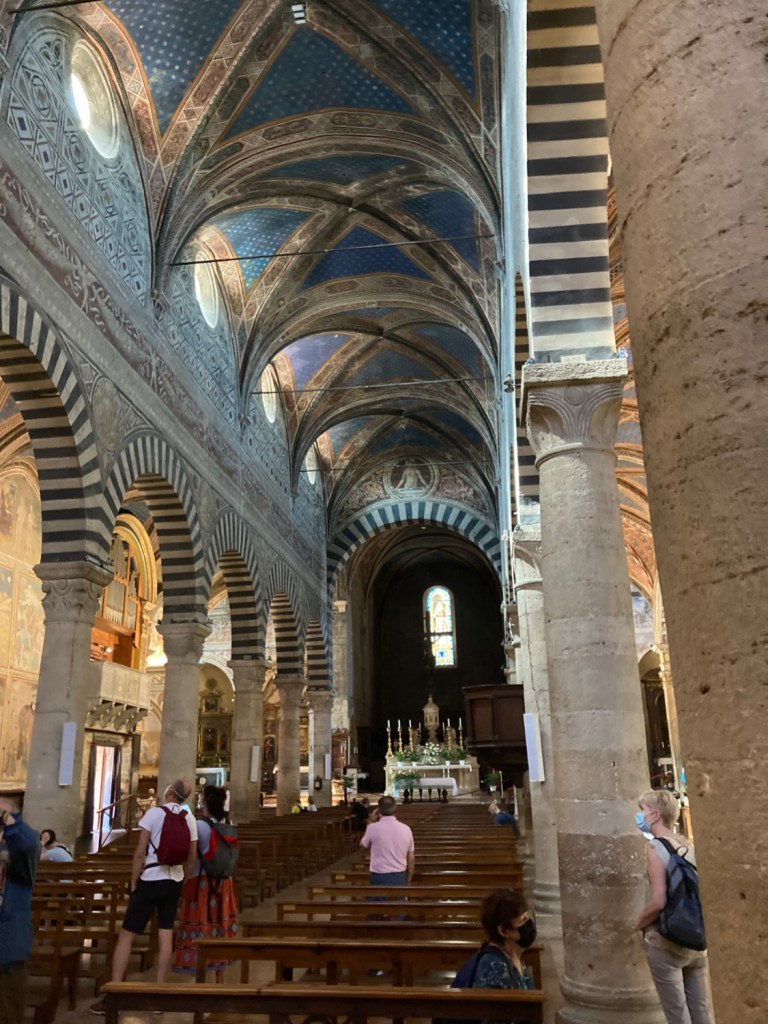
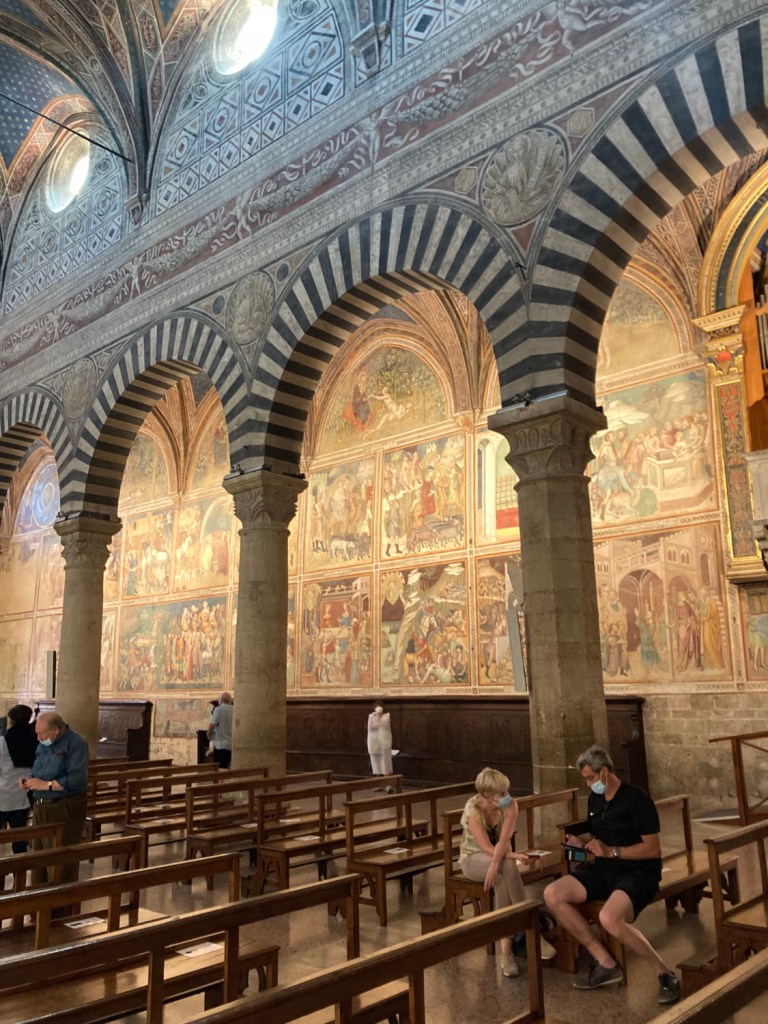
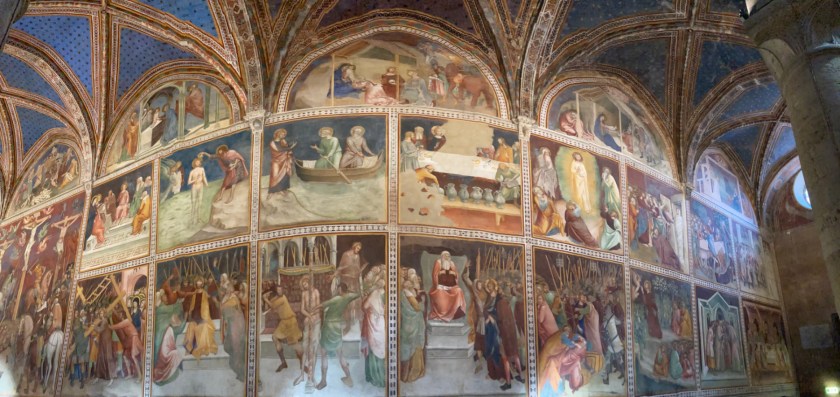
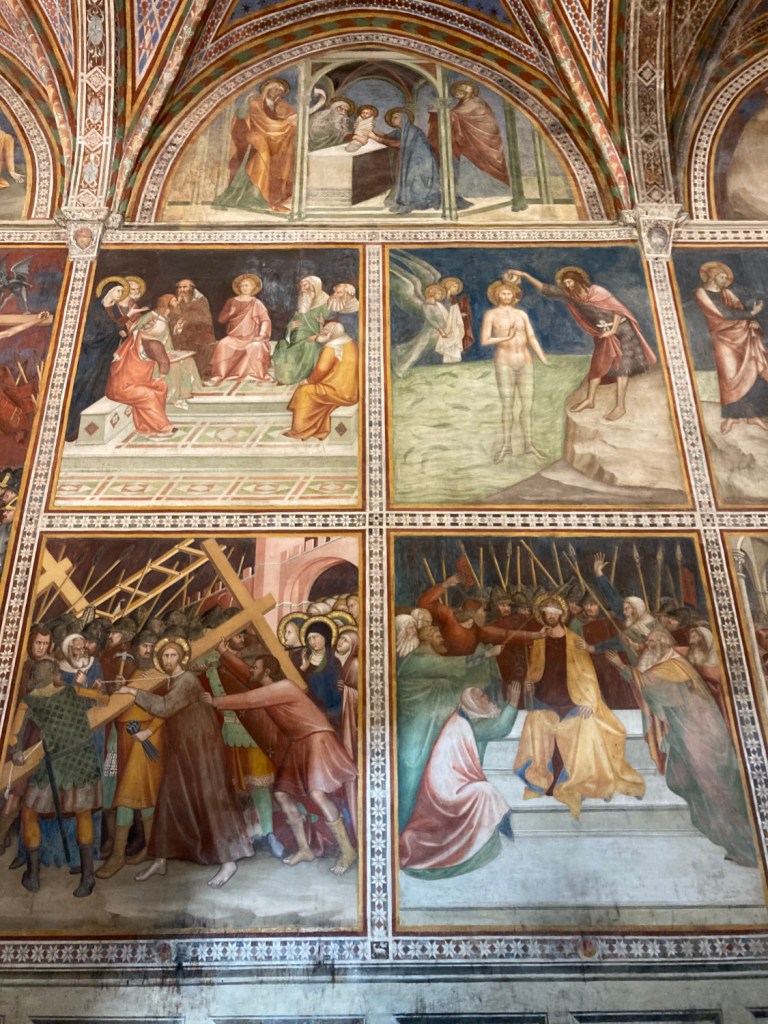
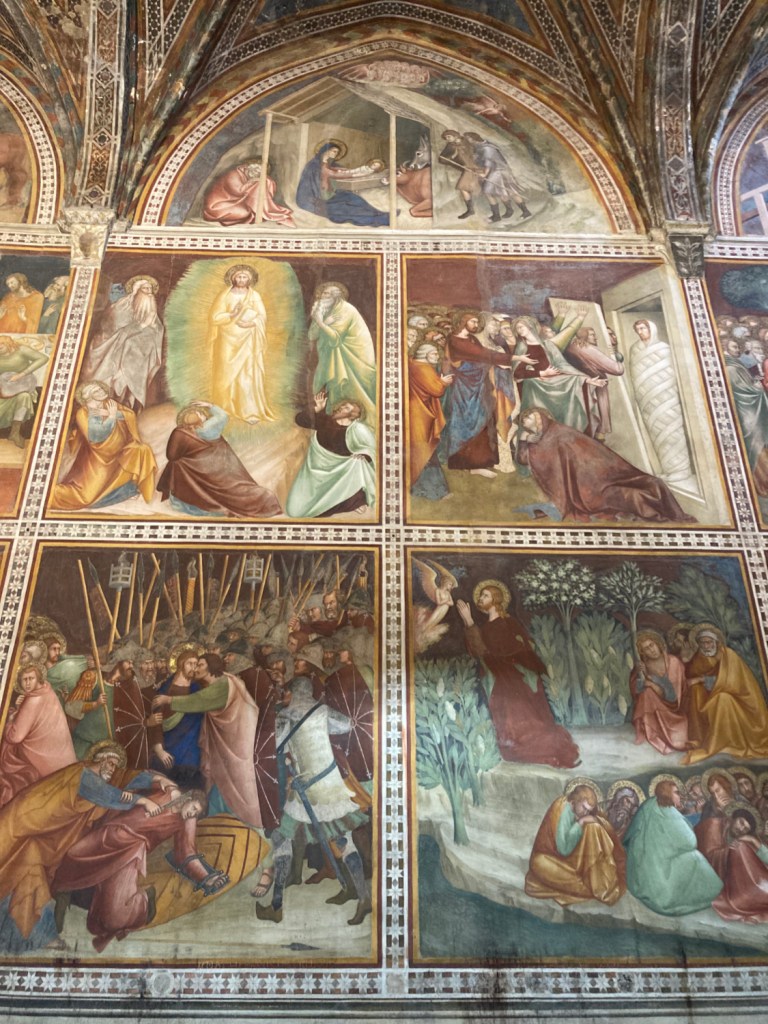
So far, this has been my favorite Catholic Church. I have developed a fascination with frescoes and this church is loaded. Frescoes are painted on damp plaster; after the plaster dries, they’re part of the building. As roofs tend to leak after a couple of hundred years and brick walls with plaster are notoriously difficult to move, the years usually take more of a toll on frescoes than paintings on canvas or sheets of wood. Fortunately, the roof of this church seems to have withstood the elements better than most and the frescoes, from entrance to altar, are in pretty good condition. There are four notable groups of frescoes. Scenes from the Old Testament decorate the left wall (when facing the altar). Scenes from the life of Christ are on the right. There is an incredible chapel dedicated to a local girl who became a saint (St. Fina or Serafina). Frescoes of St. Sebastian as well as Paradise and Hell are at the back of the church.
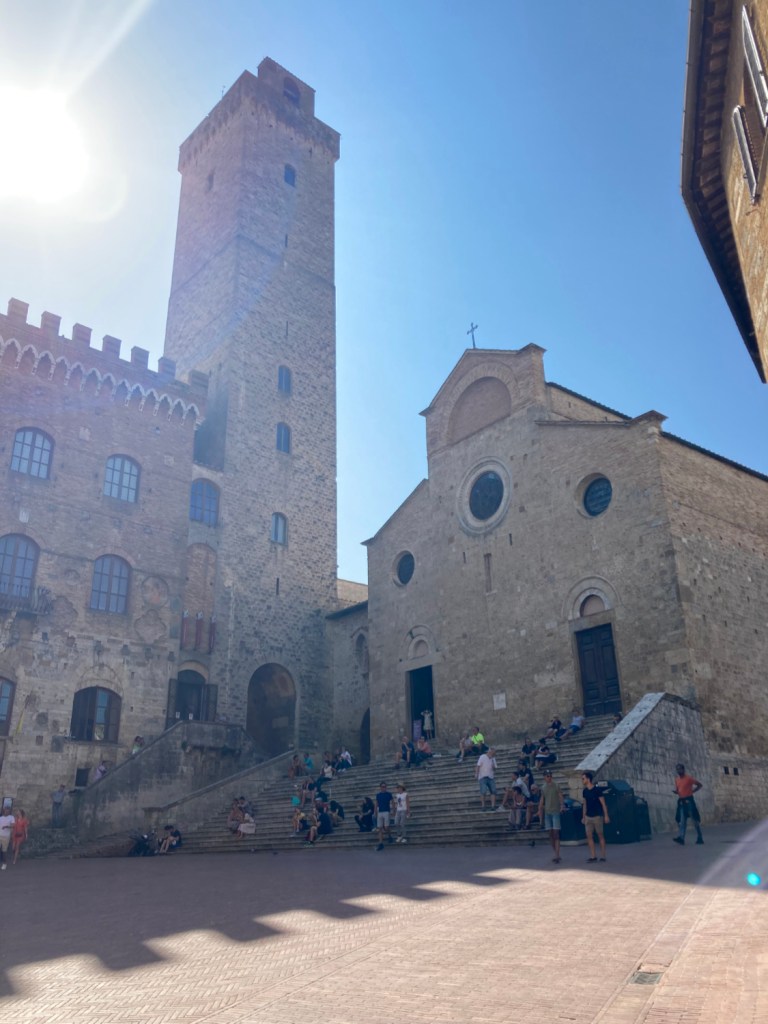
The Collegiate Church of the Assumption of Mary. Don’t judge this church by it’s plain facade.
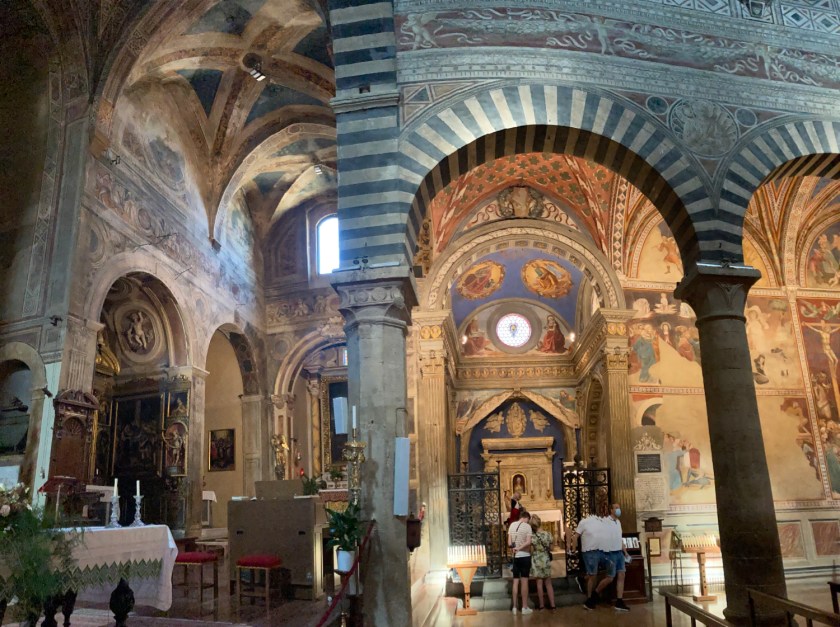
Looking towards the altar. Old Testament scenes on left and New Testament scenes on right.
Frescoed from front to back and floor to ceiling.
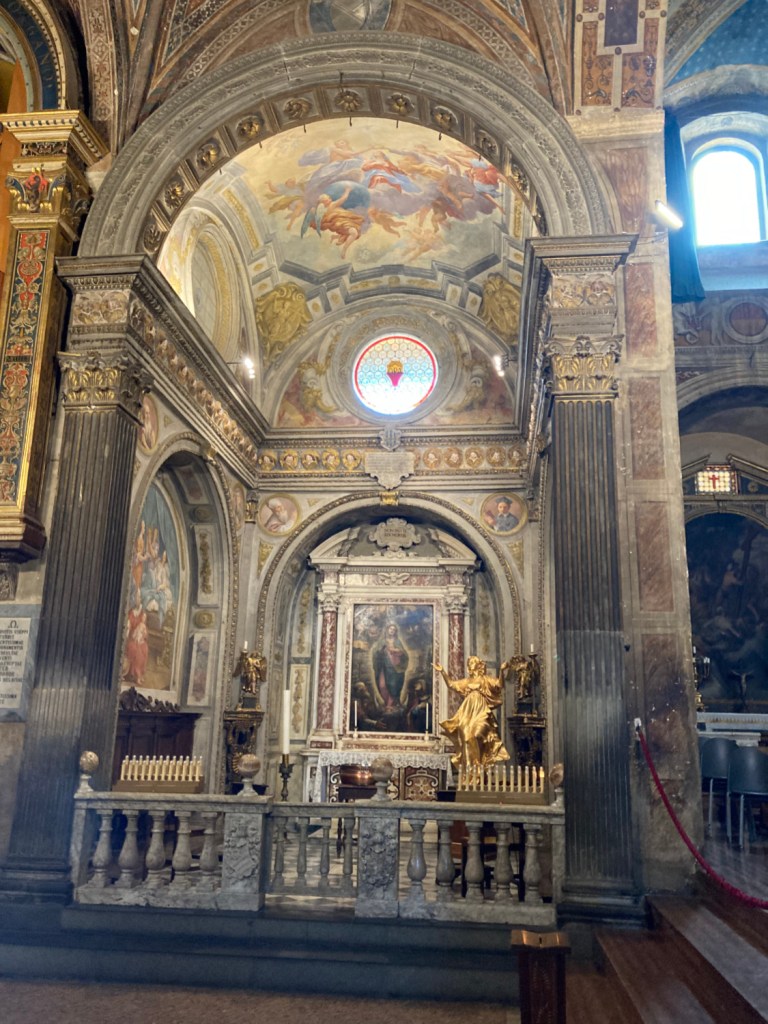
Chapel of St. Fina by Dominico Ghirlandaio
.Chapel of St. Fina (beyond the middle arch). St. Fina (1238-1253 CE) fell ill and became paralyzed at age 10. She bore her suffering and pain with grace and patience.
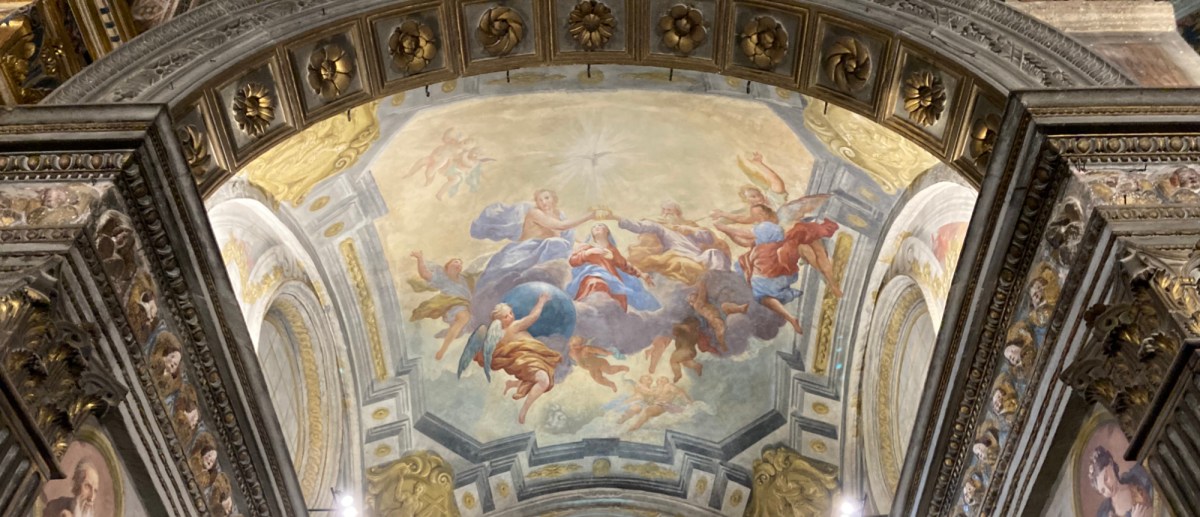
Ceiling of St. Fina’s chapel decorated with frescoes of Matthew, Mark, Luke, and John. The frescoes in this chapel are by Dominico Ghirlandaio and are his first major works. Ghirlandaio is also remembered for his school/workshop which is where Michelangelo received his first formal training.
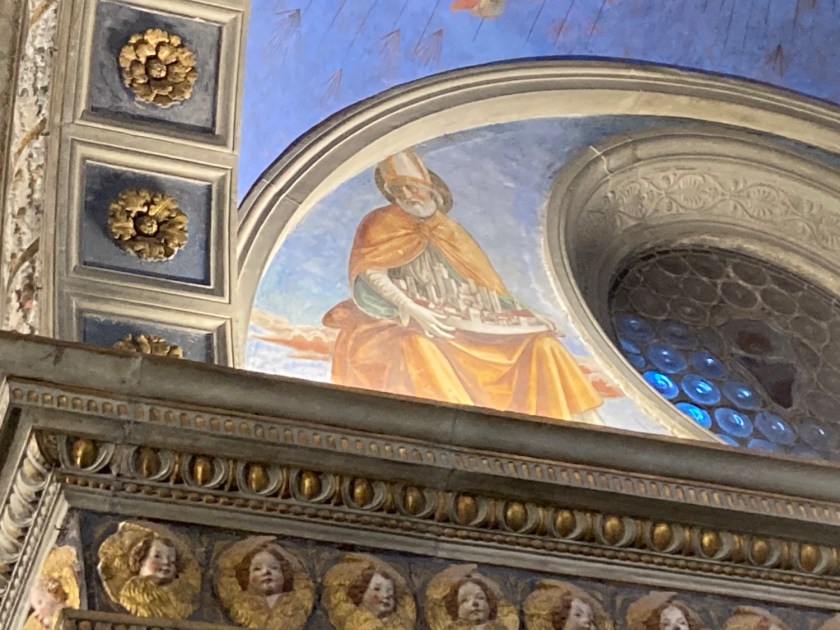
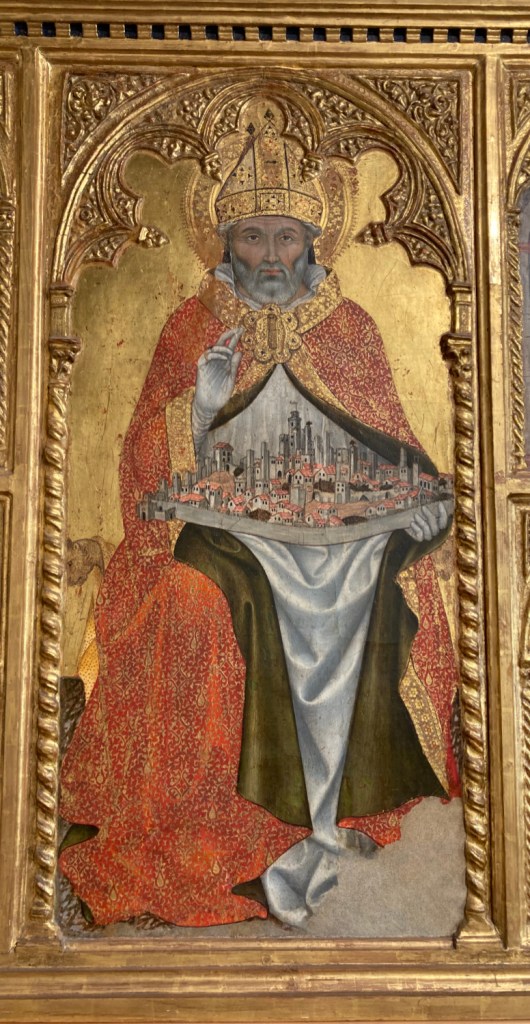
Another portrait of Sanctus Geminianus holding and protecting the town of San Gimignano.
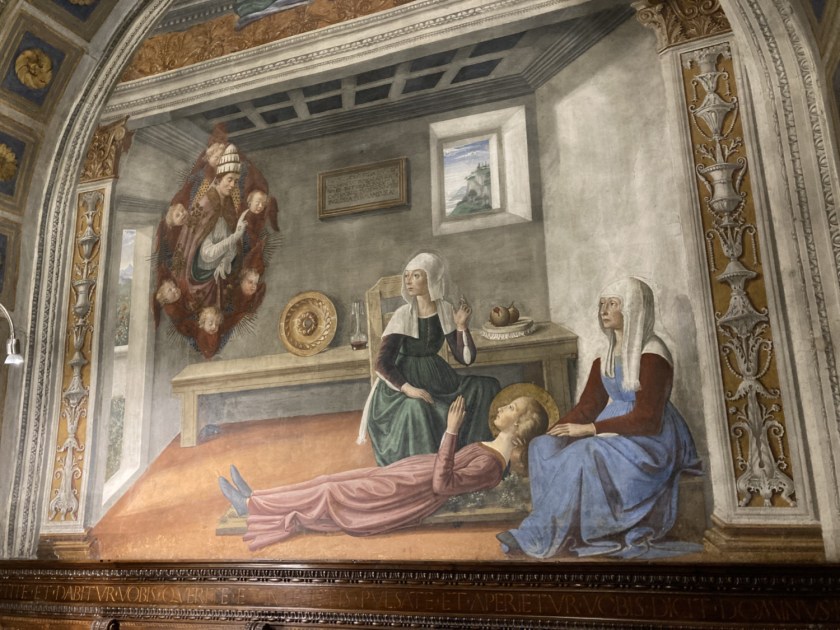
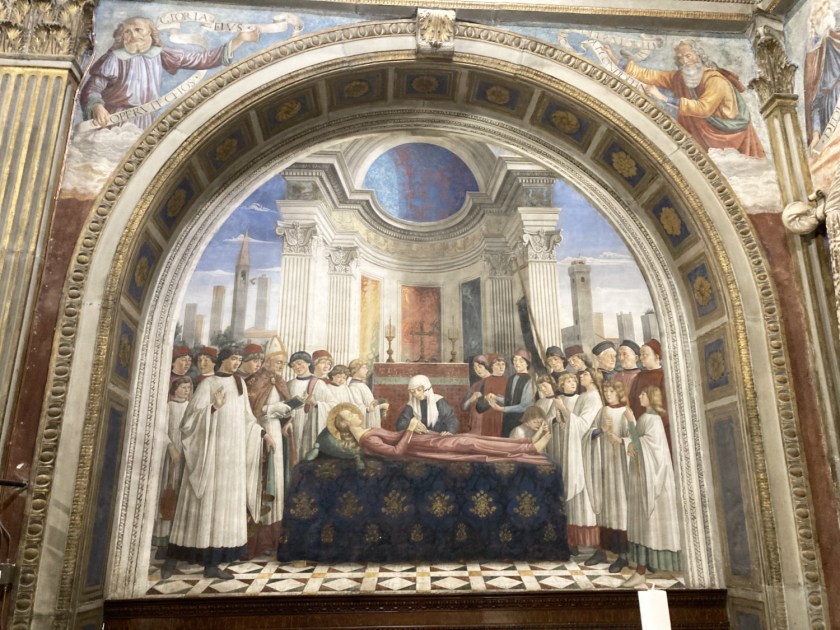
St. Pope Gregory the Great (assisted by disembodied cherub heads) telling Serafina that she was being called to heaven. Note the attendant in red on the right supporting Fina’s head.
Fina became a saint because of her posthumous miracles. Two are shown here. First, the attendant noted above (here in the middle holding St. Fina’s hand) supported Fina’s head for so long that her hand became paralyzed. While sitting with the Fina’s body, the paralysis was cured. At St. Fina’s feet, a blind boy touches his eyes to her feet which restored his vision.
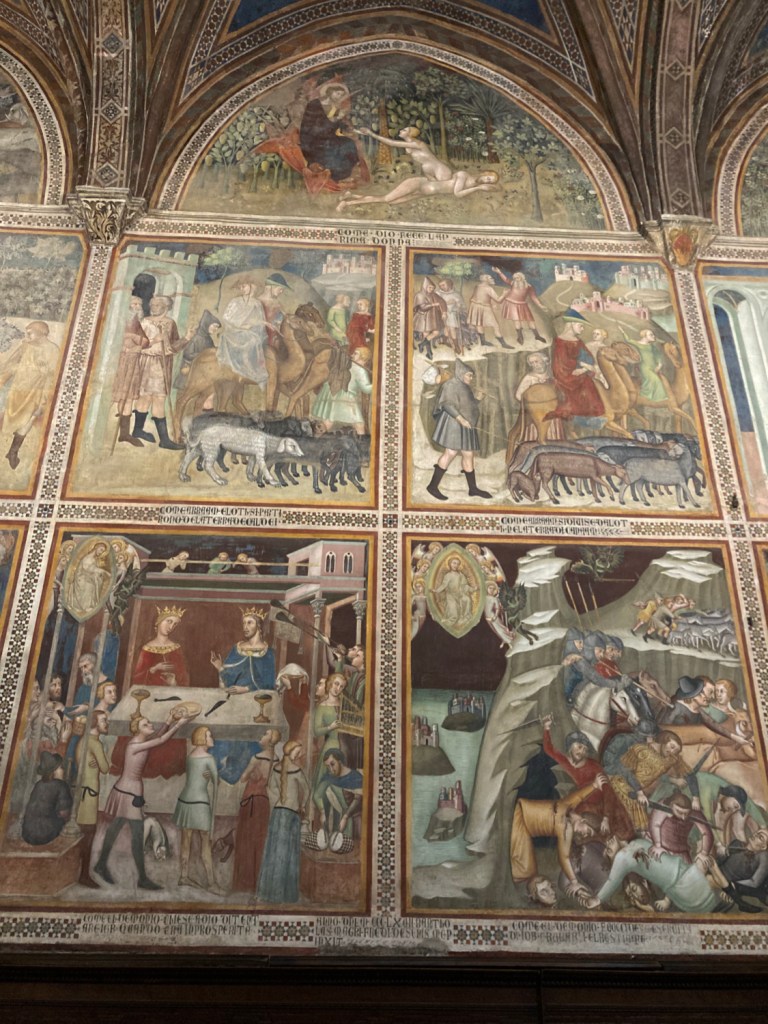
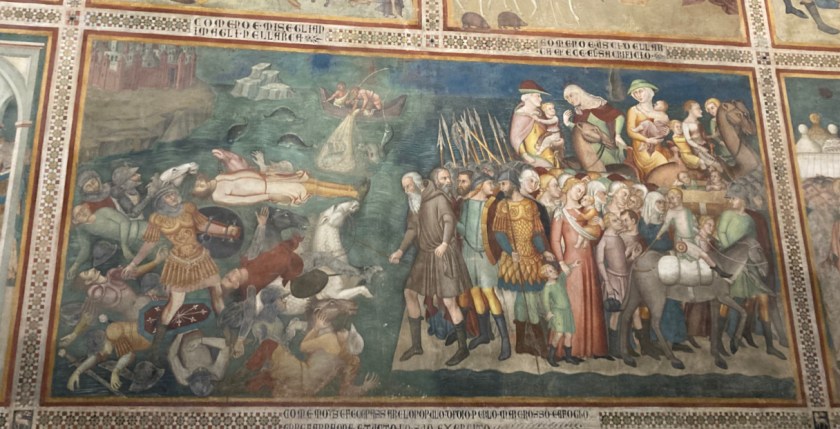
Old Testament Cycle (left aisle) by Bartolo di Fredi
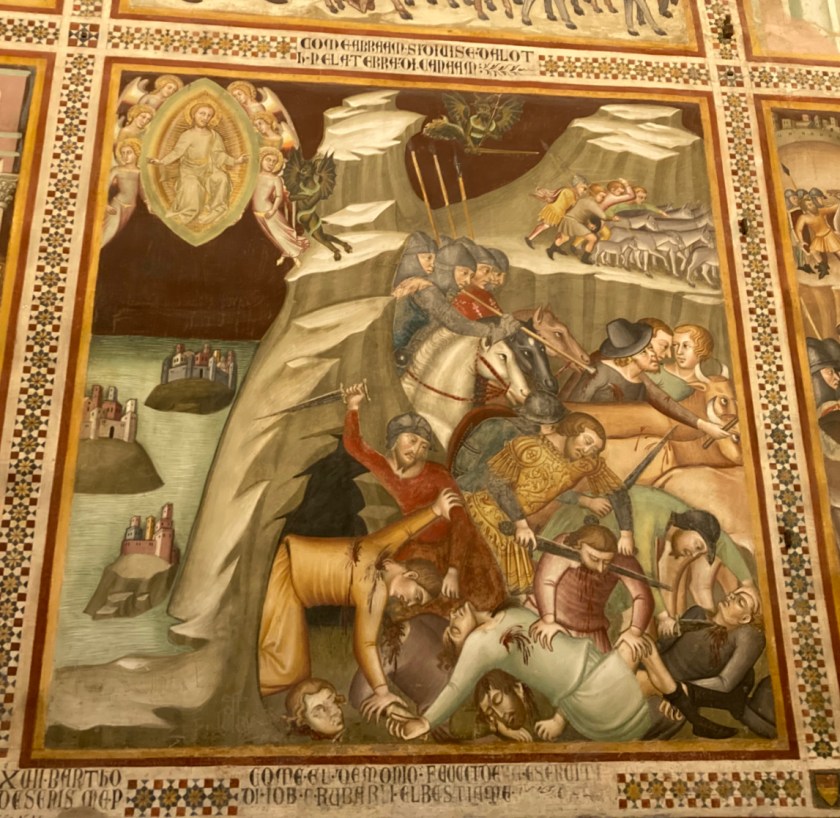
Killing of Job’s servants and animals. I don’t really remember any minister or Sunday school teacher making a big deal out of this. I wouldn’t have predicted this to be a featured story from the Old Testament.
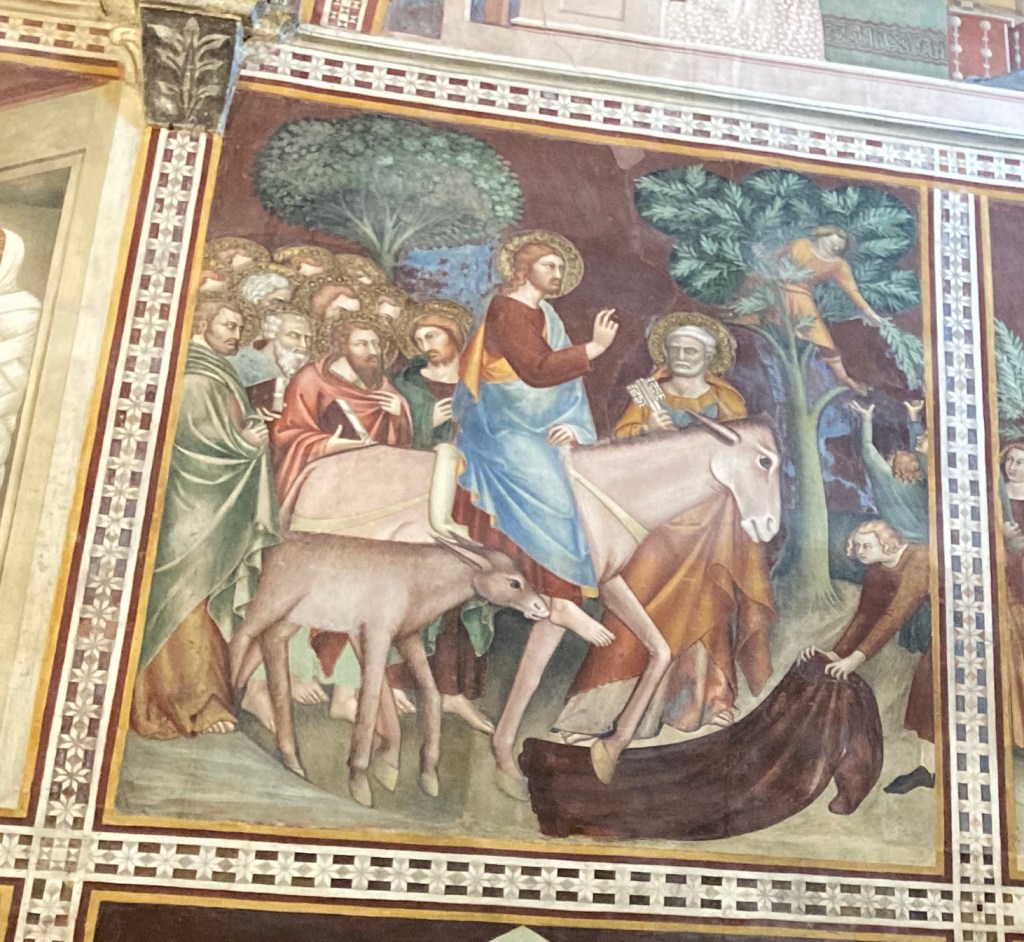
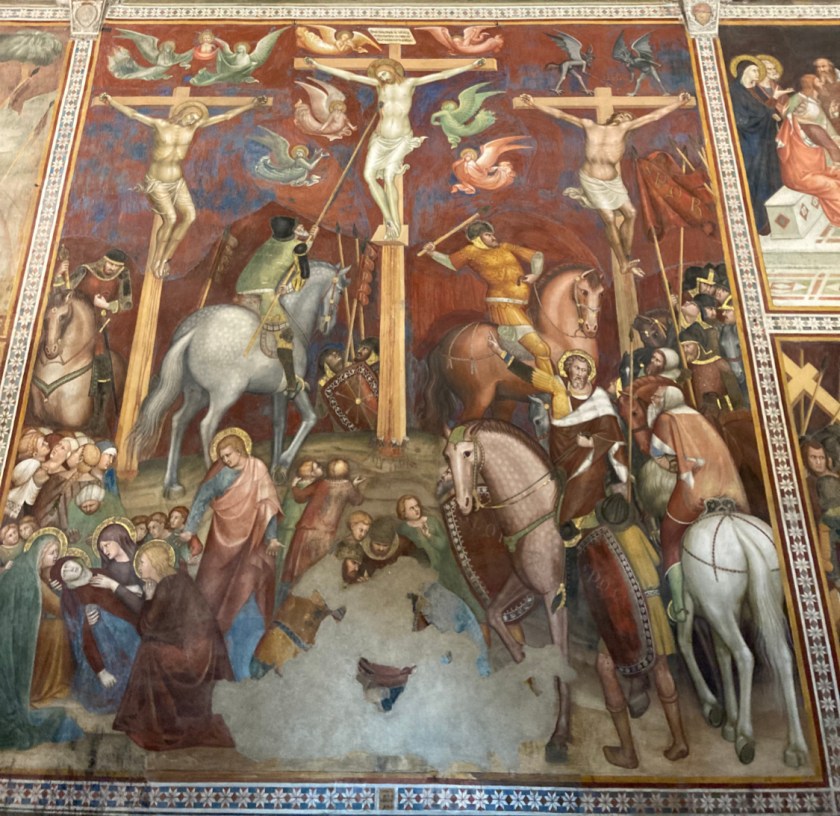
Life of Christ (right aisle) by Lippo Memmi…probably
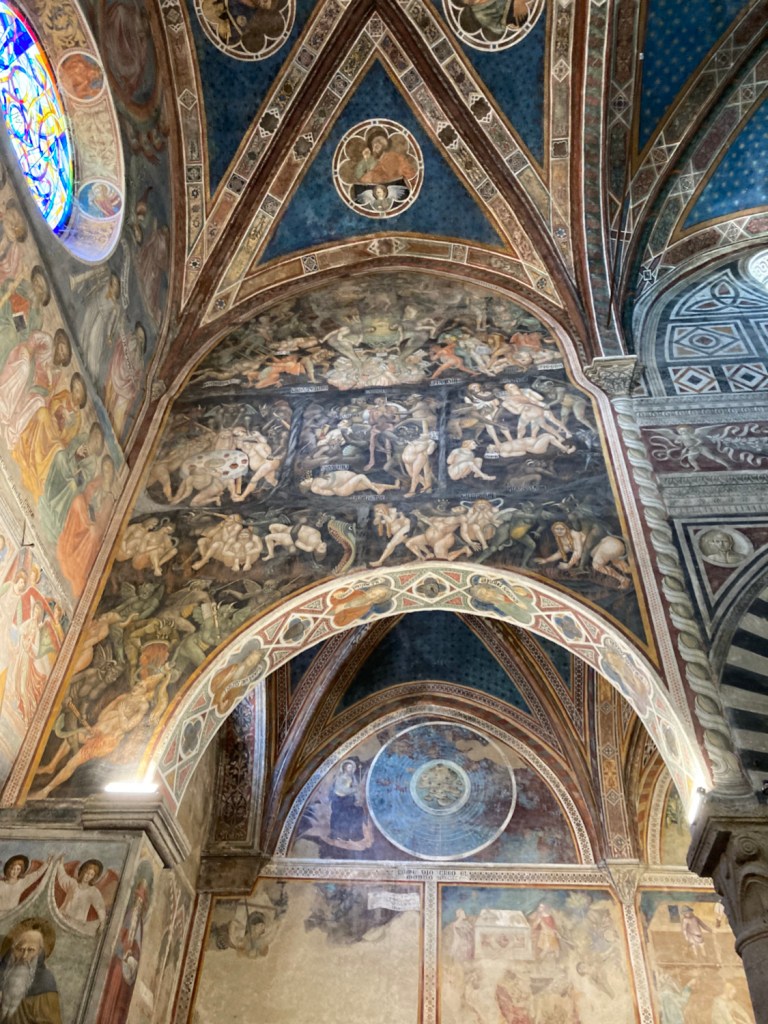
Tortures of Hell by Taddeo di Bartolo
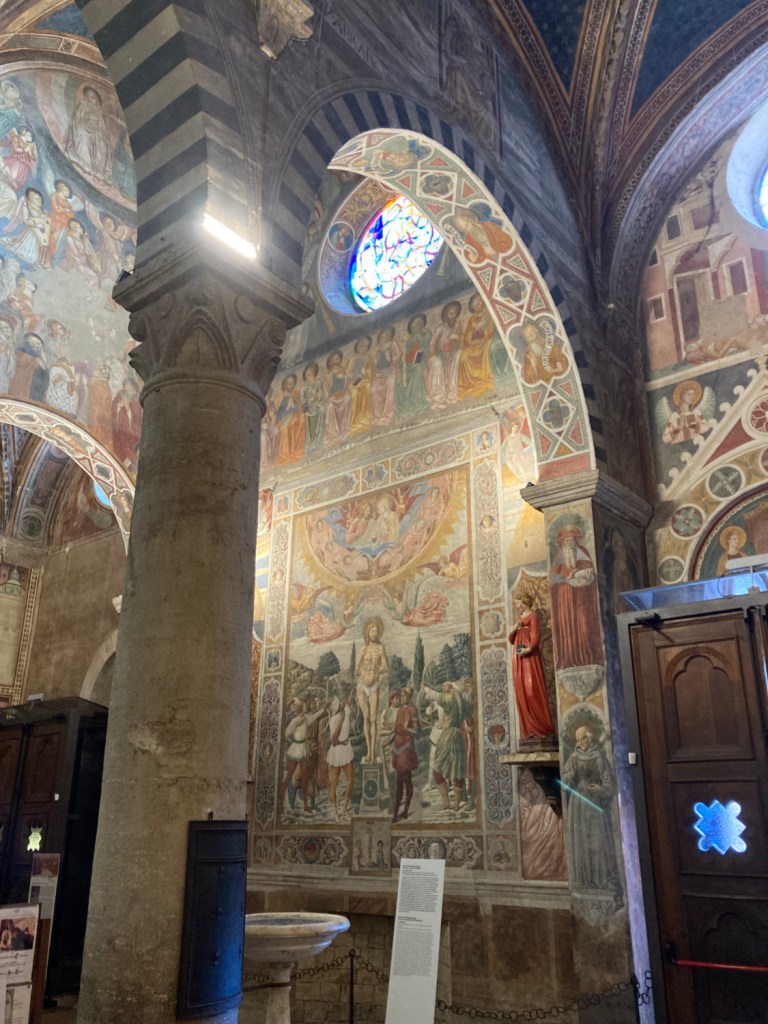
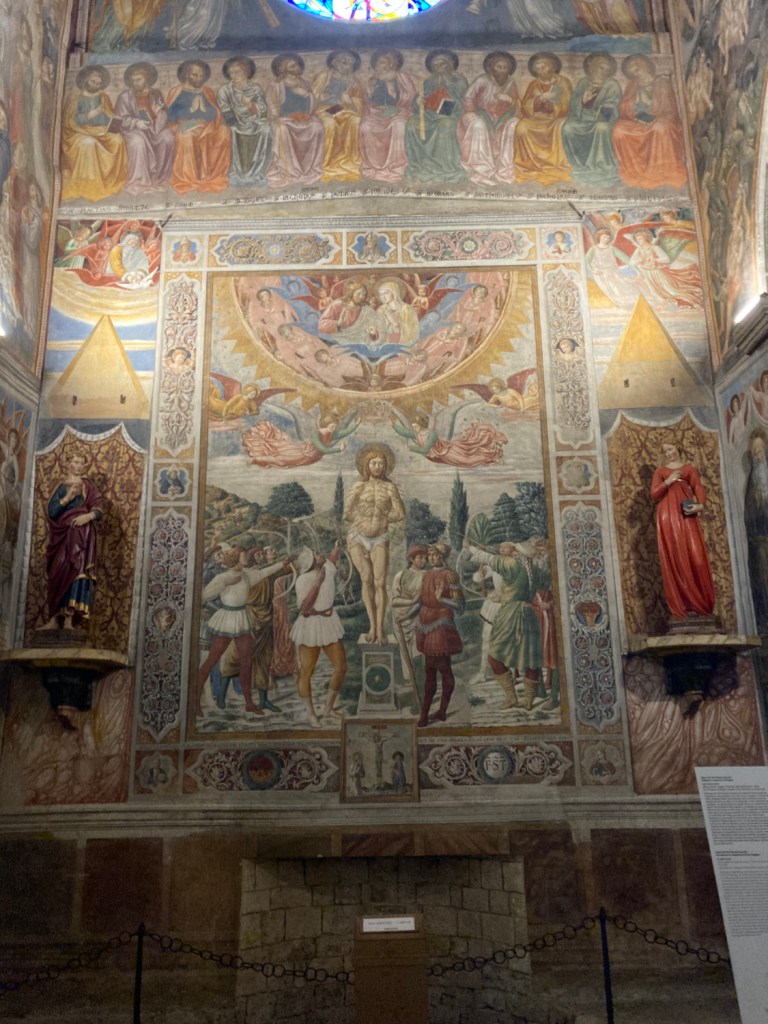
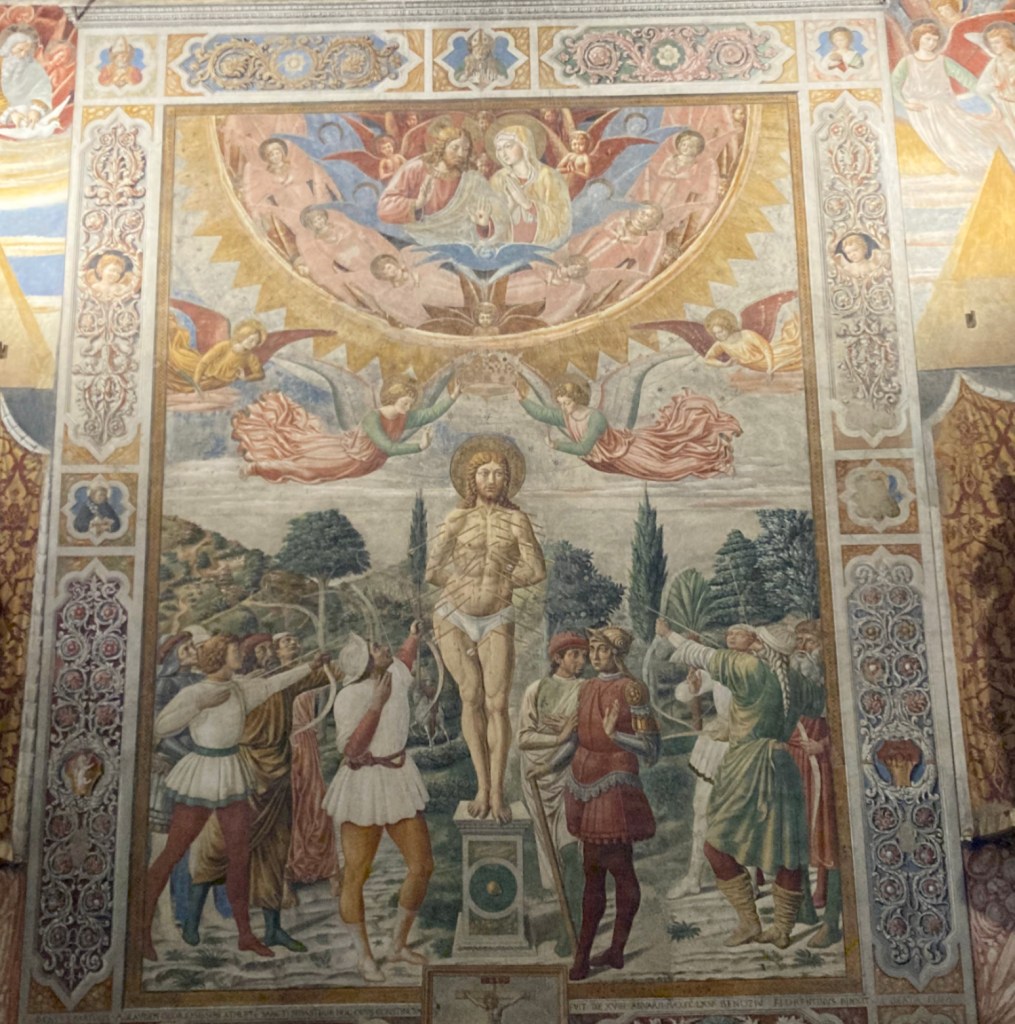
The Martyrdom of San Sebastian by Benozzo Gozzoli
I hate to be a stickler, but my reading of the World Wide Web is that Sebastian actually survived the arrows. Having recovered, he went to a parade where he heckled Roman Emperor Diocletian who had Sebastian arrested and beaten to death. So, this attempted execution by a crack team of archers is, at best, just the beginning of his journey to martyrdom.
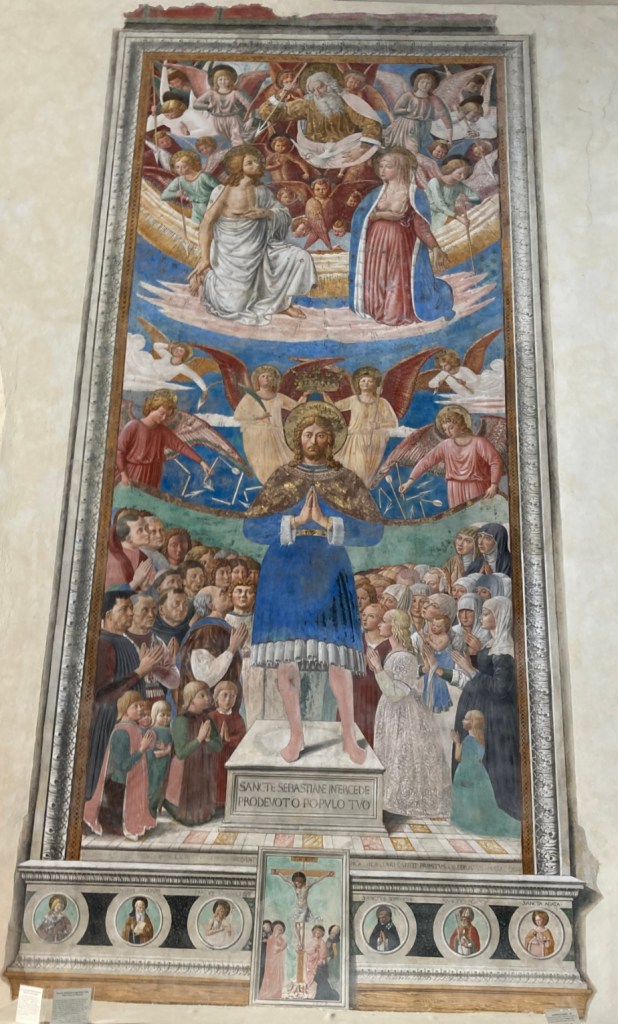
This fresco by Gozzoli in the Chiesa Sant’Agostino (also in San Gimignano) illustrates San Sebastian’s Medieval association with protection from the plague. Angels spread his blue cape over the people of San Gimignano protecting them from the “Black Death,” represented by the arrows breaking on the outspread cape.
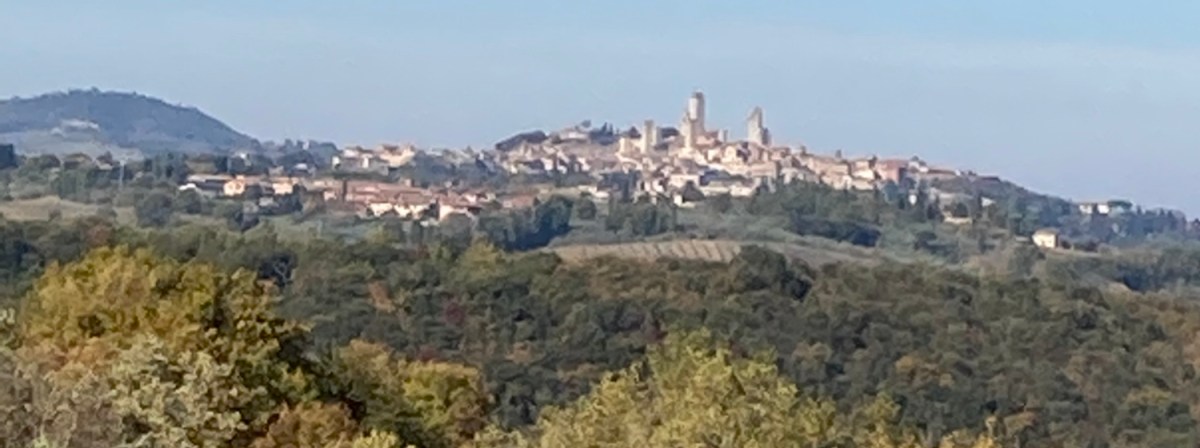
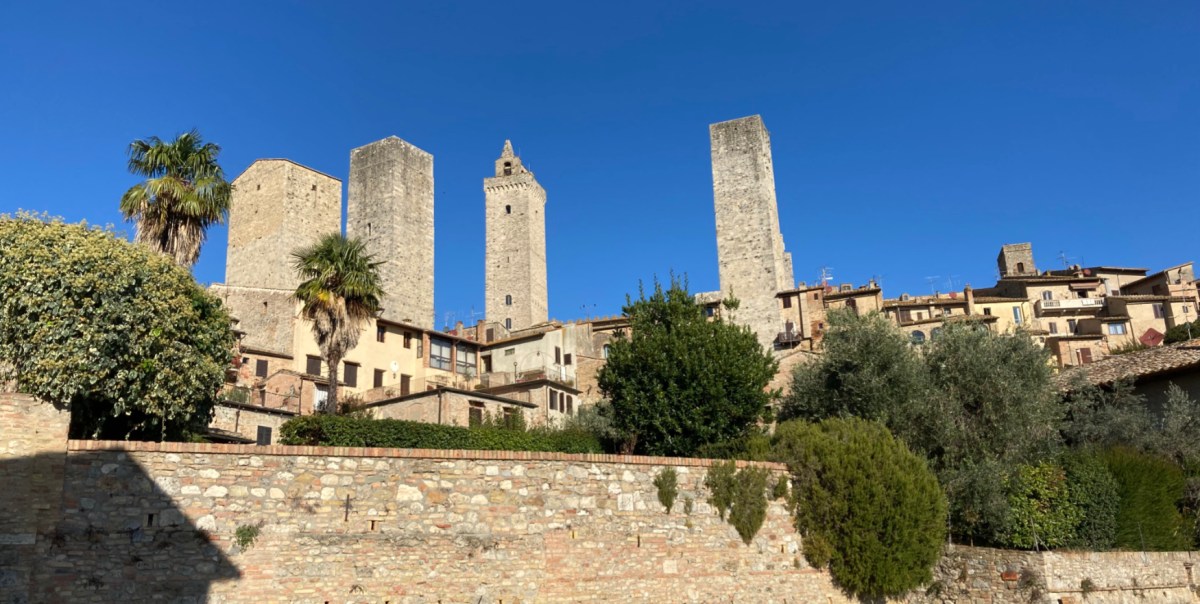
San Gimignano (san jim-in-yawn-o) began as an Etruscan town in the 3rd century BCE. In the 1st century BCE, it was know to the Romans as Silvia and became San Gimignano in 450 CE when Saint Geminianus posthumously intervened to protect it from Attila the Hun. Today, San Gimignano is famous for the number of surviving medieval towers that give it the skyline of a 20th century city. The web reports two explanations for the construction of these towers by medieval patrician families. First, the towers show wealth and power (‘my tower is taller than your tower’). Second, competition between these patrician families could be intense and the towers were potential refuges when a rivalry escalated to violence. Most Medieval towns had these dramatic skylines. For several reasons, San Gimignano has retained the most towers (14 out of the original 72). It is a spectacular Tuscan hill town.
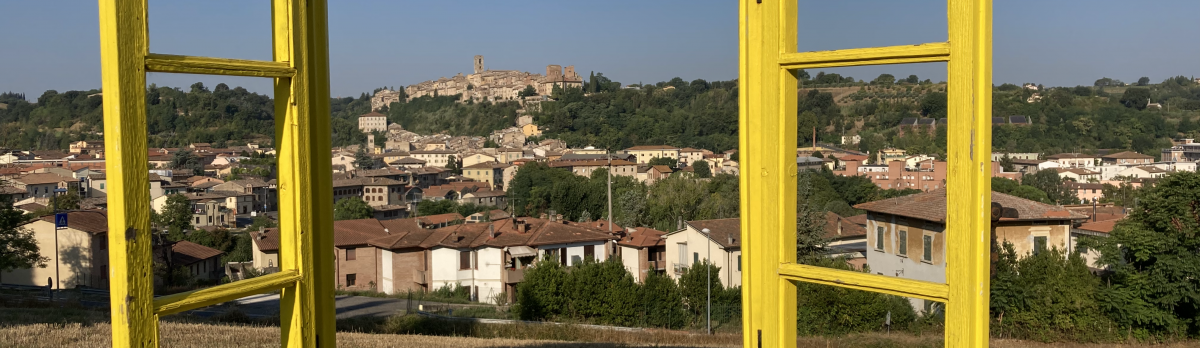
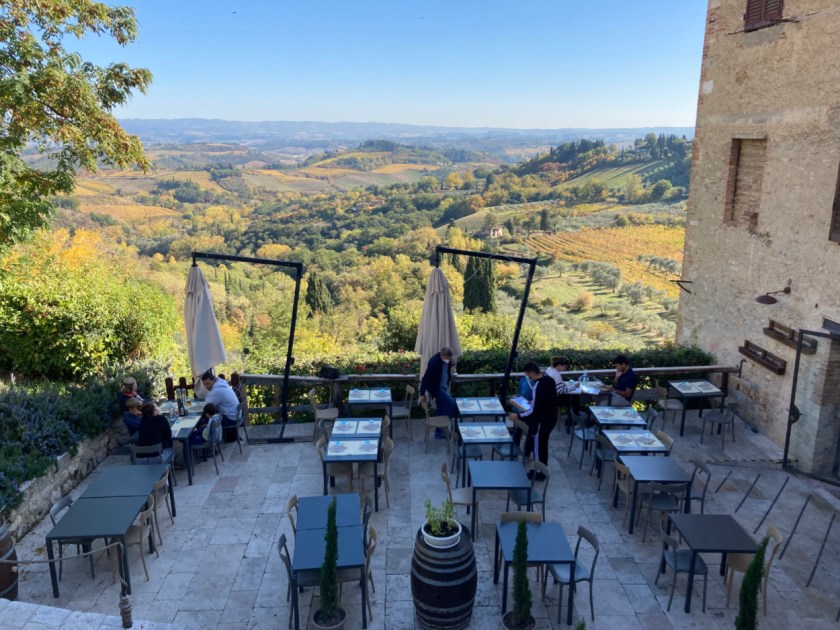
Sept. 28, 2021– Tuscan countryside just outside the main gate.
Oct. 28, 2021– the areas turning yellow are mostly vineyards.
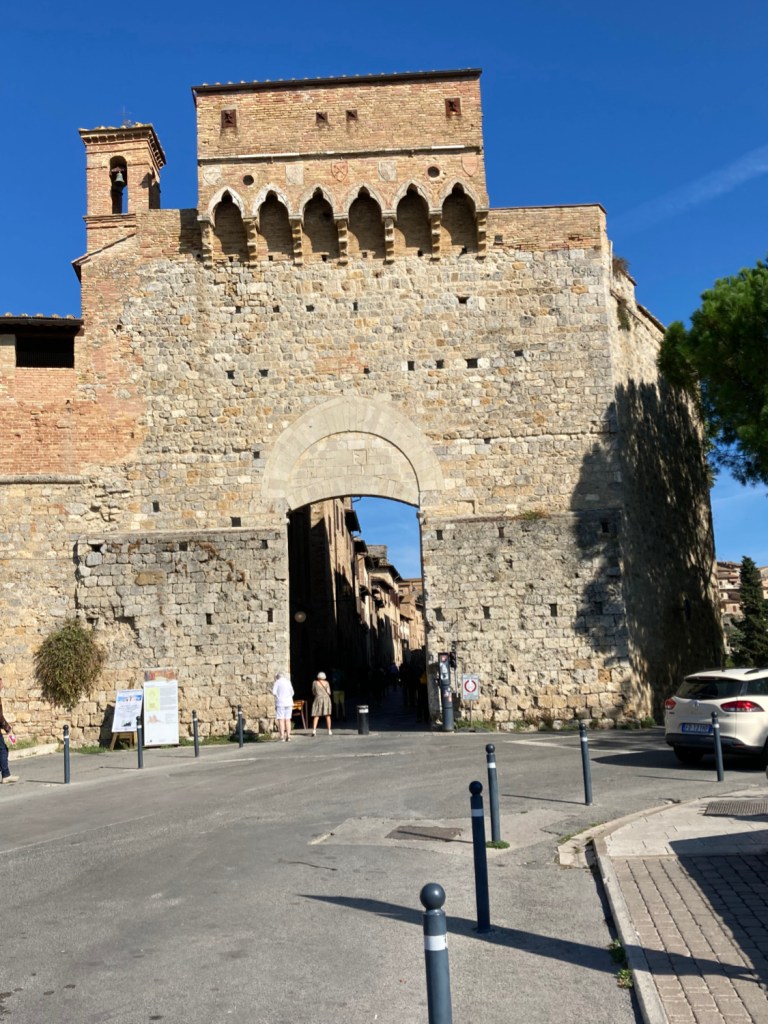
Porta San Giovanni
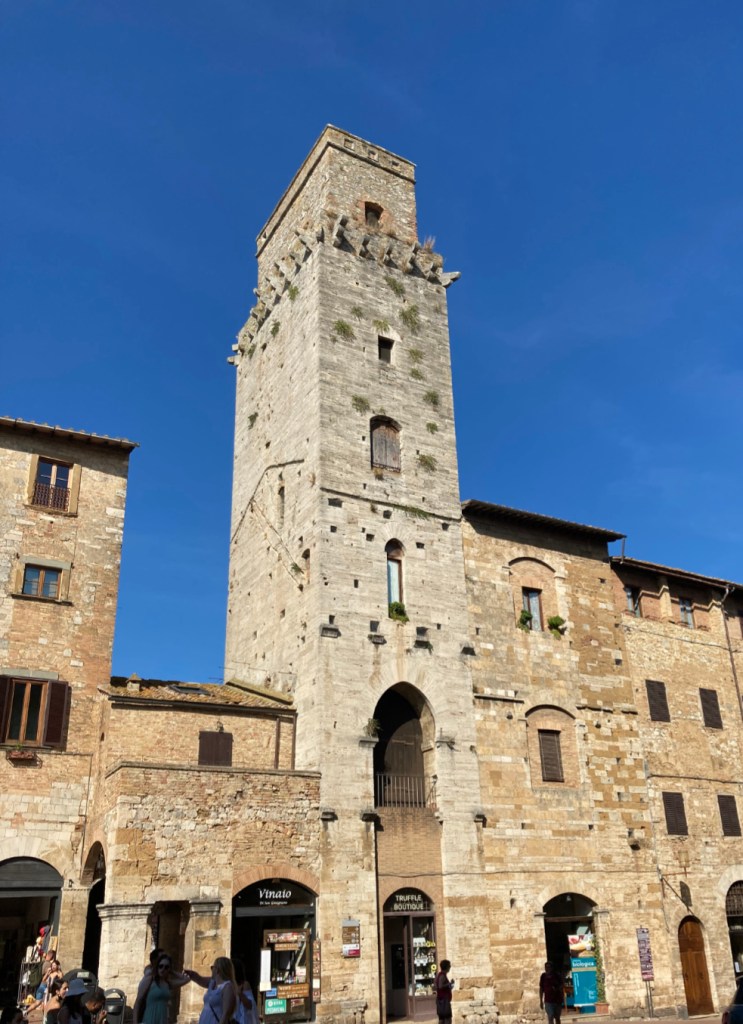
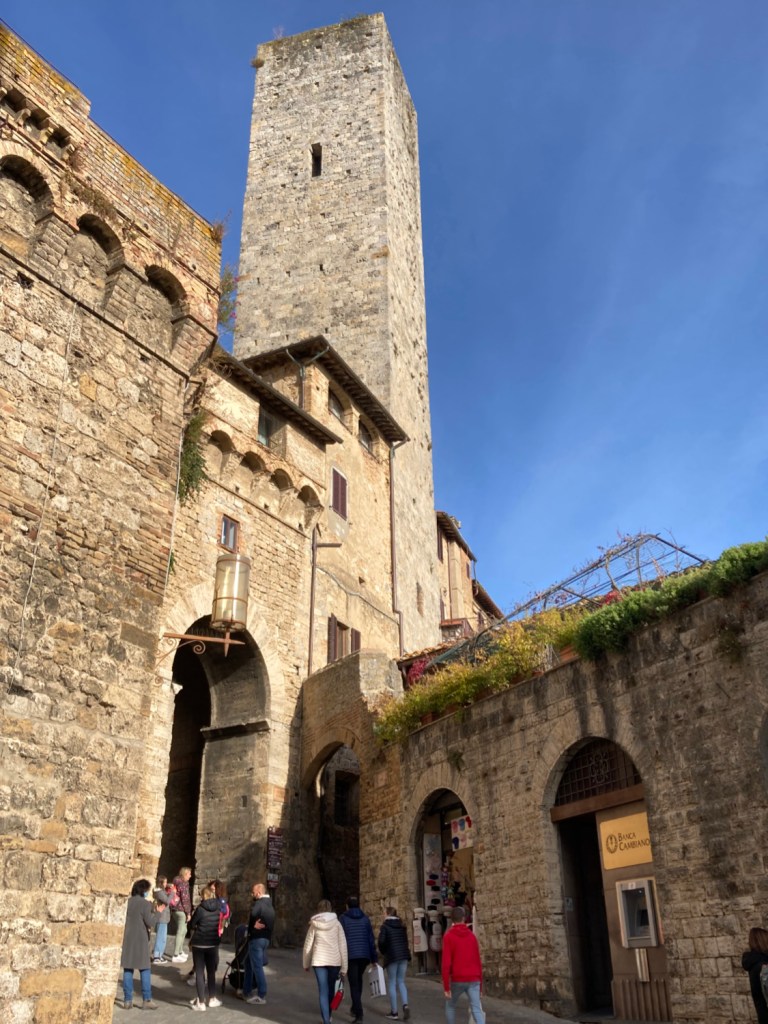
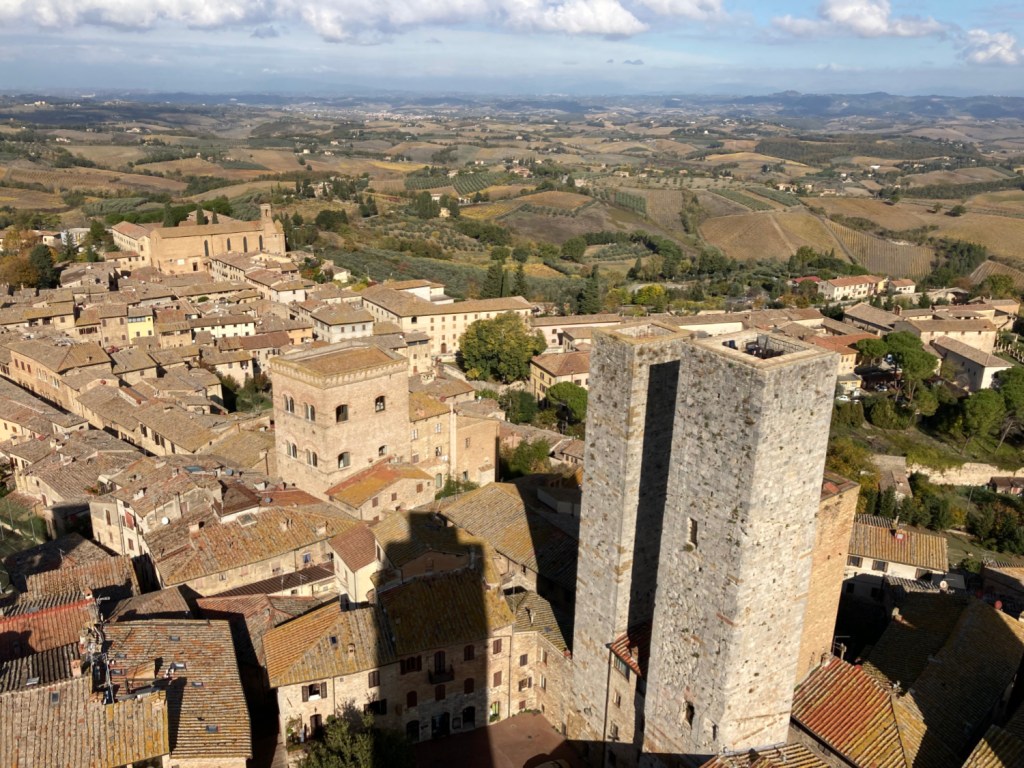
The towers are the stars of the show in San Gimignano.
Notice the dark holes and what appear to be doors leading to nowhere in the upper floors of this tower. In 1300 CE, timbers extending from the holes would have supported cantilevered balconies or even entire rooms off the side of the tower.
A defensive wall was built around San Gimignano in 1207. By 1251, San Gimignano had grown beyond the existing wall and a new wall was built that encompassed the expanding city (1251-1262 CE). In some places inside the city, you can see remnants of the original wall. This is a gate from the 1207 wall.
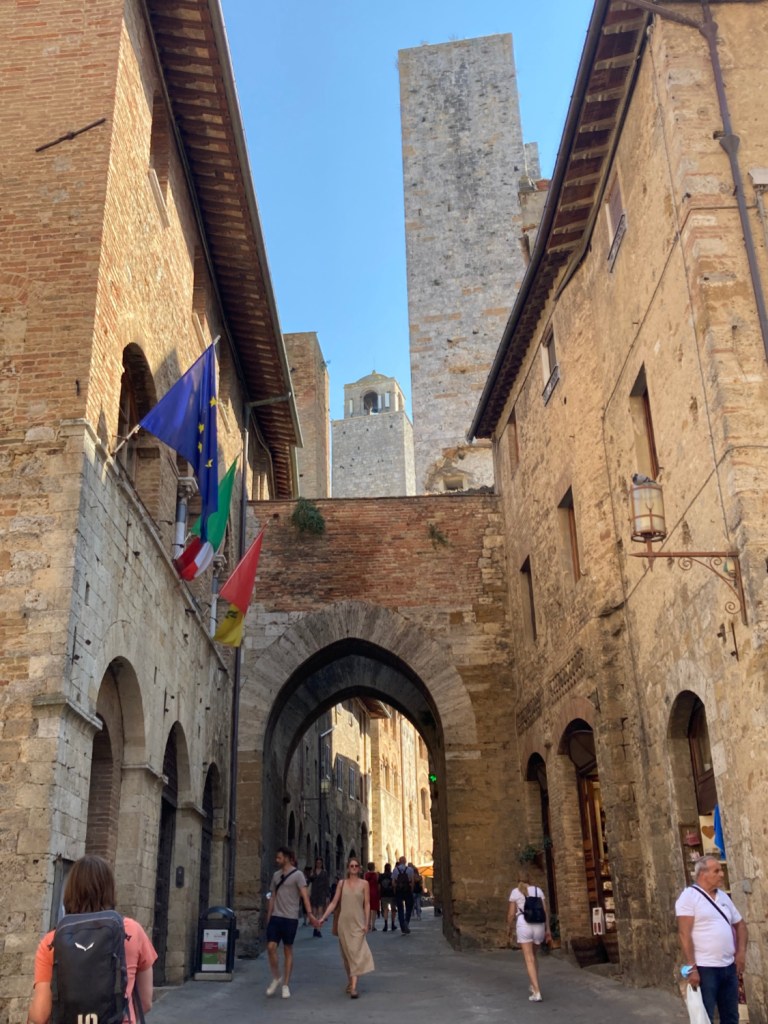
Another gate in the first city wall.
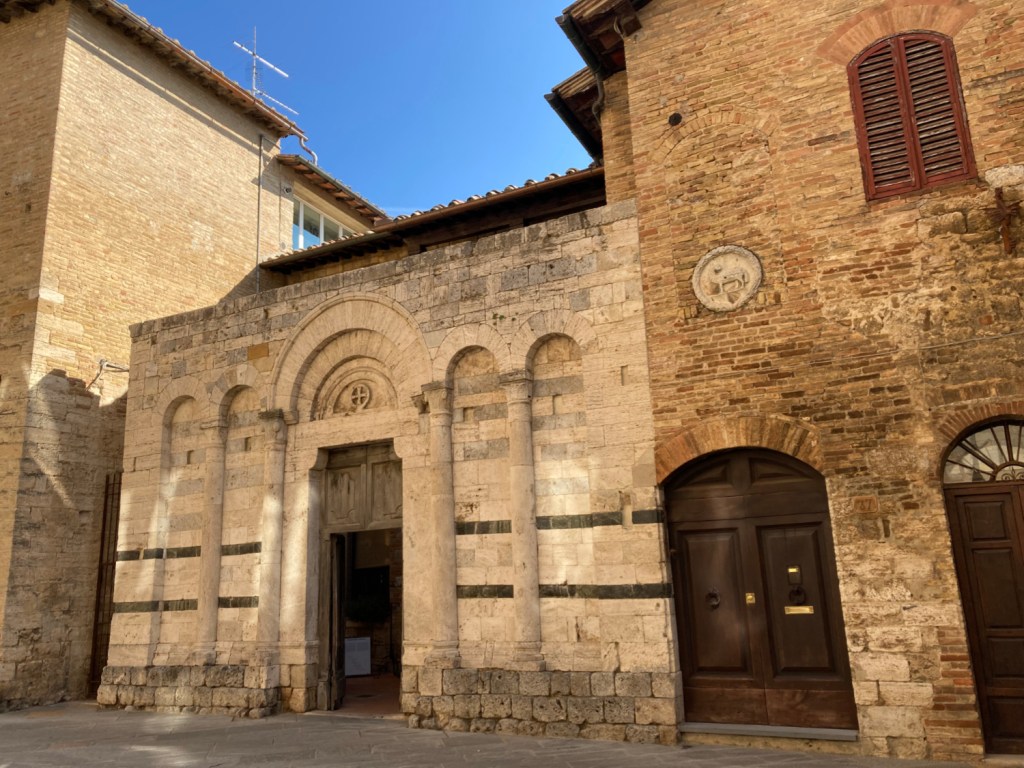
12th century CE pilgrim shelter run by the Knights of Malta. Only the facade remains.
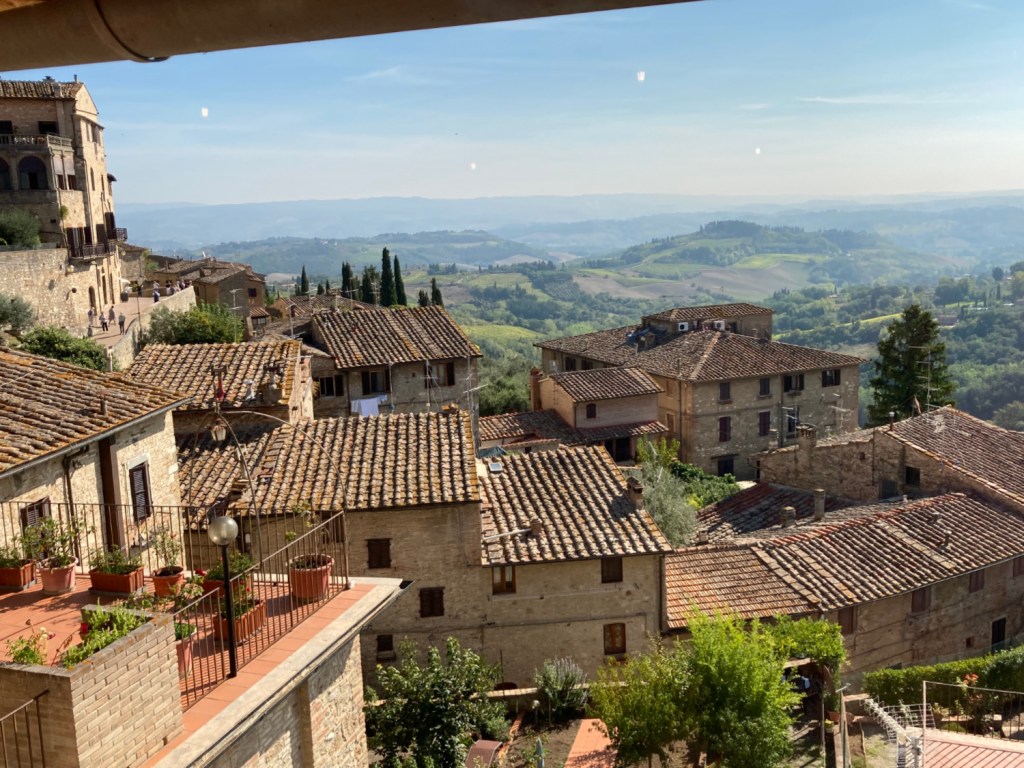
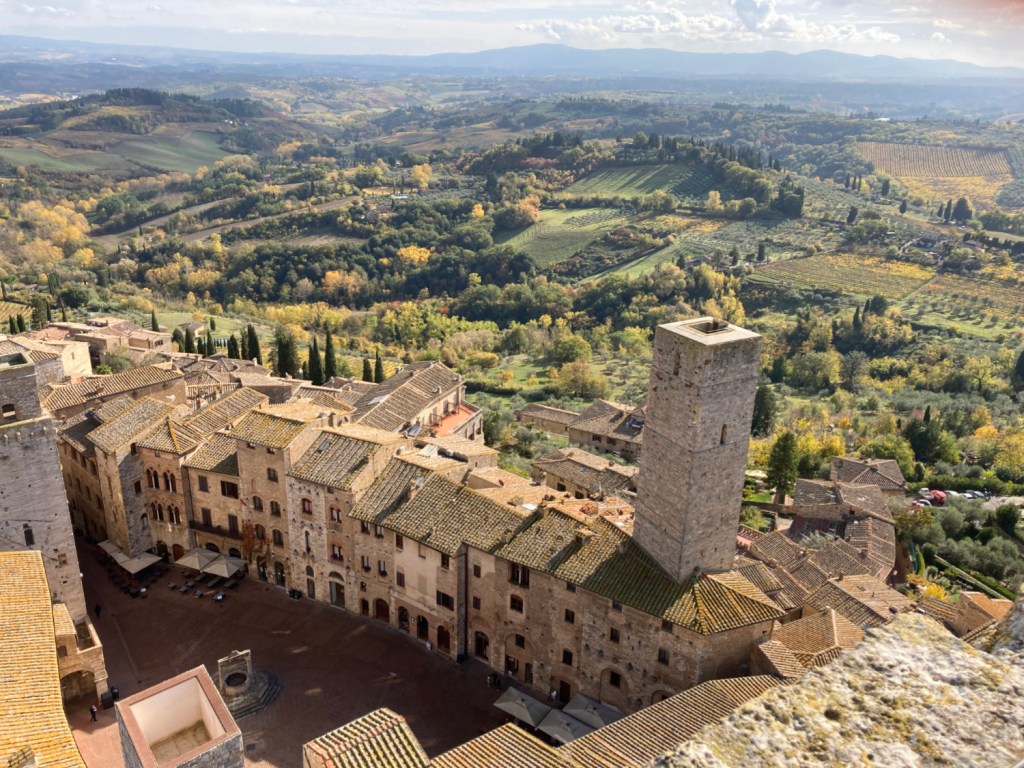
Panoramic viewpoint
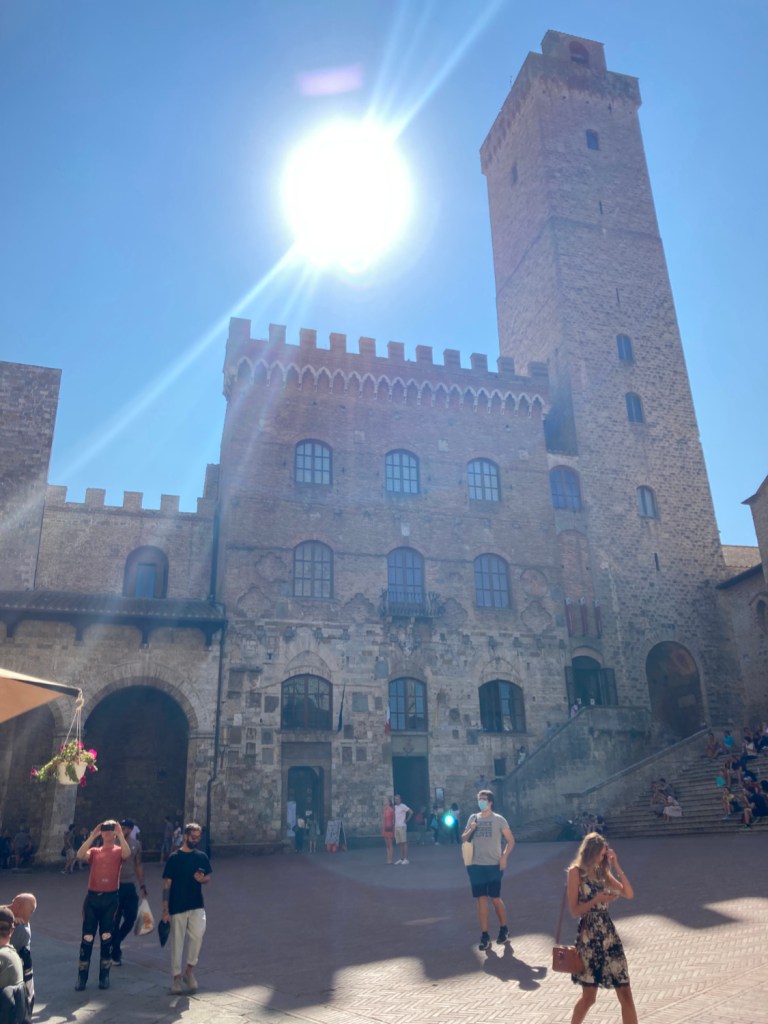
Palazzo Comunale. This was “city hall.” Today, it has the only tower you can climb and see…
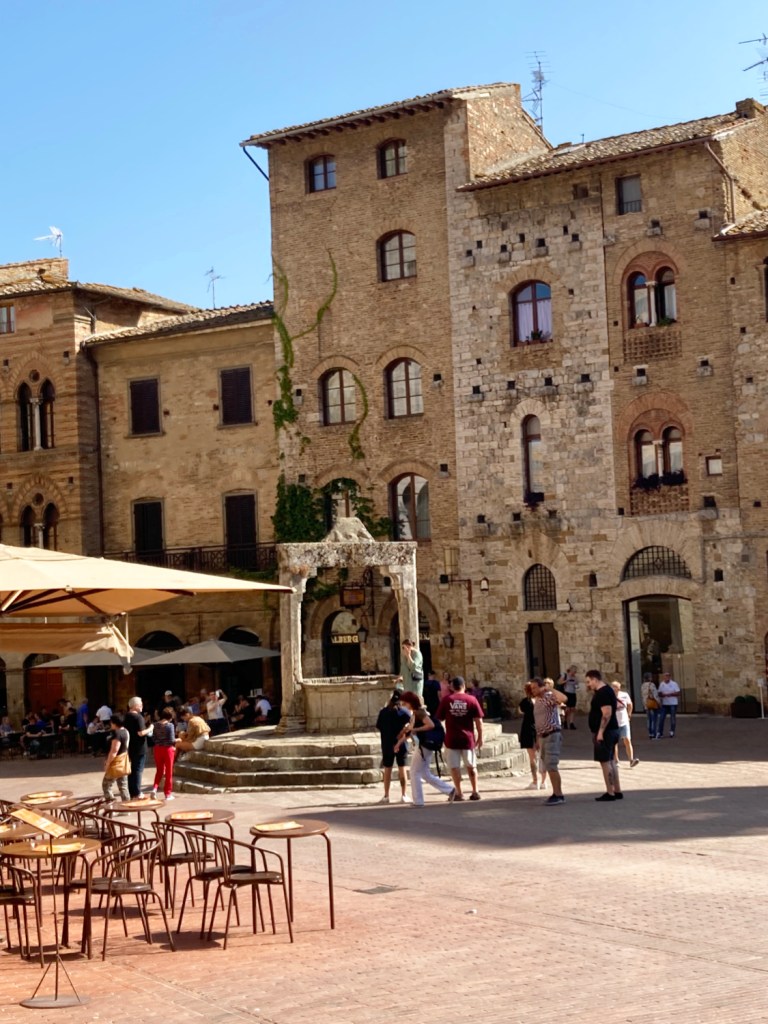
Piazza della Cisterna. A giant cistern is beneath the entire piazza. A system of pipes collects rainwater from nearby rooftops and deposits it in the cistern. The sides of the well are lined with grooves on the top, presumably from a few hundred hears of hauling up buckets filled with water.
Sanctus Geminianus holding and protecting the city of San Gimignano in his lap. This from an altarpiece done around 1391 by Taddio Barolo.
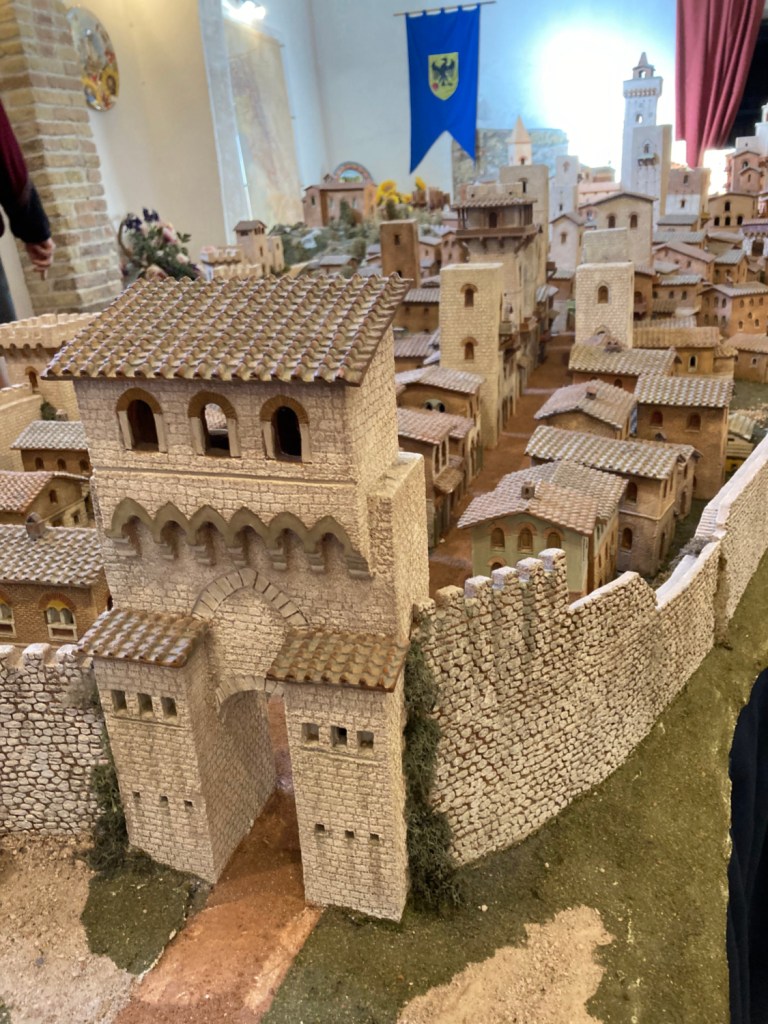
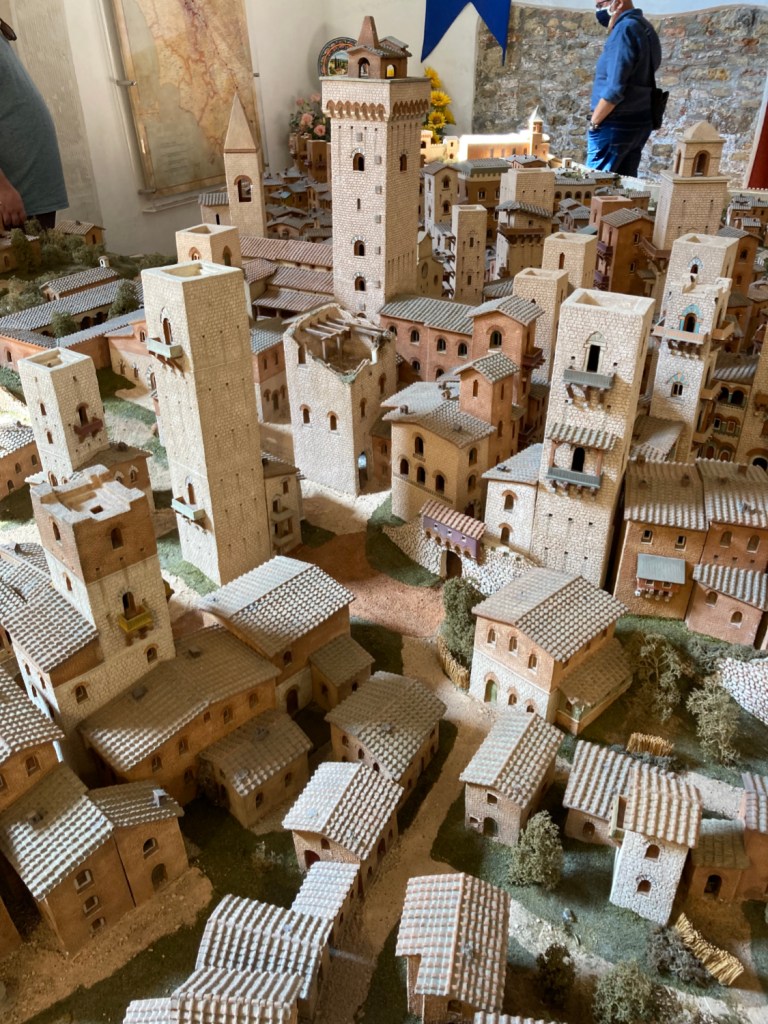
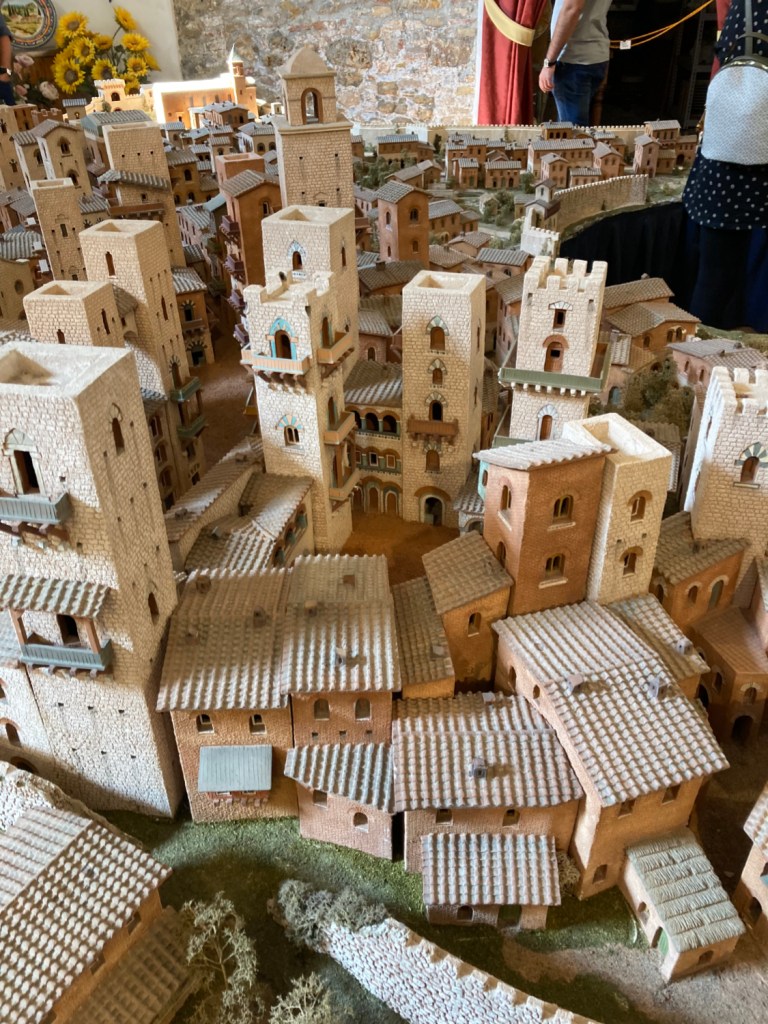
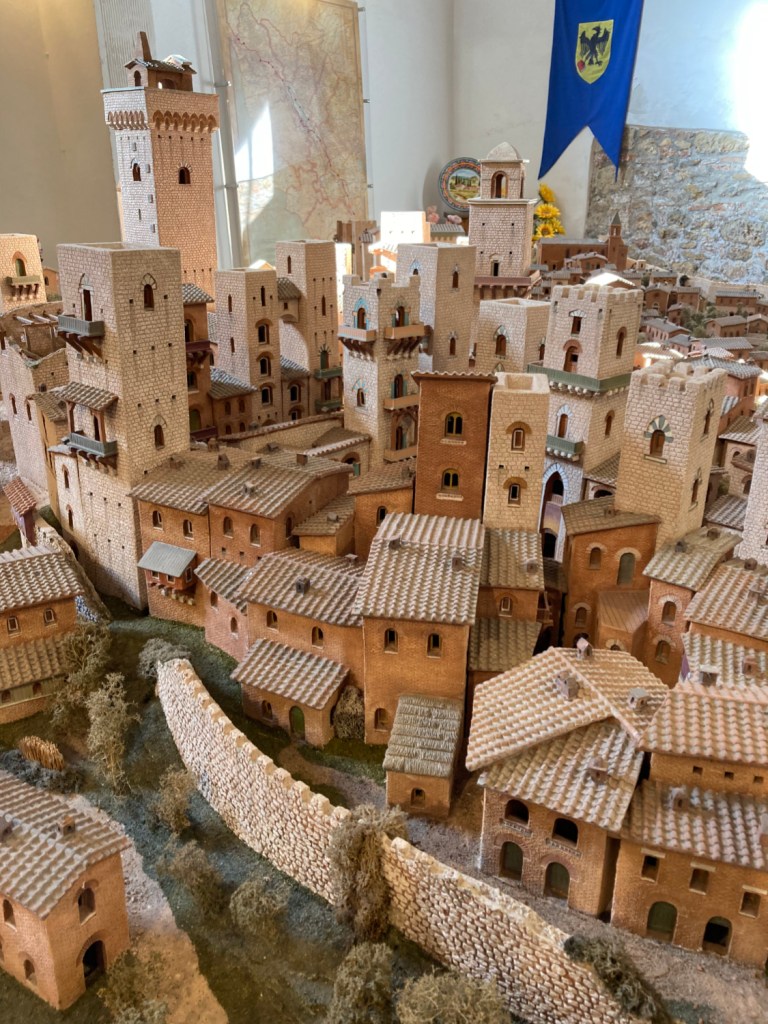
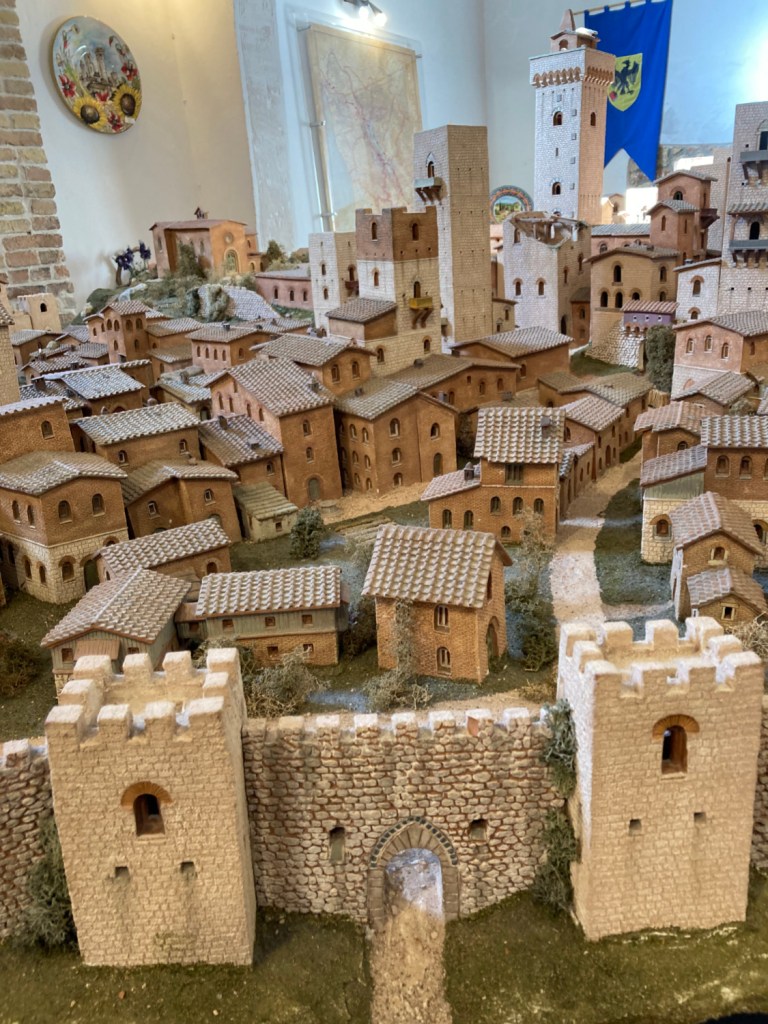
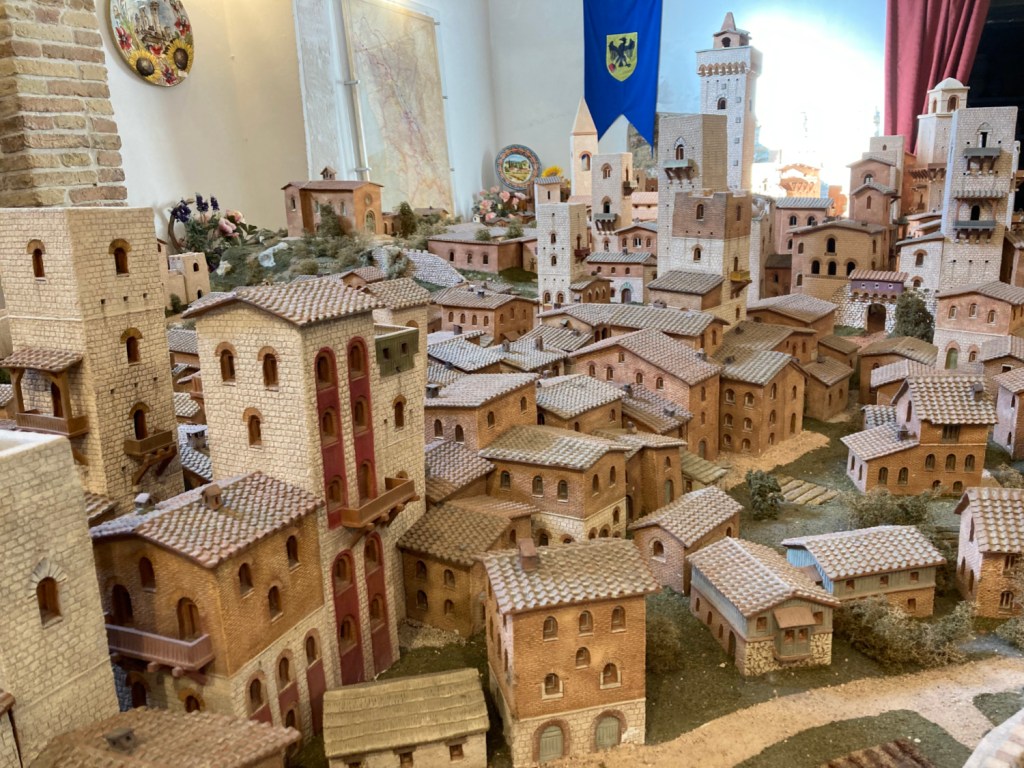
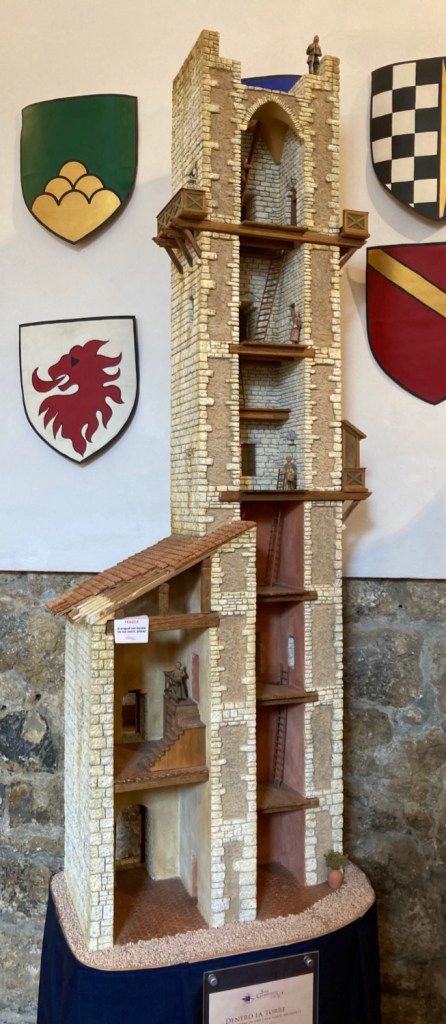
San Gimignano is one of the best hill towns in Tuscany. There’s a lot going on there so I’m going to break it into a couple of posts. We’ll start with 1300 San Gimignano. This is a 1:100 scale model (in clay) of the city as it was in 1300 CE. The model was built by Michelangelo and Raffaello Rubino (and assistants) over 3 years. It’s on display in the brothers’ art gallery in San Gimignano. Enjoy.
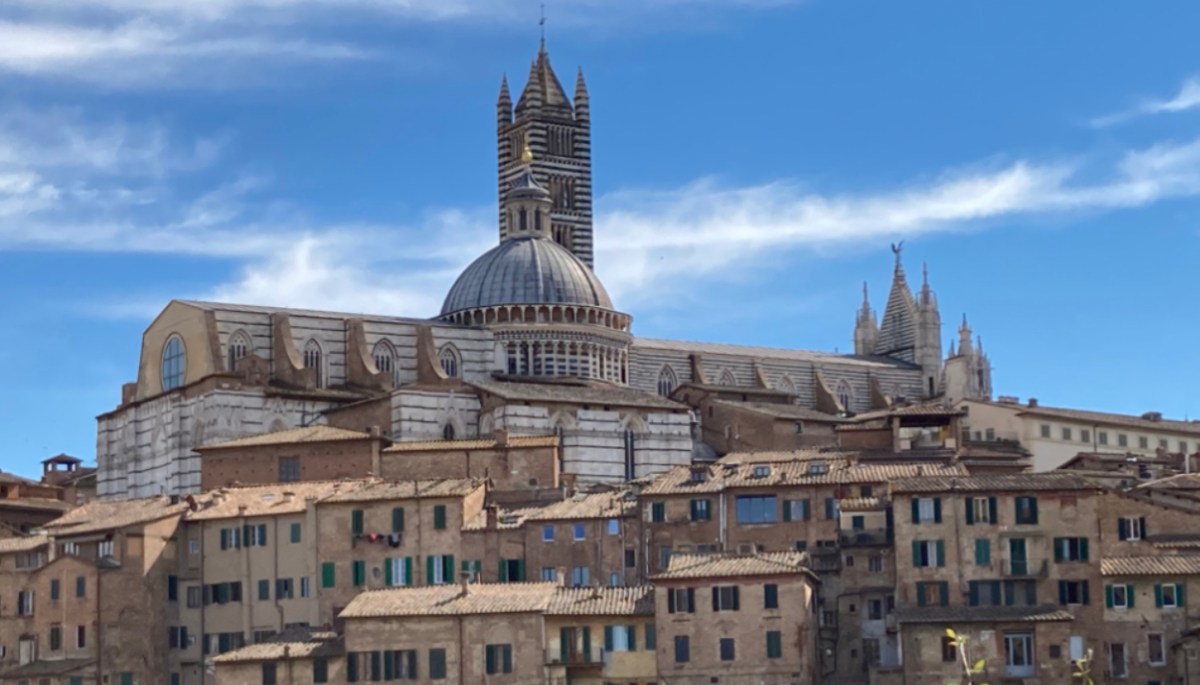
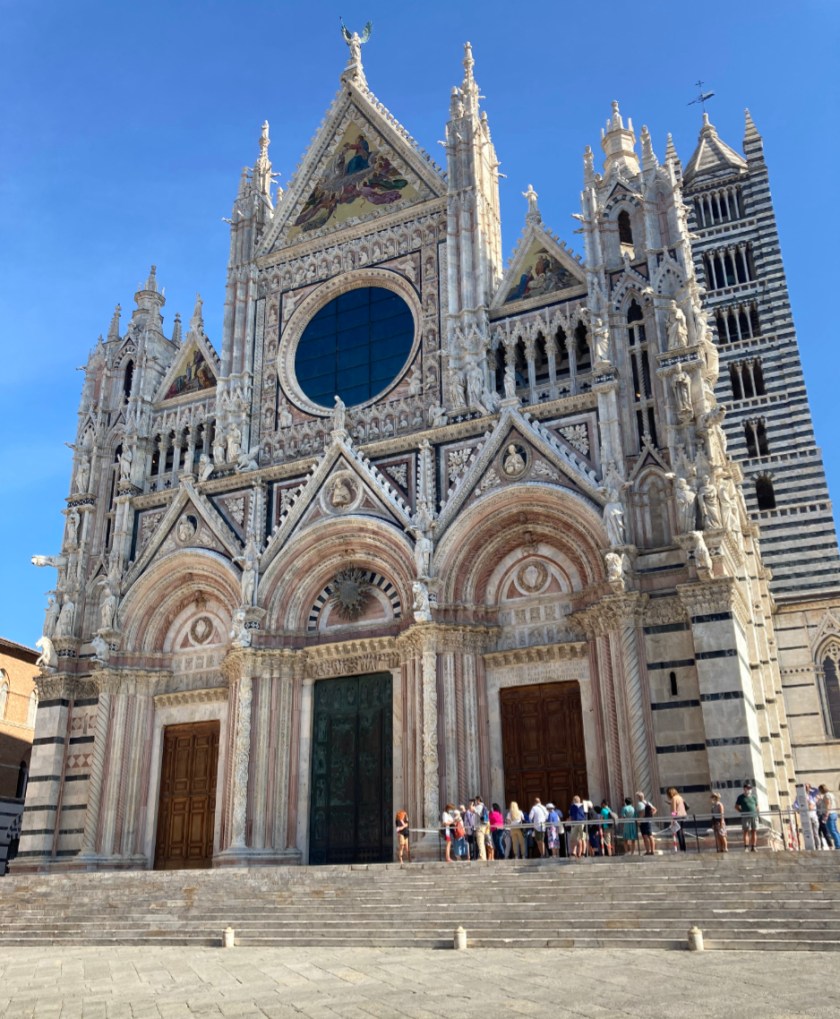
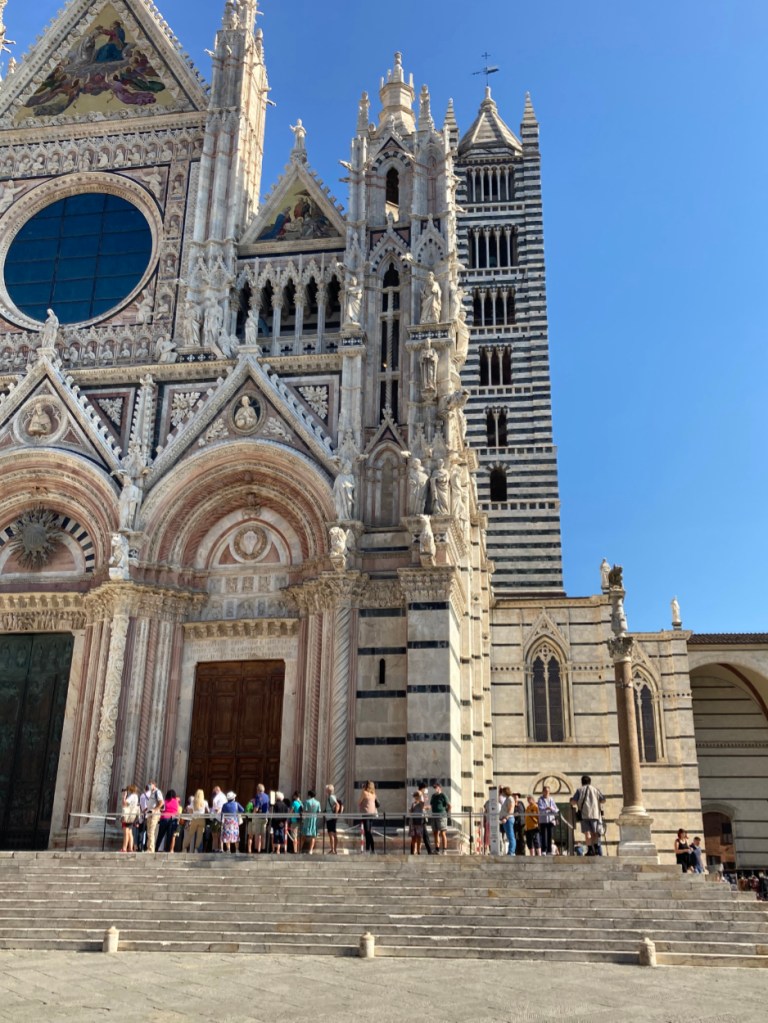
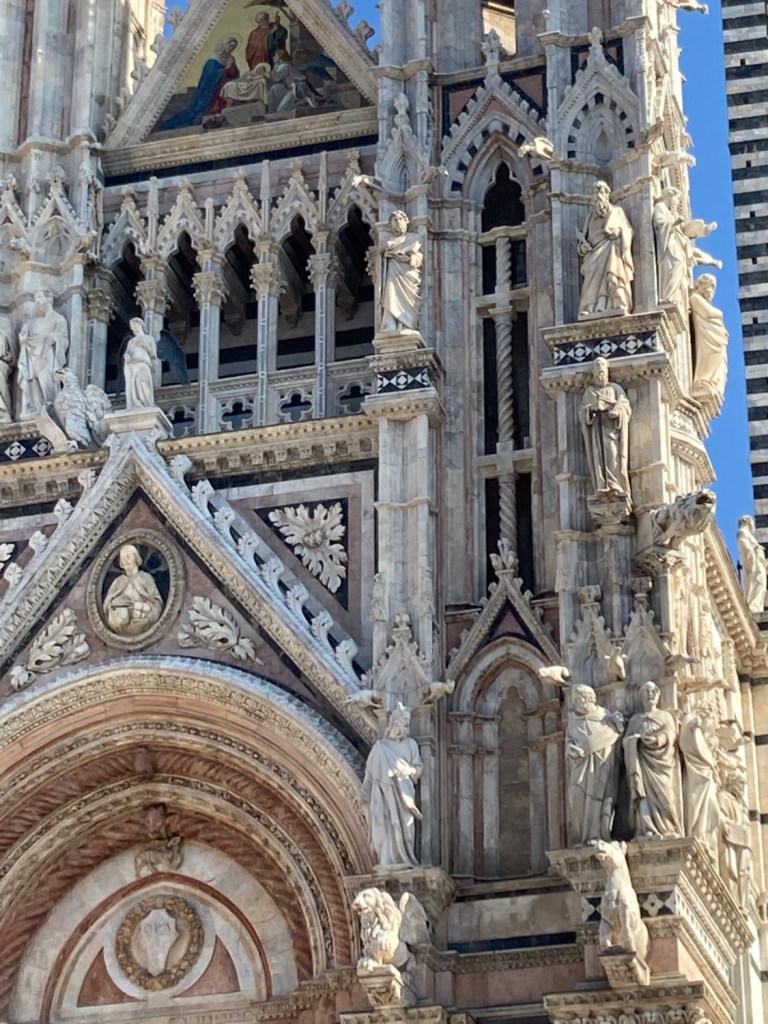
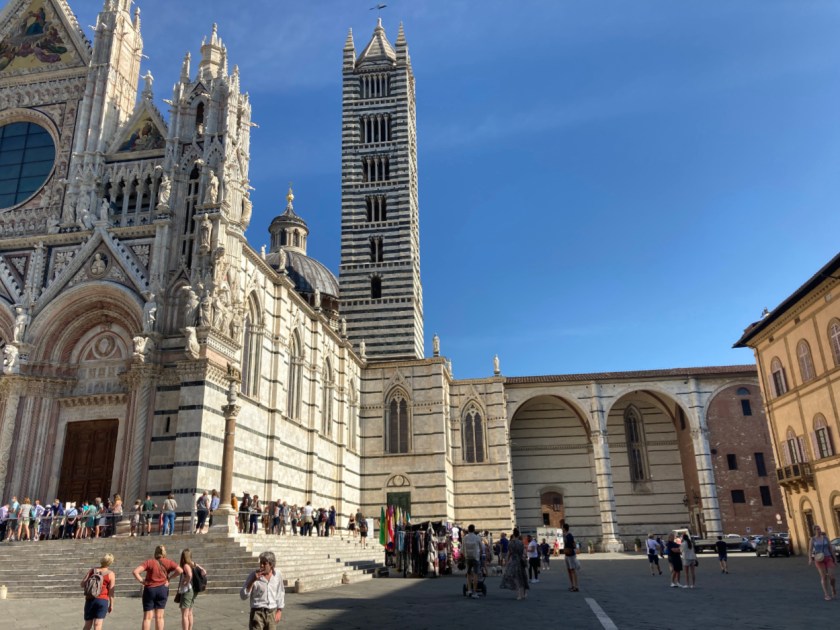
Duomo di Siena. You can always turn to the World Wide Web if you need more information. Here are some highlights. Design and construction began around 1220 CE. The dome was completed in 1346. The church is dedicated to the Assumption of Mary. Associating churches with Mary seems to pretty common in Tuscany. The church was built of brick, then sheathed in alternating stripes of white marble and green marble which has since oxidized to something closer to black. Several artists contributed to the facade which is covered in saints, prophets, patriarchs, gargoyles, oxen, beasts (lions with wings), and did I mention gargoyles.
The Florence Duomo is bigger. In 1296, Florence began to build a duomo that would be bigger than the Siena Duomo. As a side note, the initial design of the Florence Duomo was by Arnolfo Cambio, who is a son of Colle di Val d’Elsa (the town where Susan and I have been staying). Anyhow, Siena could not allow Florence to have the biggest Duomo. So, in 1339, Siena planned to expand their Duomo. In the next few images, I’ll try to explain how.
The plan was to build a central nave with an aisle on each side. This structure would be perpendicular to the existing duomo making the original church the transept of the new duomo. In the image above, the tall arches in the lower right indicate where the boundary between the central nave and right aisle would have been.
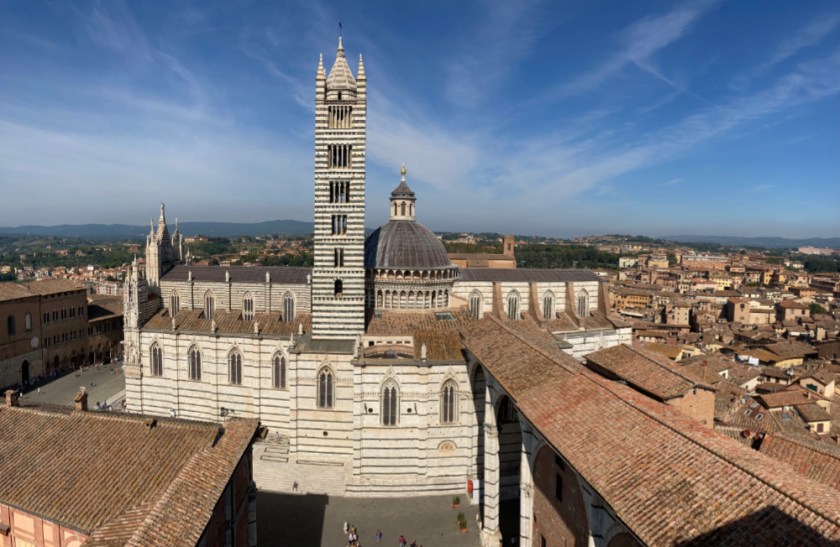
This view gives you an idea of the new duomo’s footprint and how it would dwarf the old one. Those arches in the image above are on the right under the roof. You can see that this aisle of the new duomo would have been almost as tall as the nave of the old duomo. The nave of the new duomo would have centered on the high altar beneath the dome and there would have been another aisle on the left.
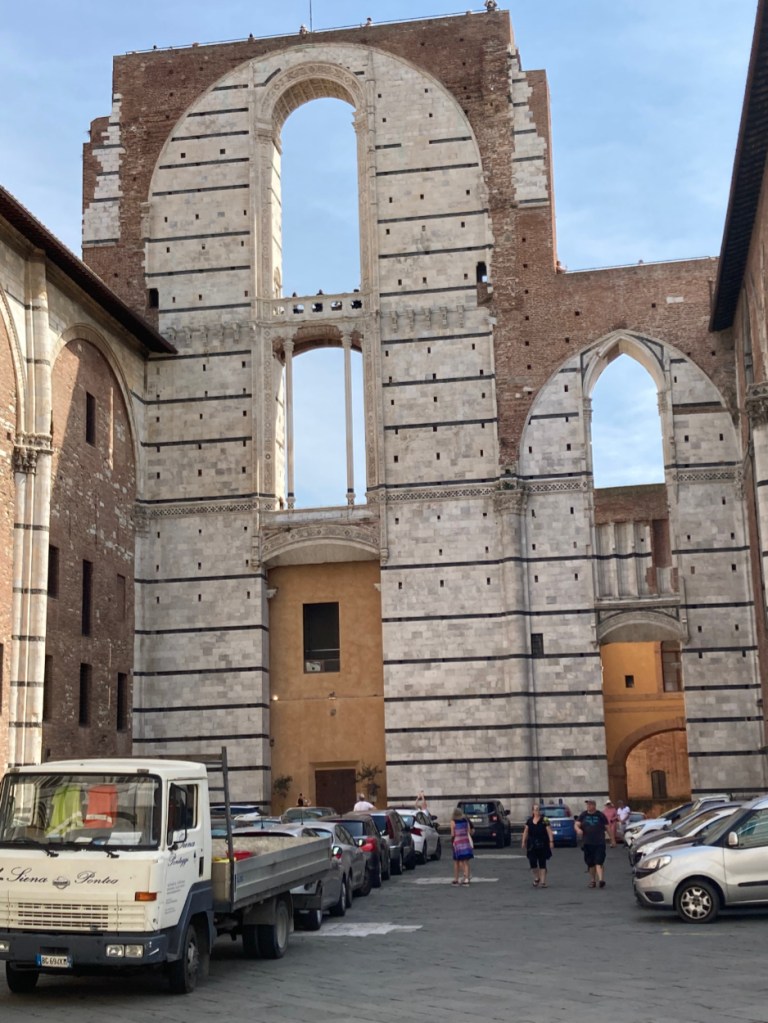
This would have been the facade (entry) of the new duomo. On the left, the arches that would have been between the right aisle and the central nave have been filled in with brick.
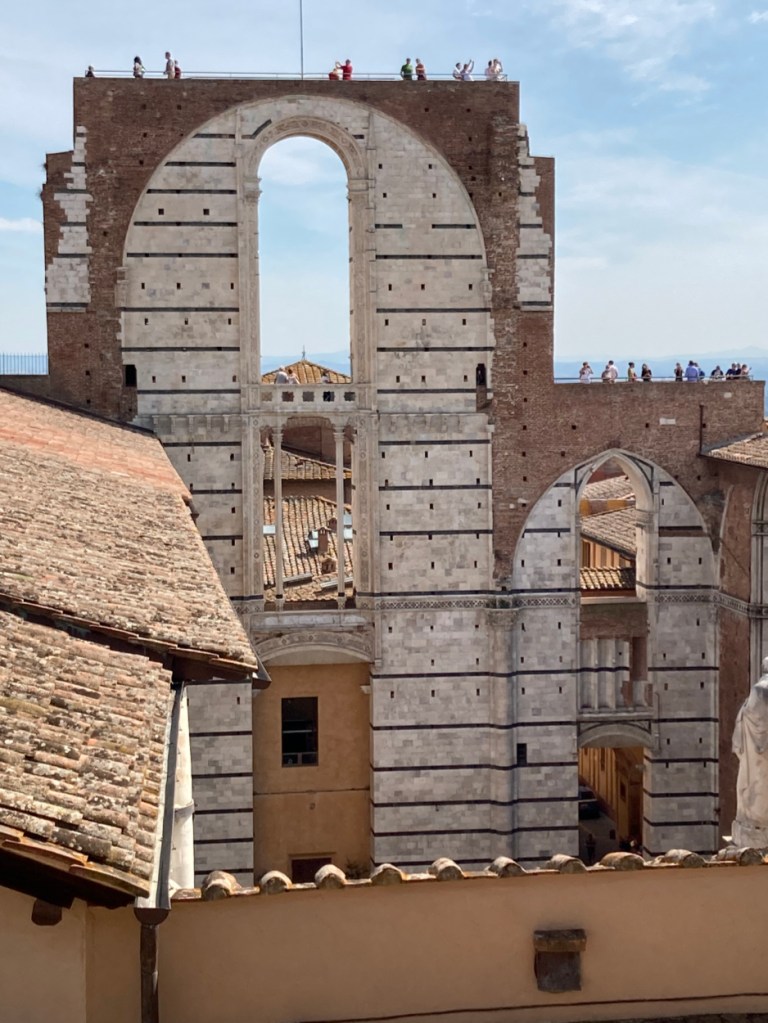
This, again, would have been the new facade viewed from the Dome. You can see that this cathedral would have been much higher than the existing one. In addition, the central nave of the new duomo would have been 140 meters in length (the nave of the existing duomo is 80 meters). Nave-length was everything in the Middle Ages.
So, what happened? In 1348, the Black Death (bubonic plague) happened. At least 50% of the Siena population died. Around 1355, Siena tried to resume construction but never could marshal the resources to complete the project. But the duomo they have, ain’t too bad.
Alright, I’m impressed.
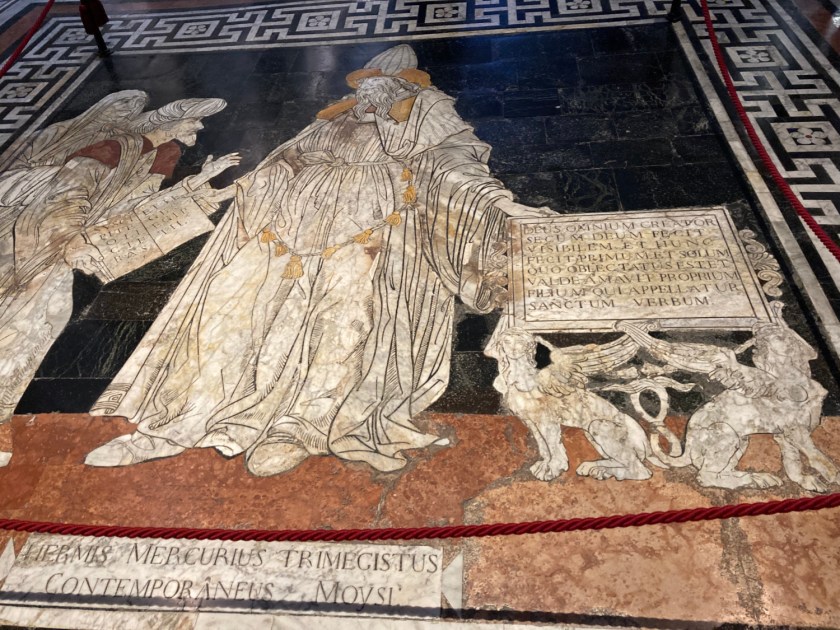
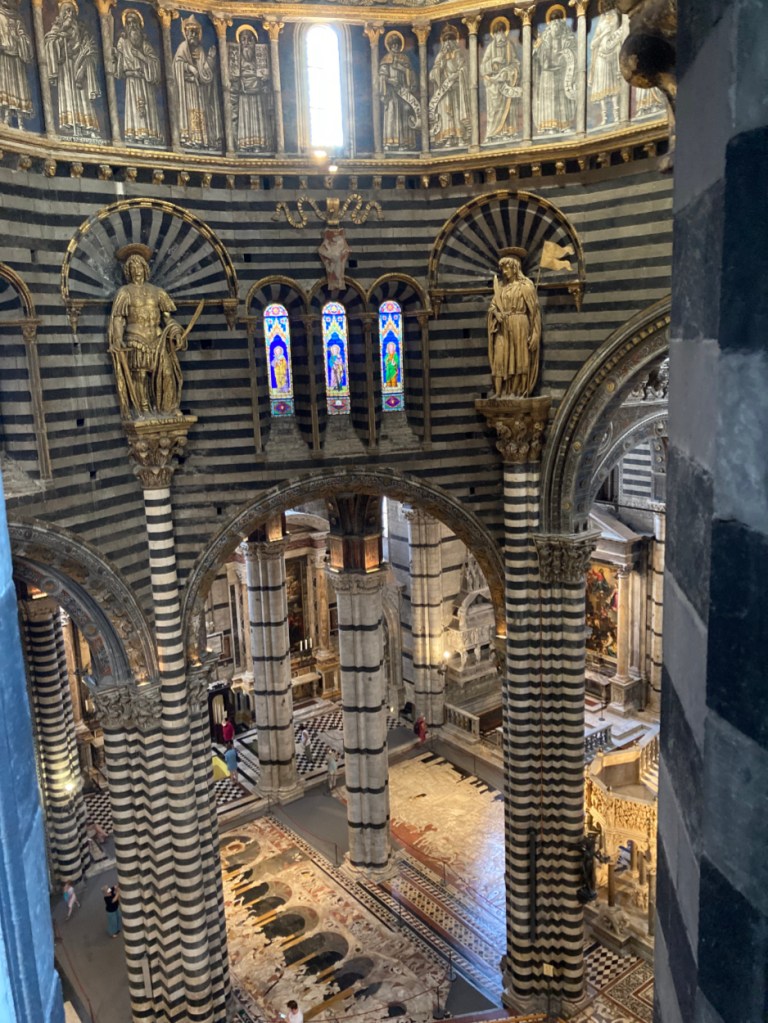
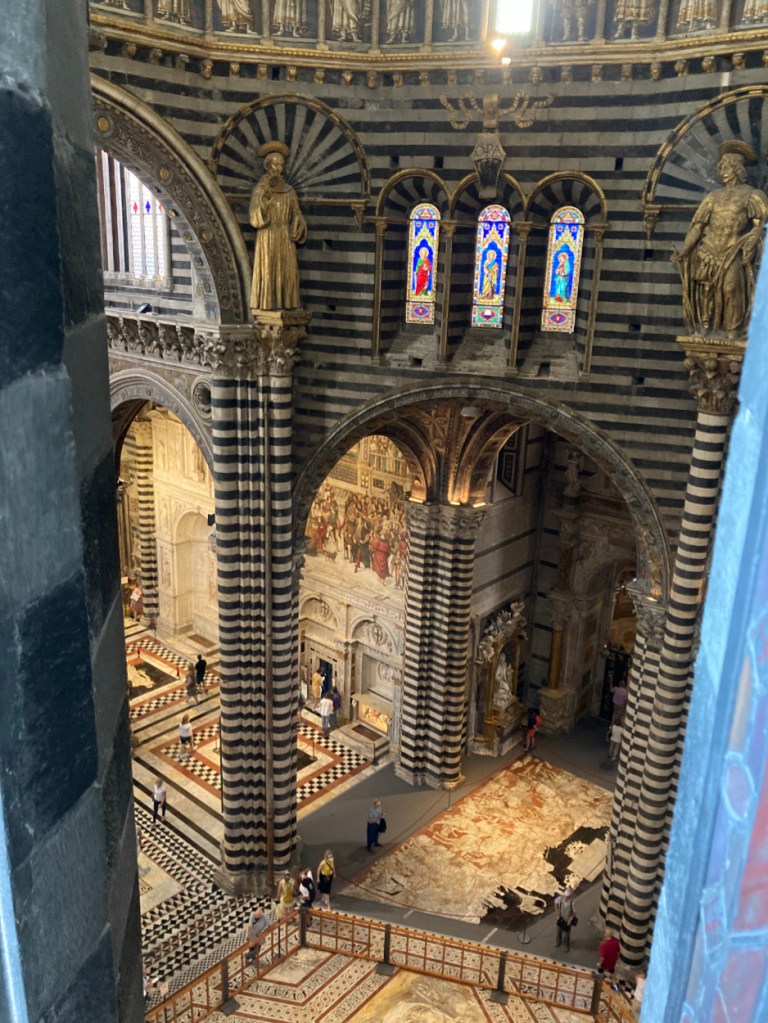
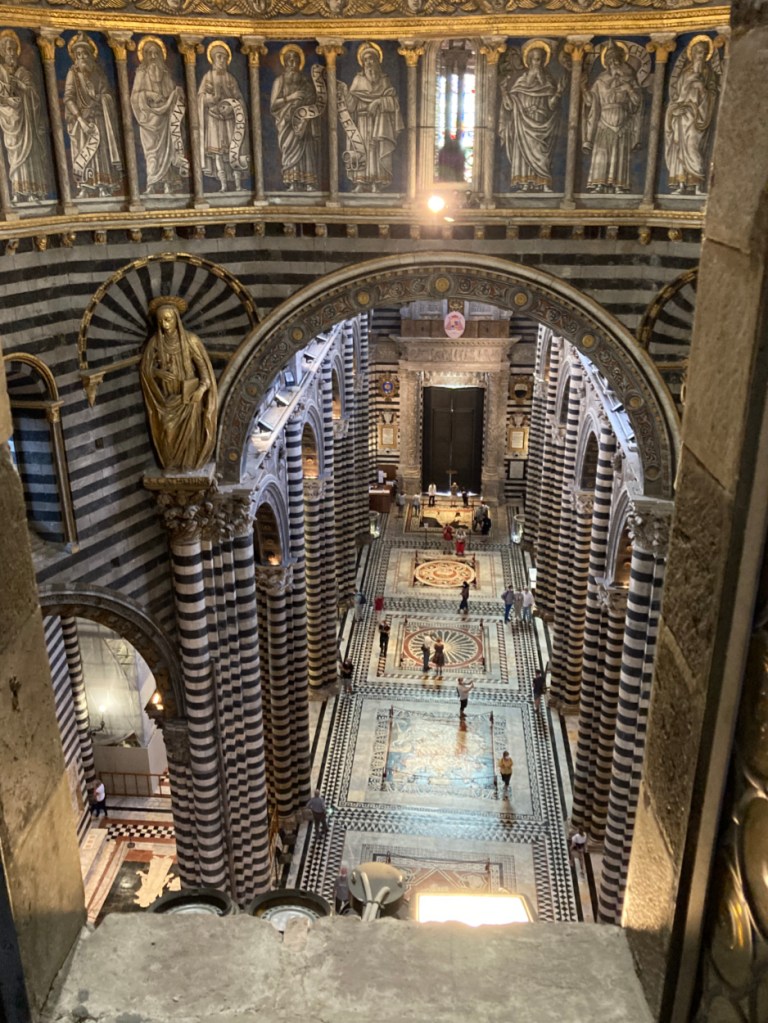
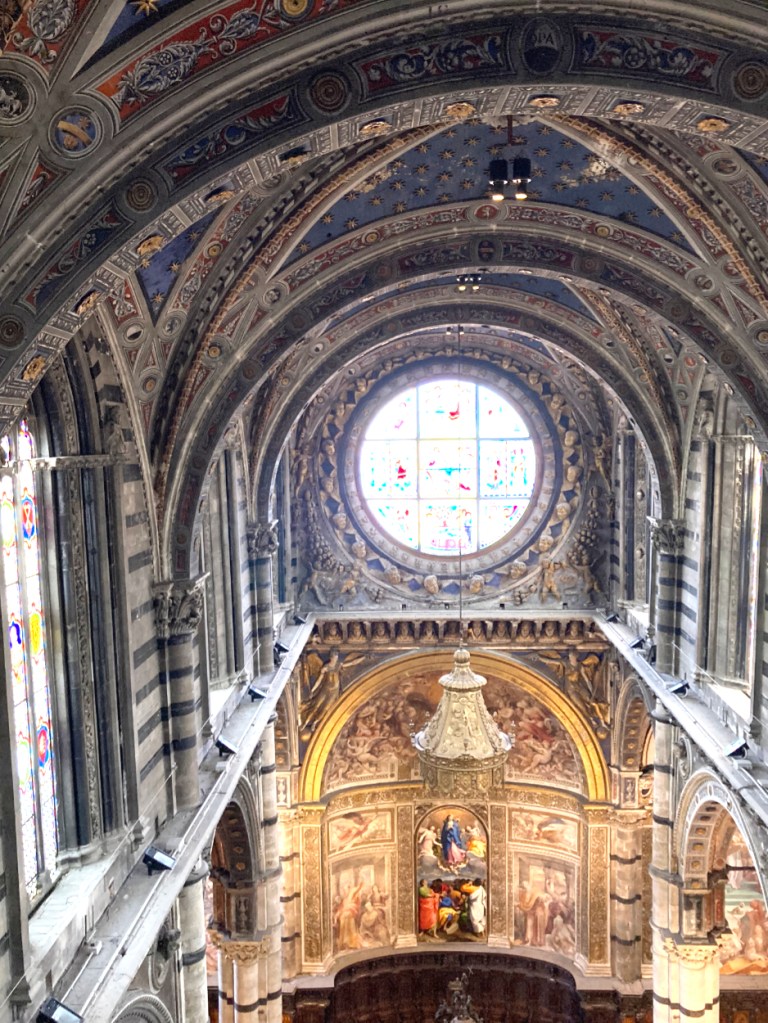
Amazing marble inlaid floors; maybe the most noteworthy art in the whole Duomo. To preserve them, you can’t walk on them and they are often covered with rugs. We were lucky but I ended up not paying much attention because my attention was continually drawn up (I think they planned it that way).
Michelangelo and Bernini.
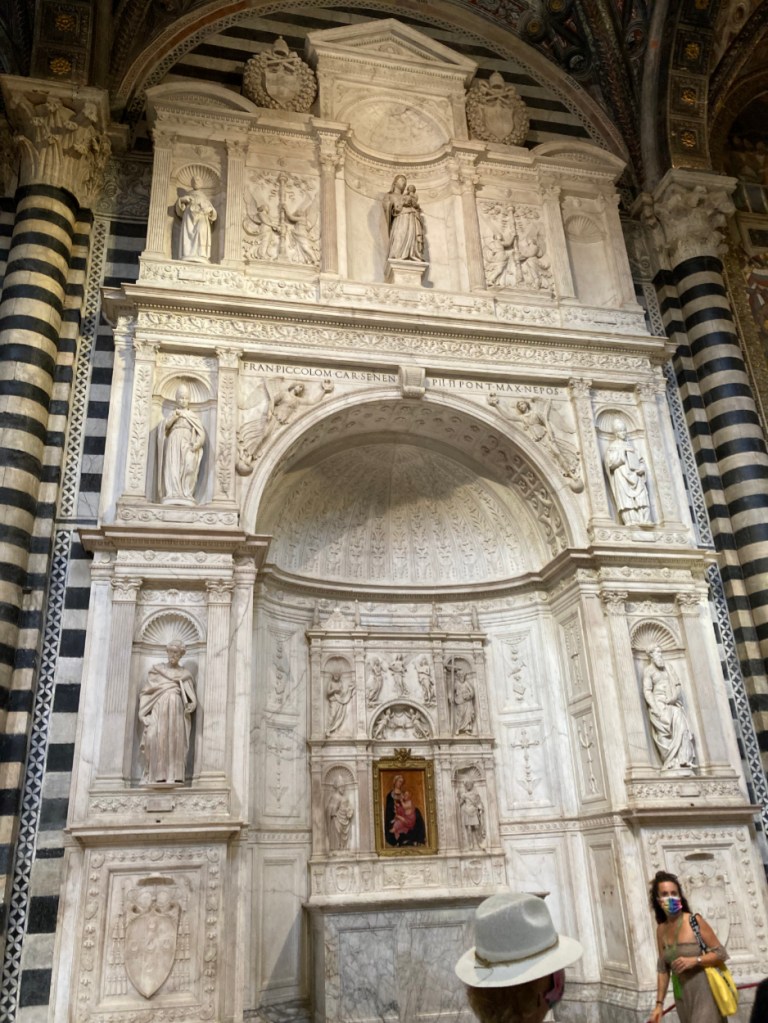
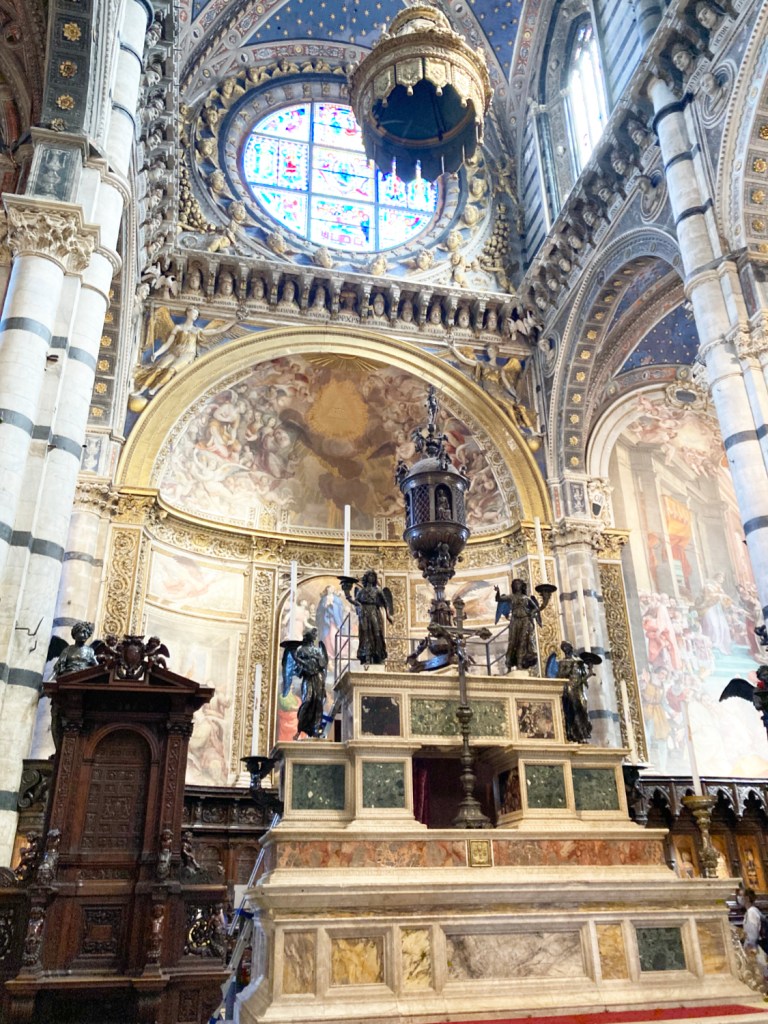
This marble altar was commissioned byFrancesco Todeschini Piccolomini who became Pope Pius III (died after 26 days as Pope). Michelangelo’s shop eventually got the contract to supply the 6 larger statues of family-favorite saints. They only supplied 5; by then, Pope Pius III had died, the family lost interest and the contract was voided.
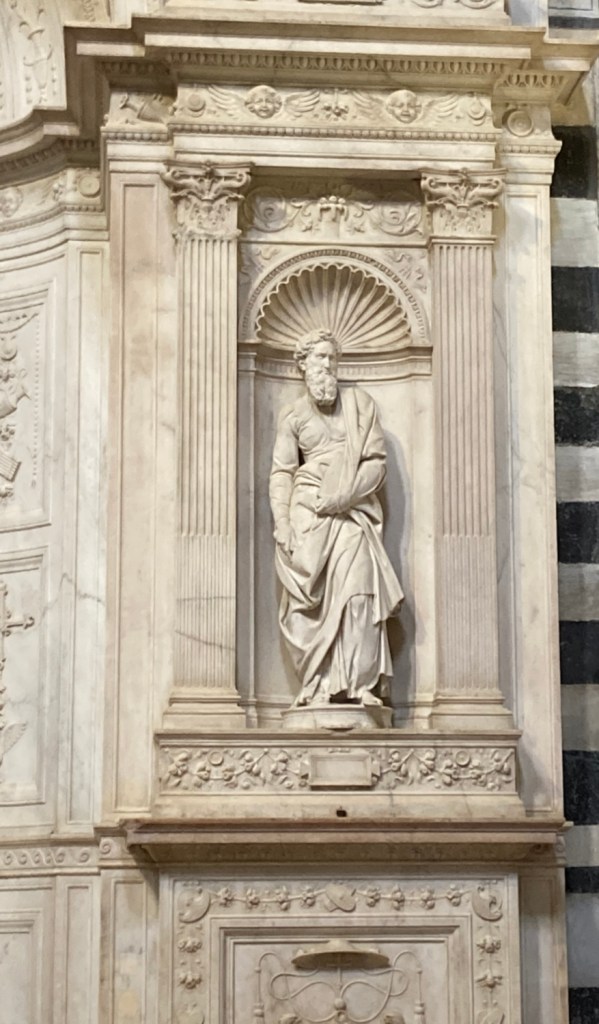
St. Paul. Rick Steves says this is the only statue actually completed by Michelangelo. Students in his shop executed the other statues. Other references, however say he did 4 of the 5 (with some help) and one reference said this statue of St. Paul might be a self-portrait of Michelangelo.
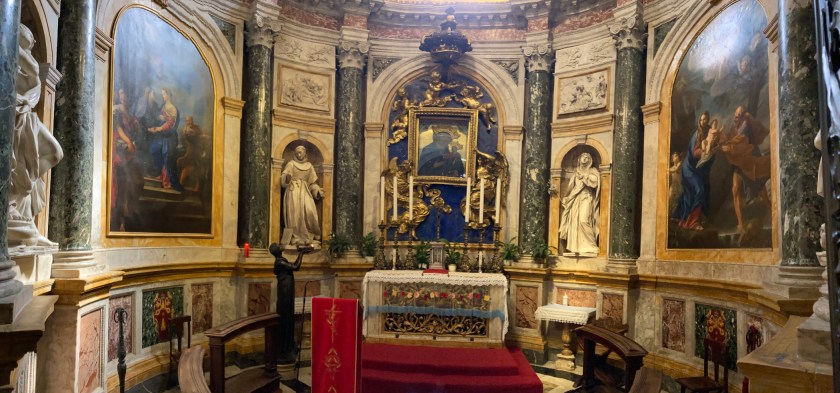
Bernini and the Chigi Chapel. Bernini (widely regarded as the greatest sculptor of the Baroque period) has 2 pieces (Mary Magdalene and St. Jerome) in the Duomo di Siena on either side of the entrance to the Chigi Chapel. Unfortunately, we weren’t allowed far enough into the Chigi Chapel to see them (one of them is partially visible on the left side). The 2 sculptures you can see are by artists’ from Bernin’s shop.
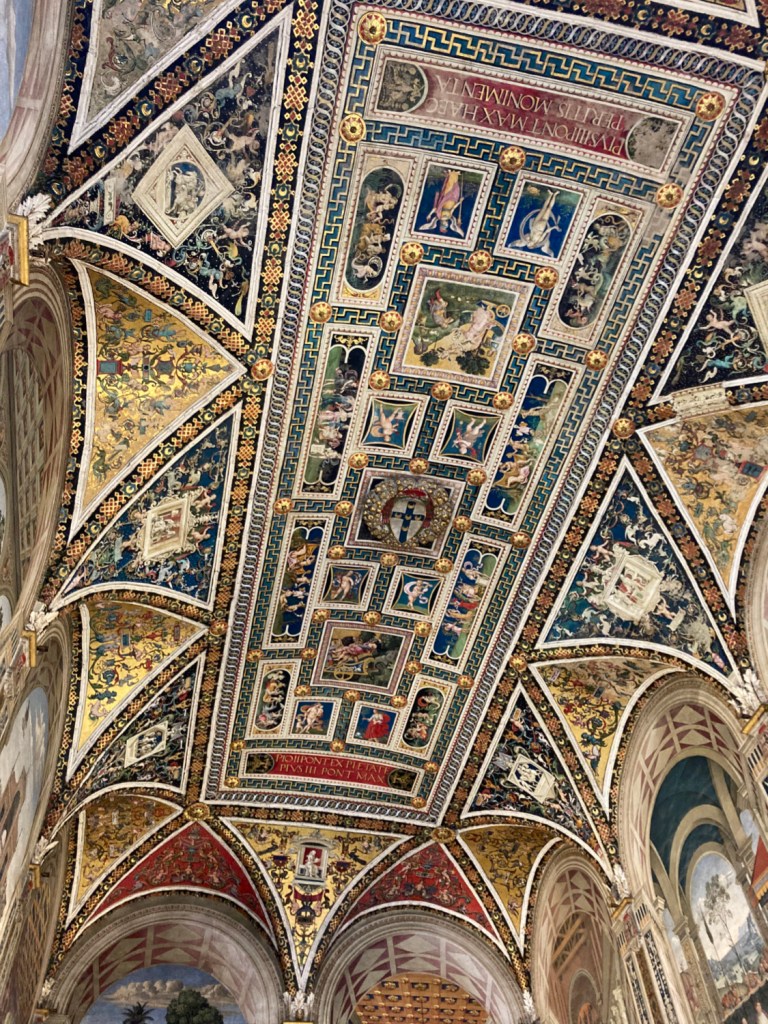
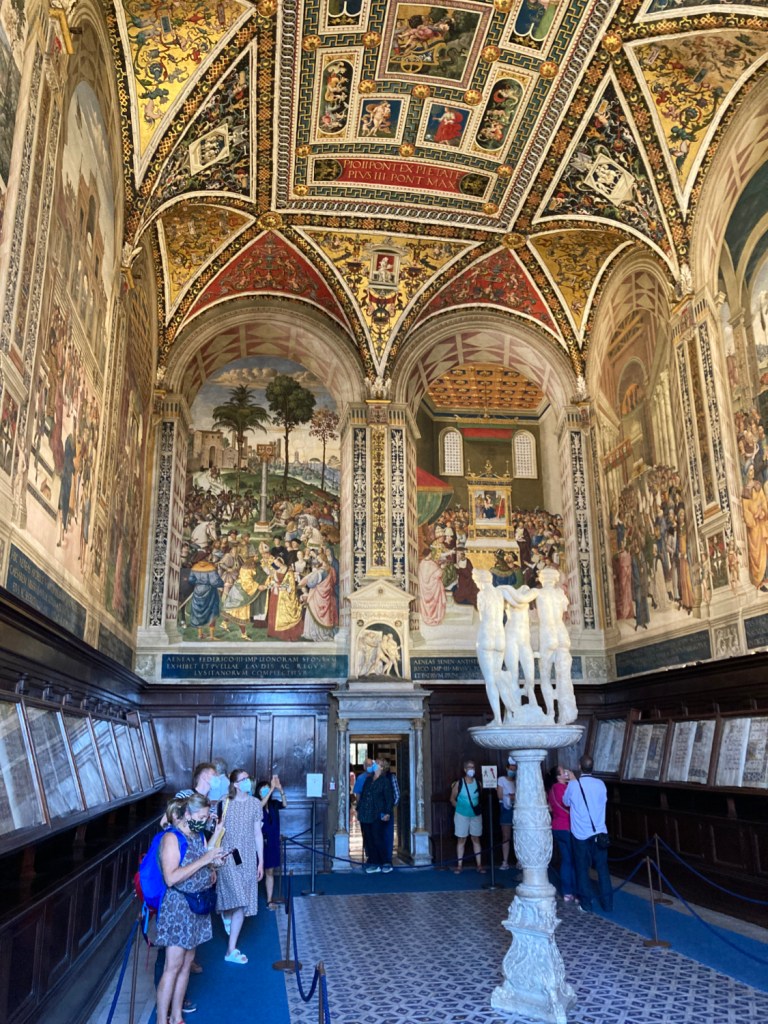
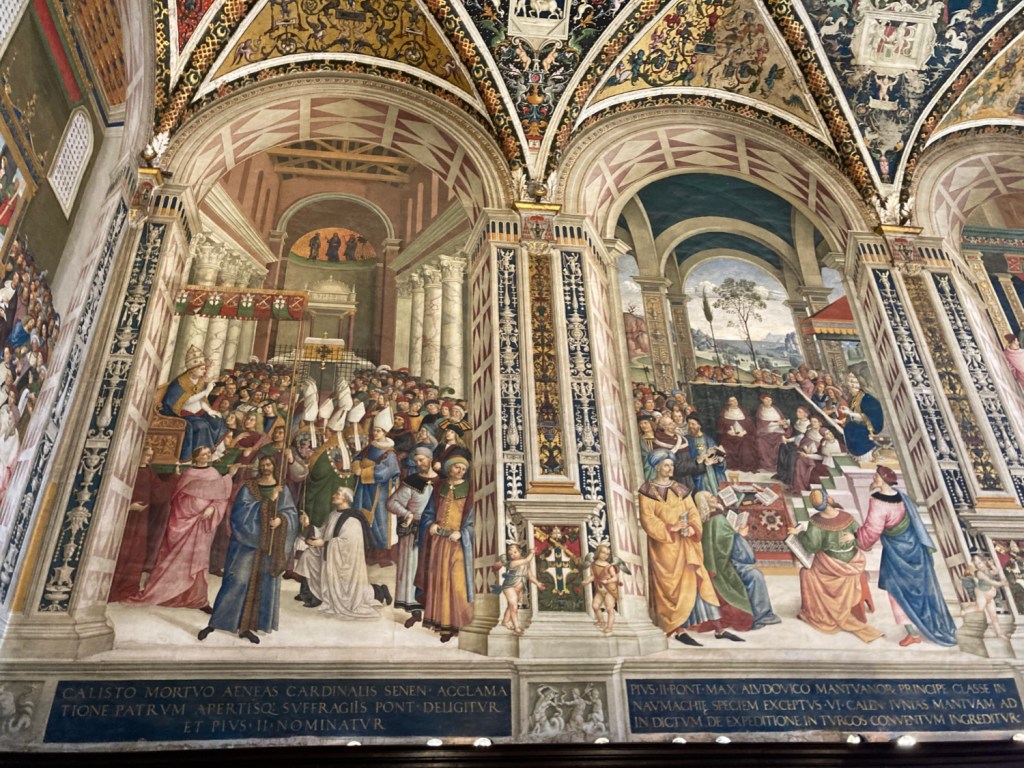
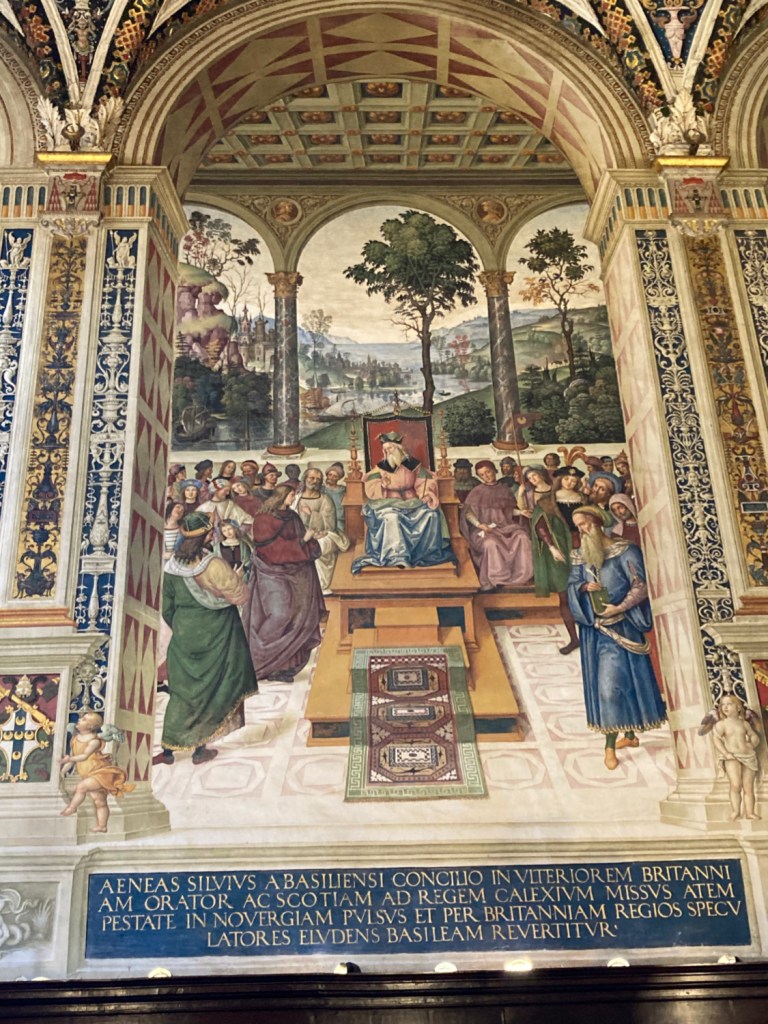
Piccolomini Library. Francesco Todeschini Piccolomini (Pope Pius III) endowed the construction of a library to honor his uncle, Enea Silvio Piccolimini (Pope Pius II). The library is off the nave and covered in frescoes that portray the accomplishments of and the offices held by E. S. Piccolomini. The frescoes are by Pinturicchio and his workshop which, at the time, included Raphael.
No words.
This room, the Piccolimini Library, is like a dessert for the eyes that’s just too rich.
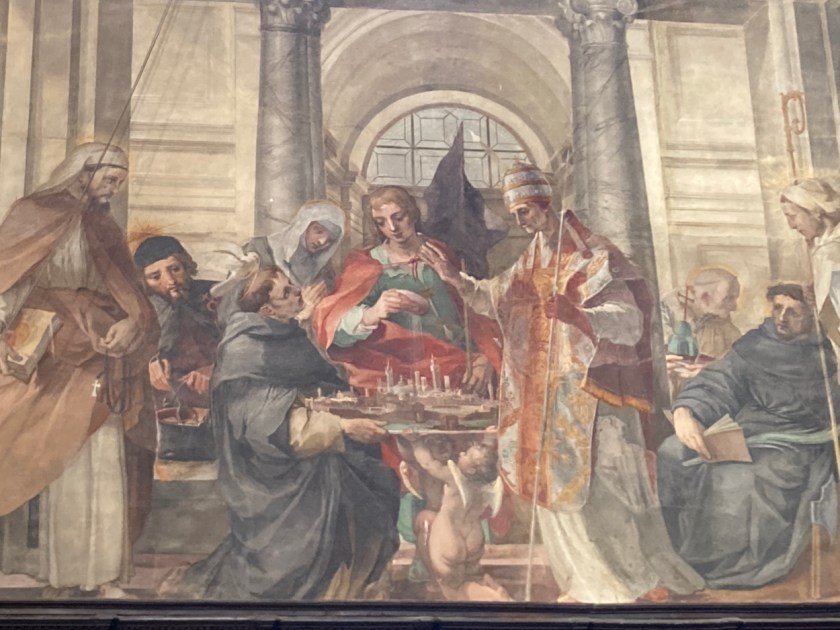
I don’t know who all the characters are but this is a common motif in Medieval Tuscan imagery- some holy person presenting their city (in this case, Siena) for protection by another Holy person or an even higher authority.
High altar.
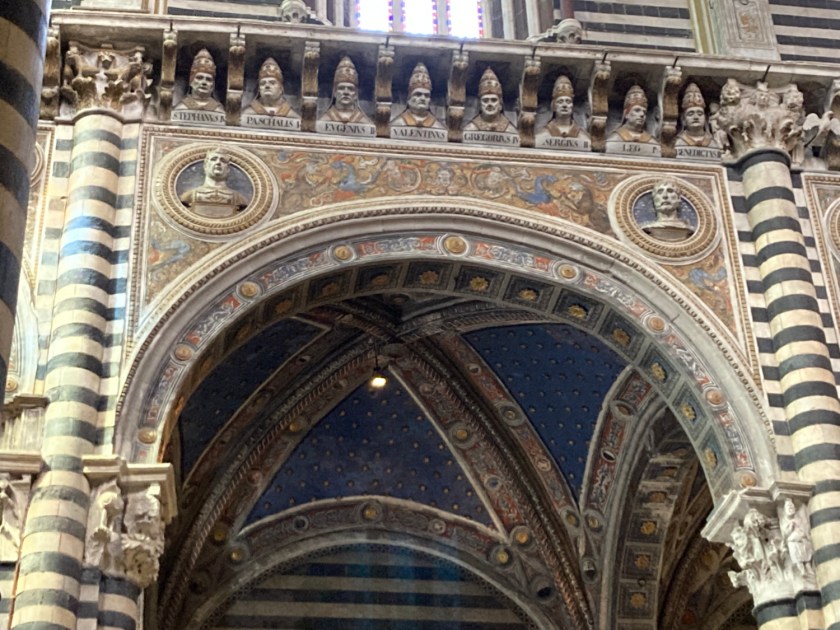
A few of my favorite popes.
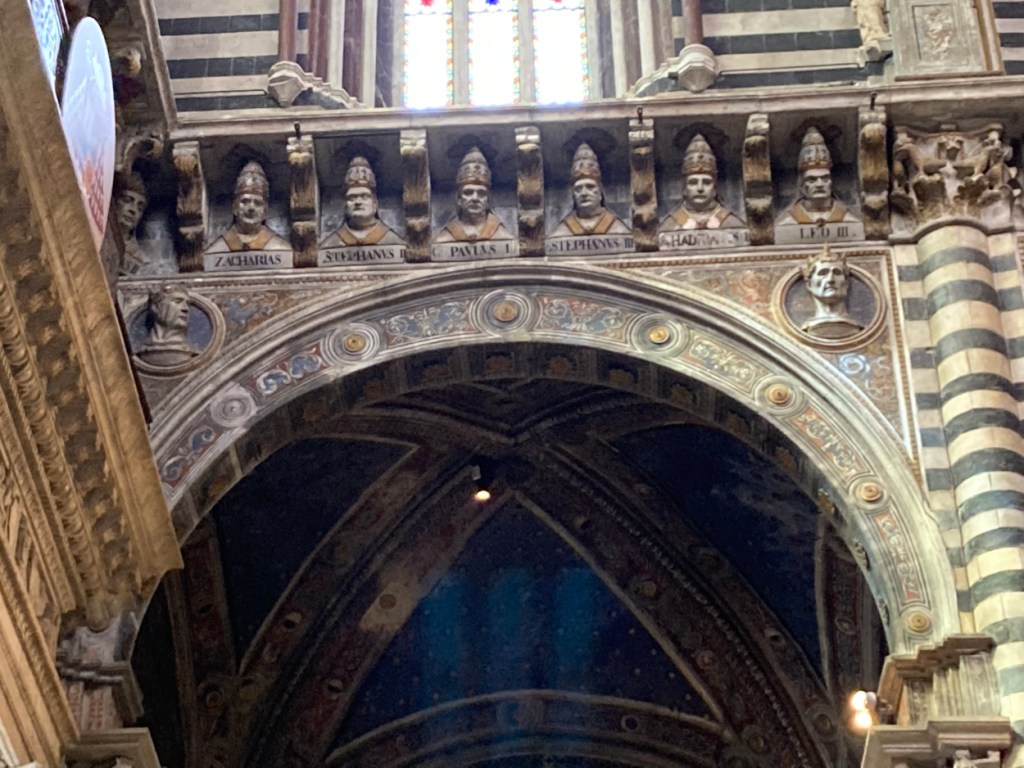
A few more of my favorite popes.
I’m not sure but I think that you can just see Heaven up above the popes.












 John and Susan's Excellent Adventure