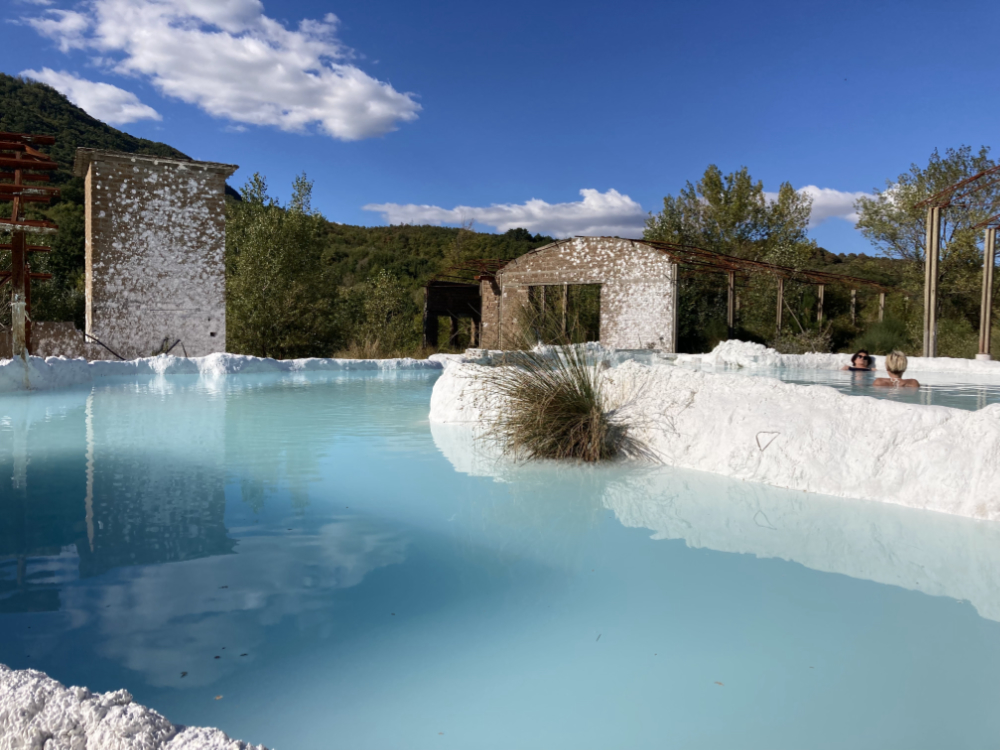
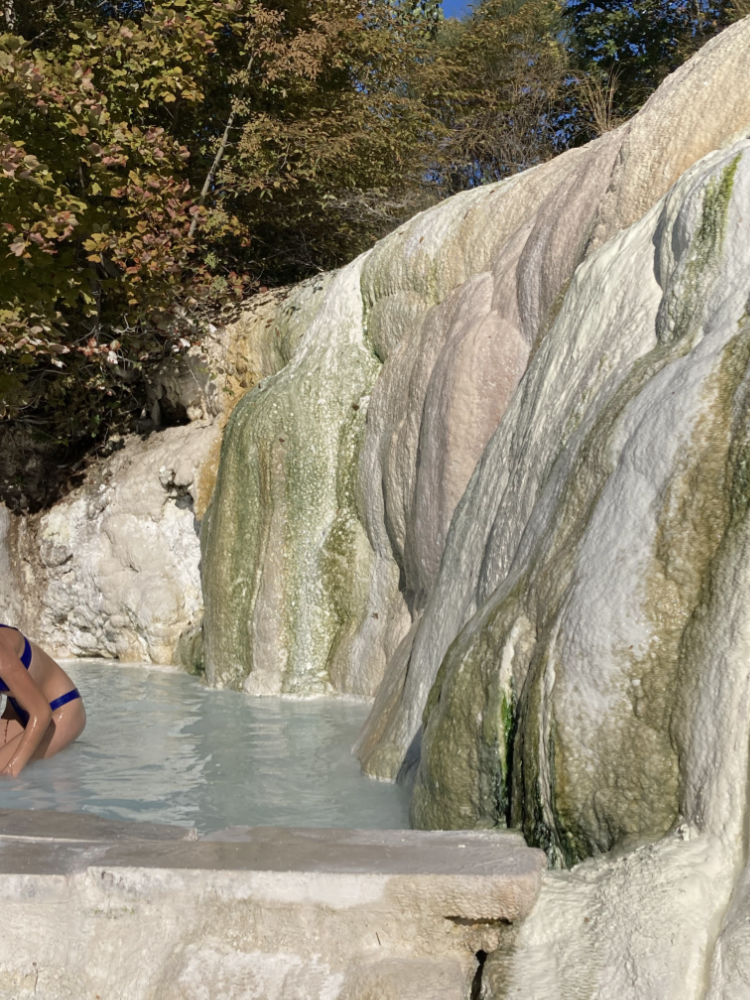
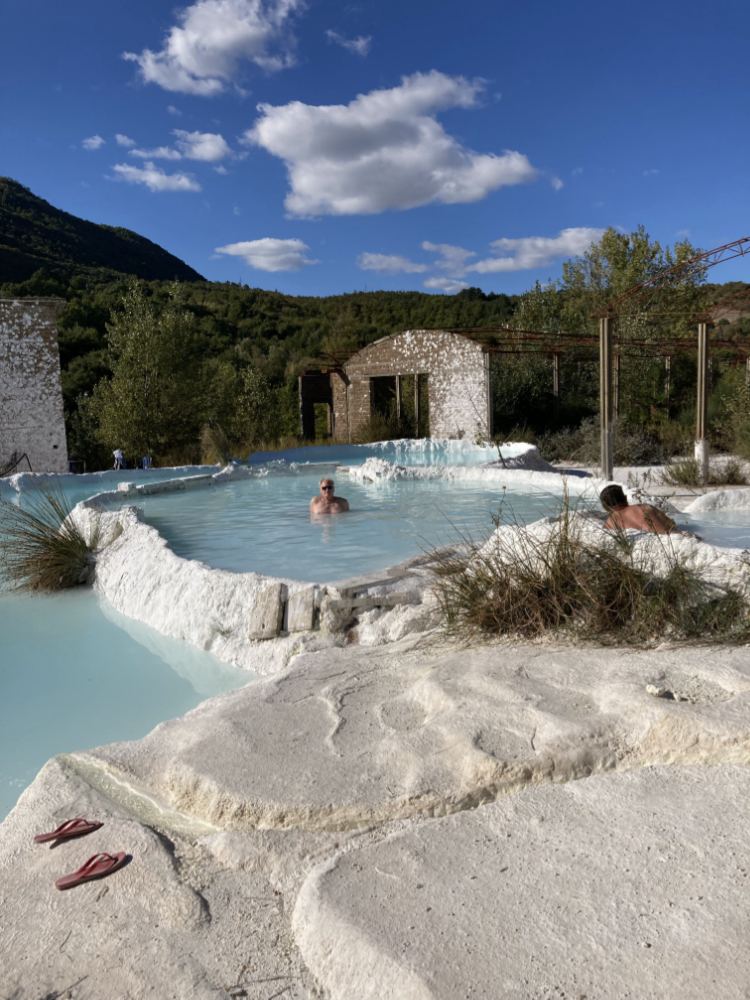
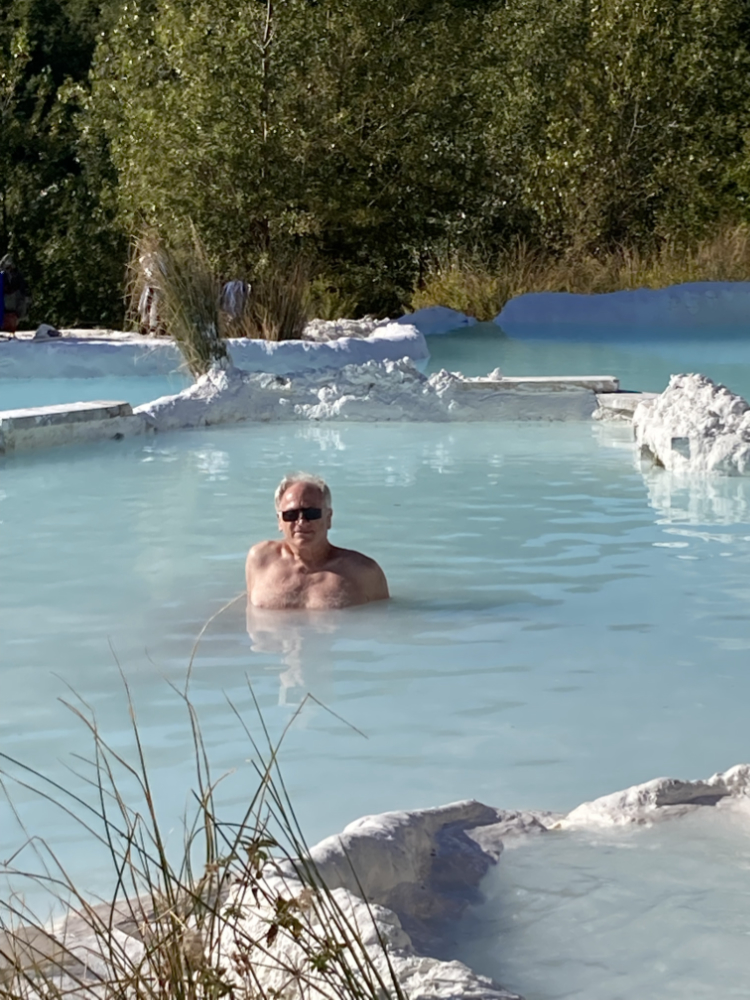
Susan and I went on a little road trip mostly in southern Tuscany. There is a lot of geothermal activity in this area creating many natural hot springs. Most of these sites have been turned into spas. We stopped at Bagni San Filippo where there are hot springs that haven’t been commercialized and you can just hop in. The white walls are built up with calcium carbonate that creates a sort of mud as it precipitates out of the water as it cools. The hot springs also release a little sulfur to keep your olfactory sense engaged.
Santa Maria Novella is between the train station and the bus station in Florence. It was the first church we visited on this trip to Tuscany. This church has a lot of great frescoes. We were visiting just a day after we arrived and were still pretty jet-lagged. So, we missed a lot. We hope to get back in a more lucid state. Turns out, I have a thing for frescoes. I knew it involved painting on wet plaster but I had no idea how complicated the whole process is. Google “fresco painting” and check out one of the videos.
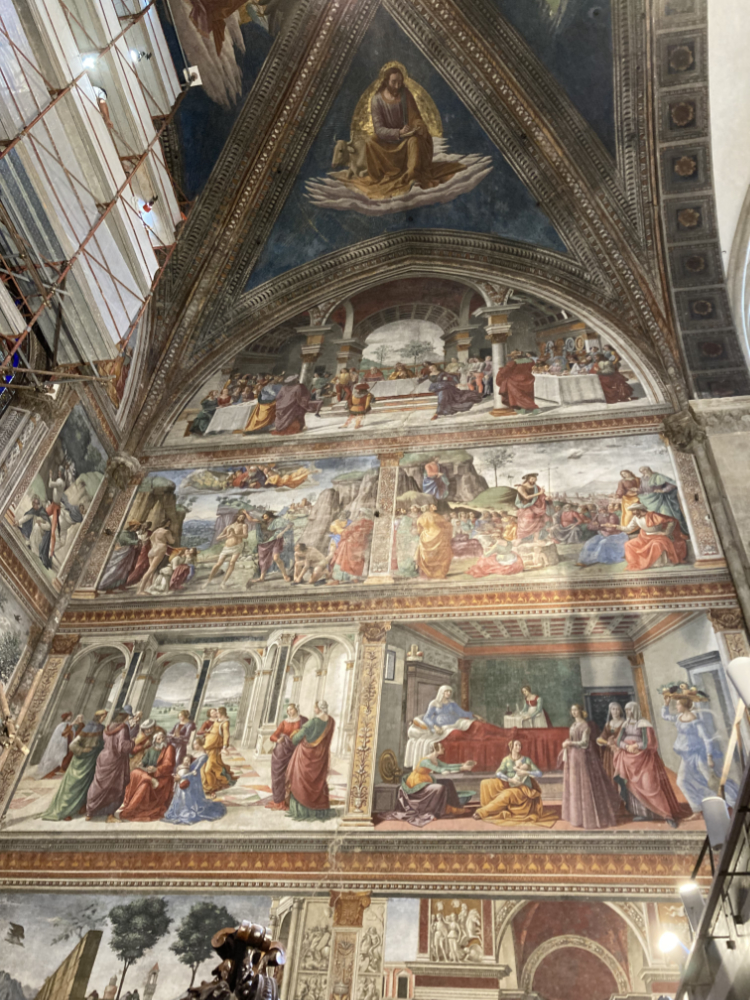
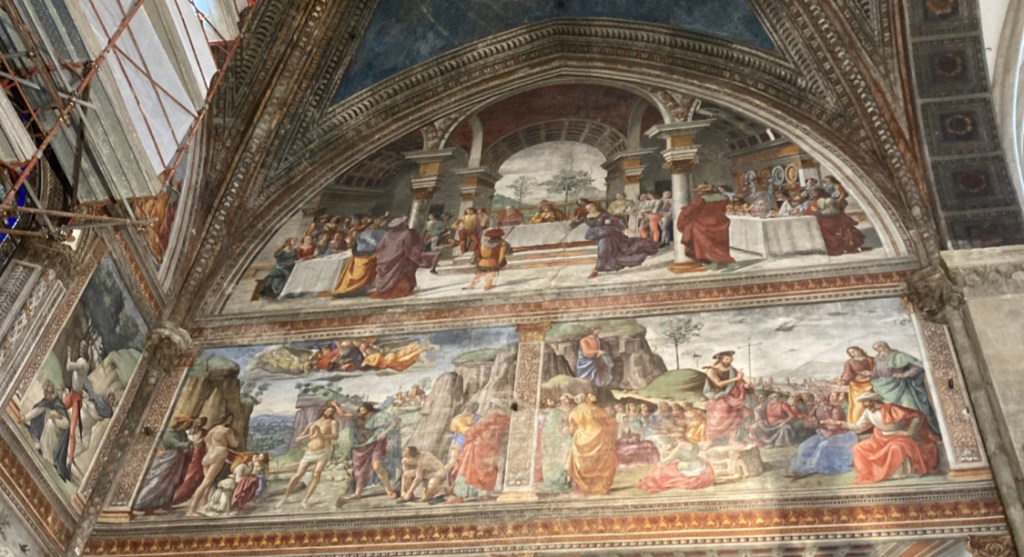
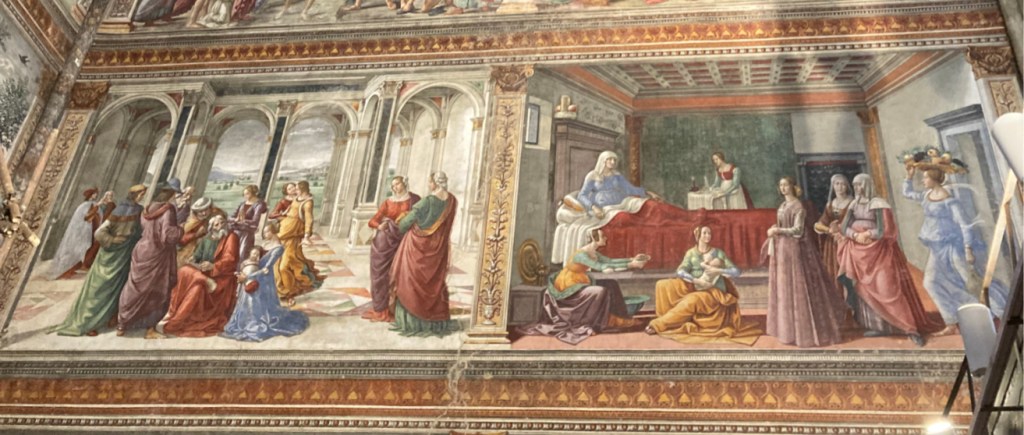
Tornabuoni Chapel (main chapel). The frescoes were done by Ghirlandaio (and his apprentices). One of his apprentices was Michelangelo (about 14 years old) but it’s not know if he worked on these frescoes. Scenes from the life of John the Baptist are his subject on this wall (some details below). That’s St. Luke at the top.
Top: Herod’s banquet. Bottom left: Baptism of Jesus. Bottom right: John the Baptist preaching.
Bottom left: John the Baptist’s father. Bottom right: John the Baptist’s birth.
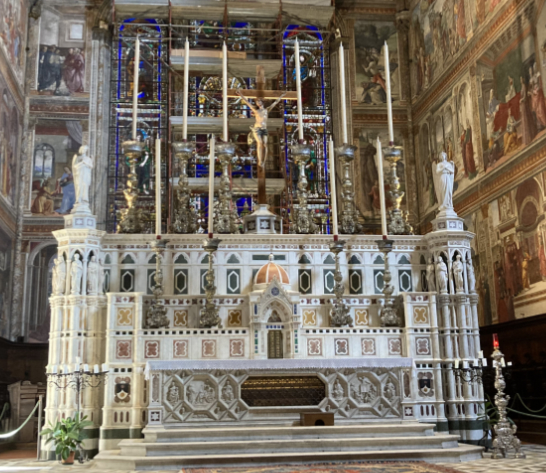
19th century Neo-Gothic altar in the Tornabuoni Chapel.
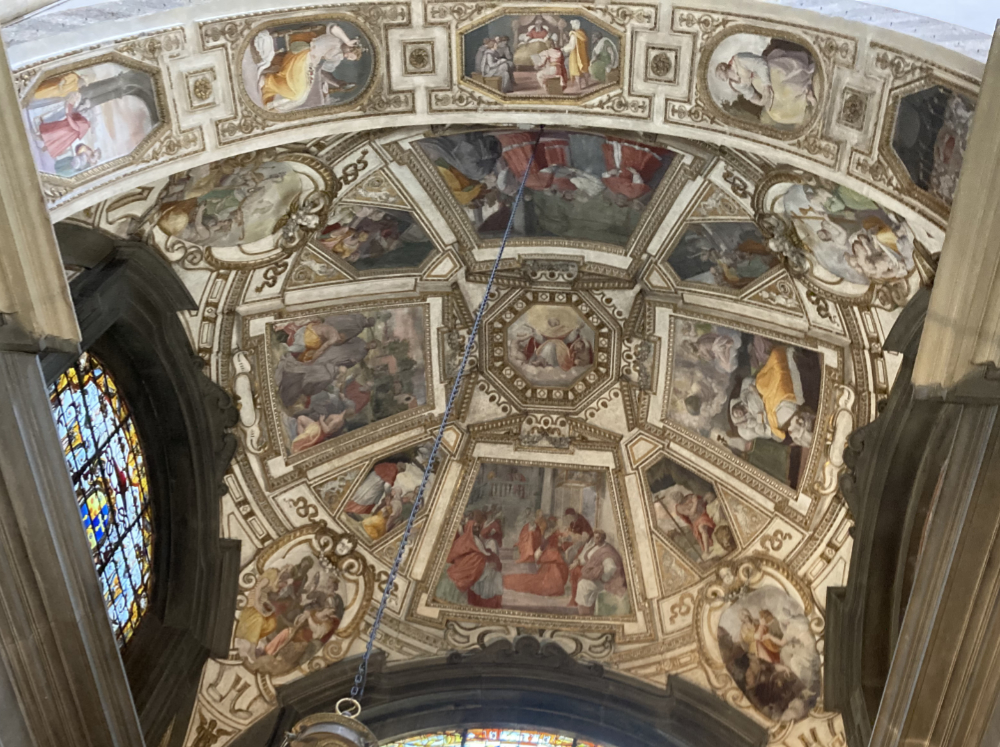
Not sure which chapel this ceiling is in.
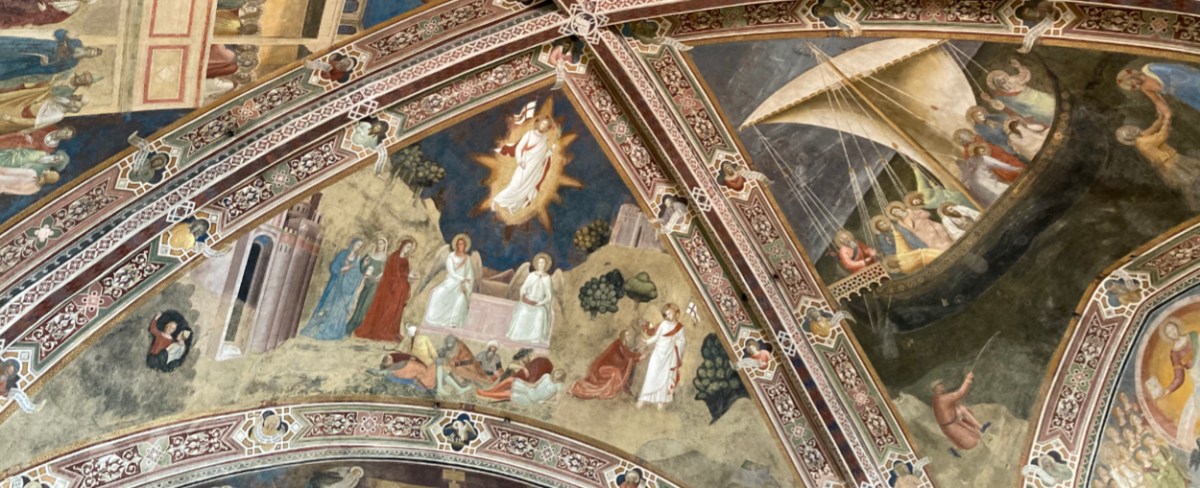
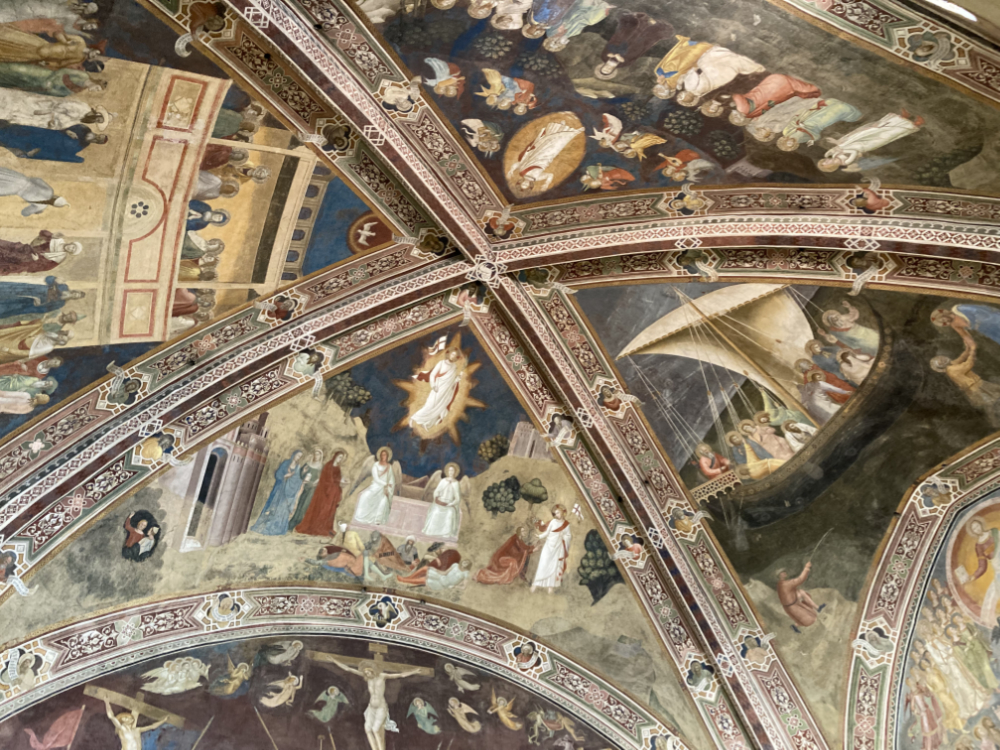
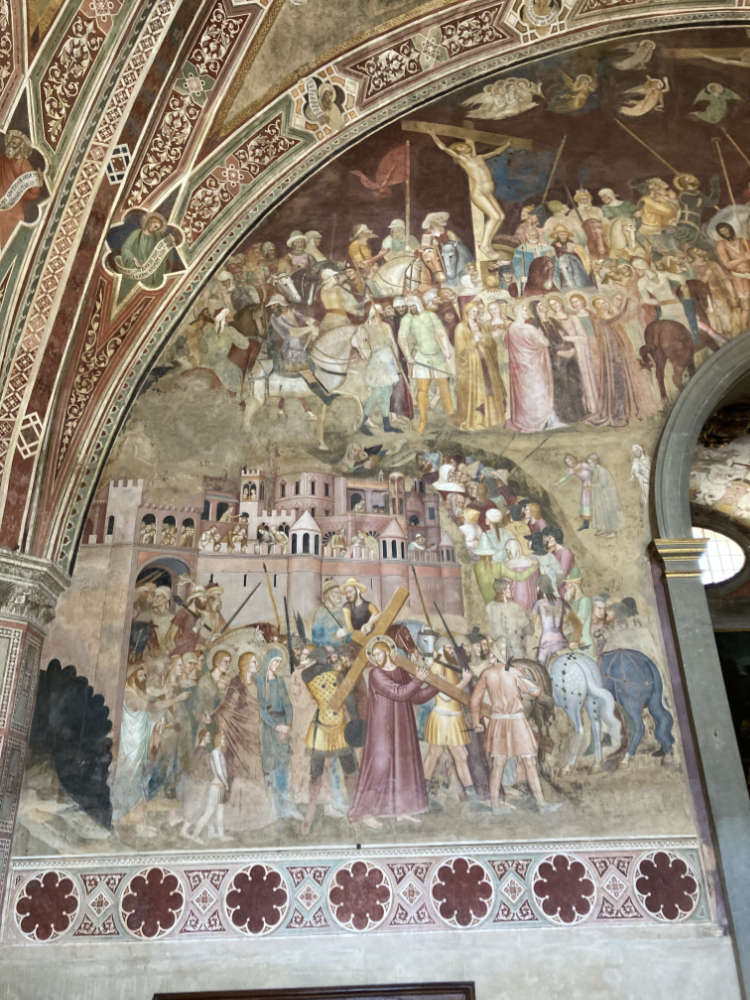
Ceiling of Spanish Chapel by Andrea di Bonaiuto (Andrea da Firenze). Scenes from the life of Christ.
This is also by Andrea di Bonaiuto in the Spanish Chapel.
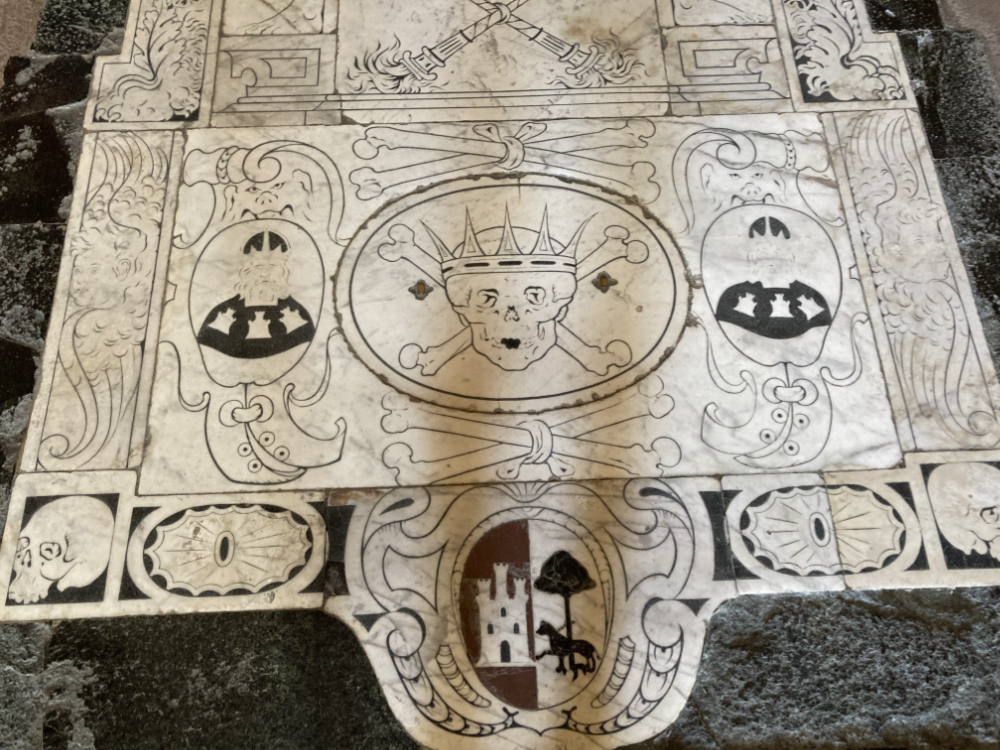
I don’t know who is buried here; I like the bones and skulls.
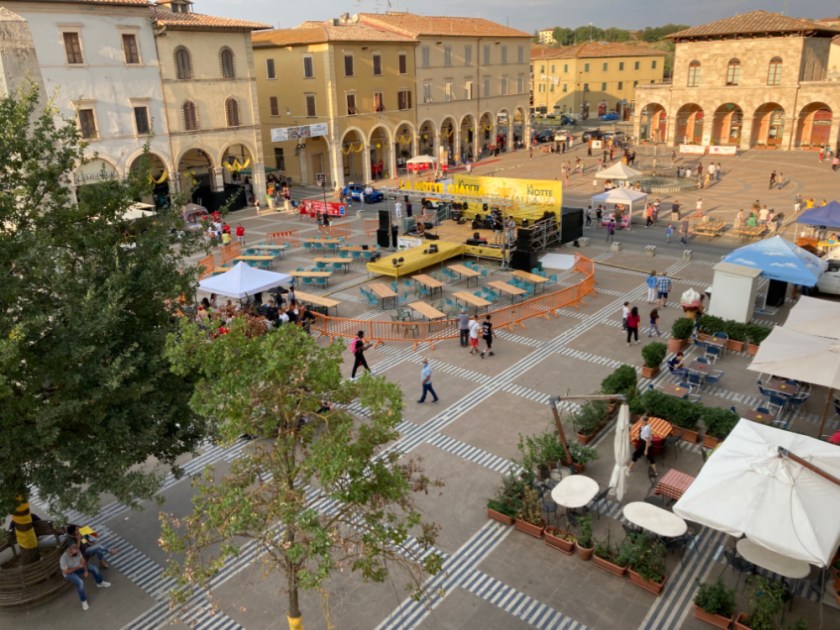
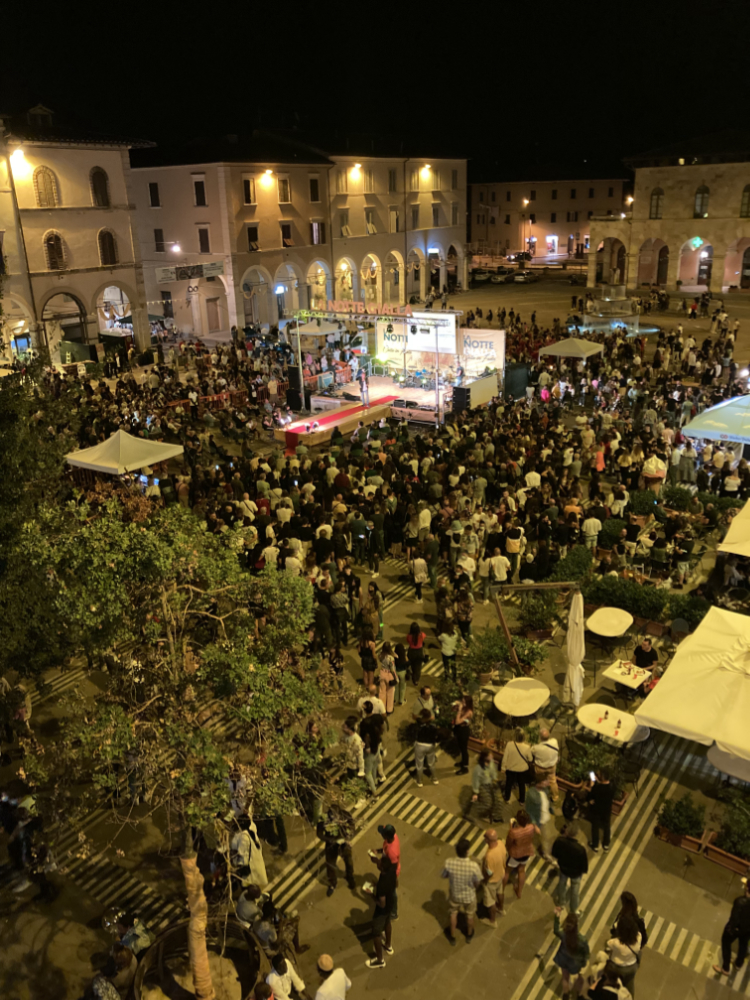
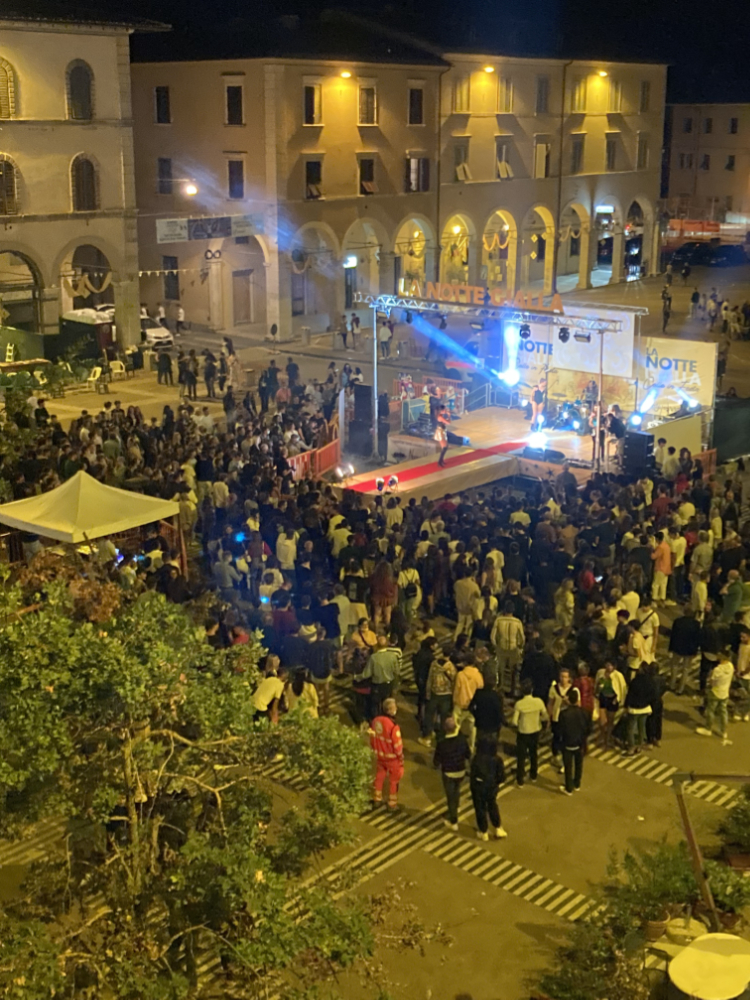
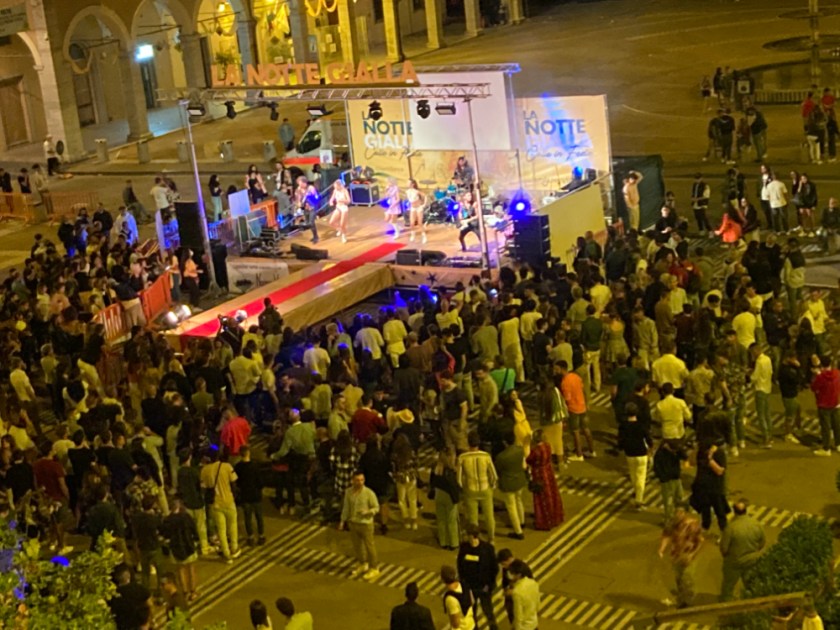
The first Saturday that we were in Colle there happened to be this music festival called La Notte Giallo (no one knew where the name came from). There were performers at several outdoor locations starting at about 4pm. The “headliners” were in Piazza Arnolfo outside our apartment.
Setting up.
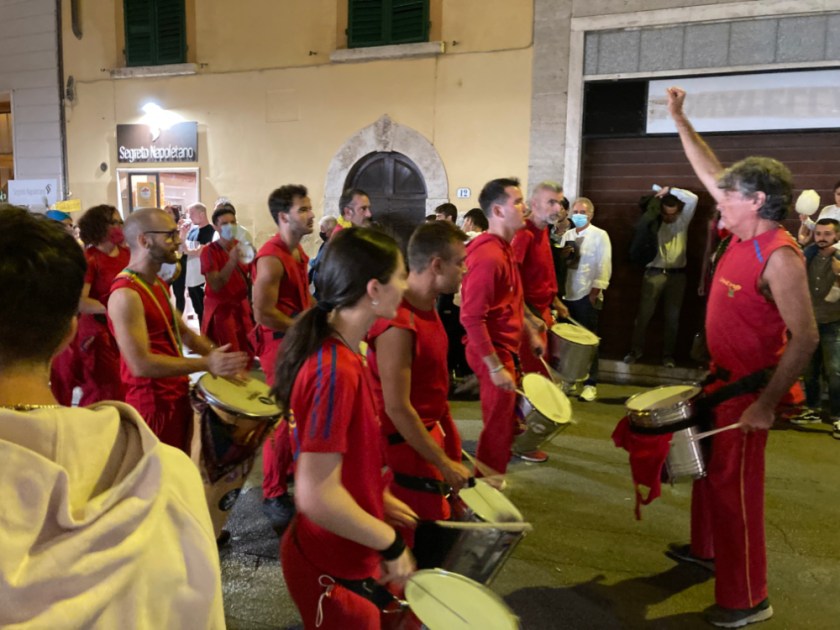
This group paraded around town on their way to the stage.
This guy’s music was as self-indulgent as he appears.
A comedian performed right before the final act,…
a band with 3 women lead singers. They covered songs by Katy Perry, Madonna, Lady Gaga, Brittany Spears, etc. The band took the stage after midnight…
…and went to about 4 in the morning. Were they good? They were LOUD!
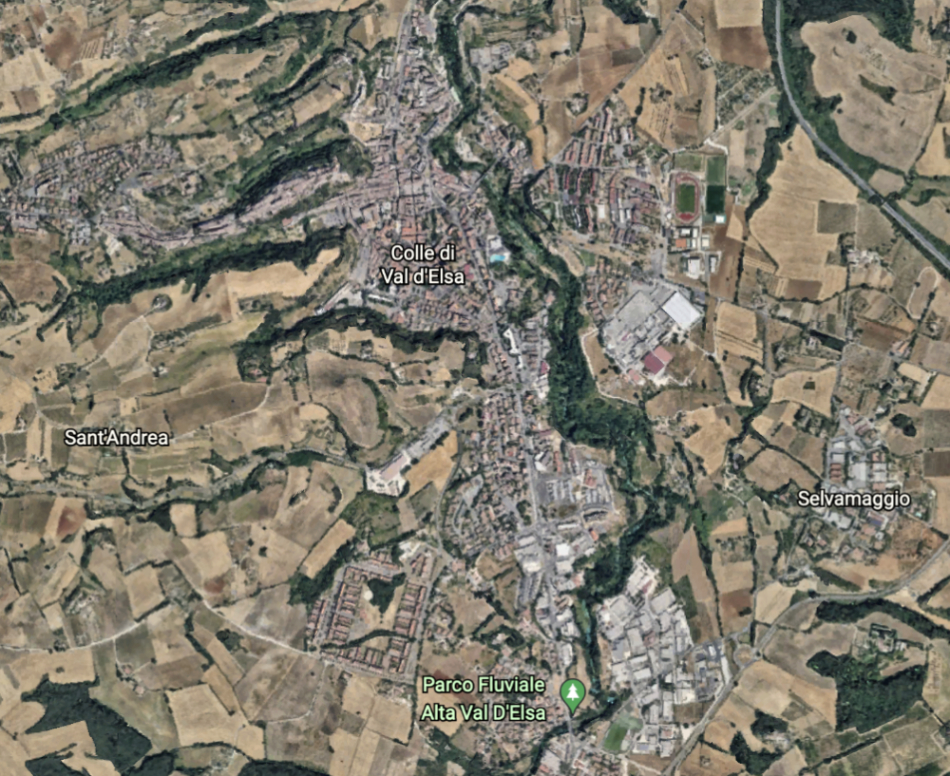
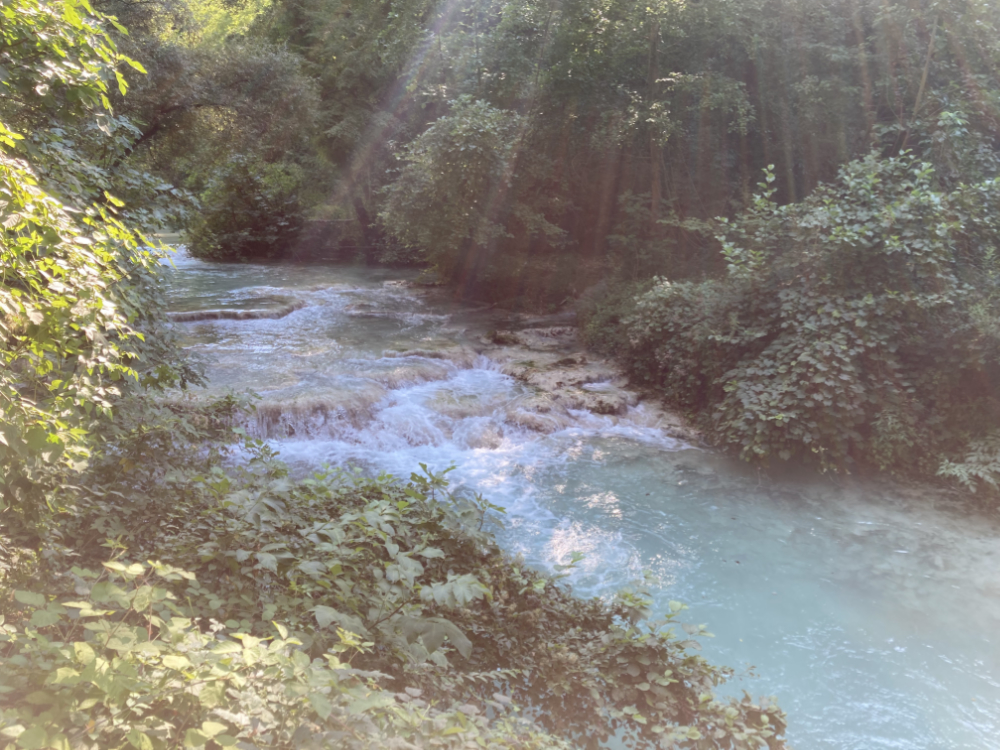
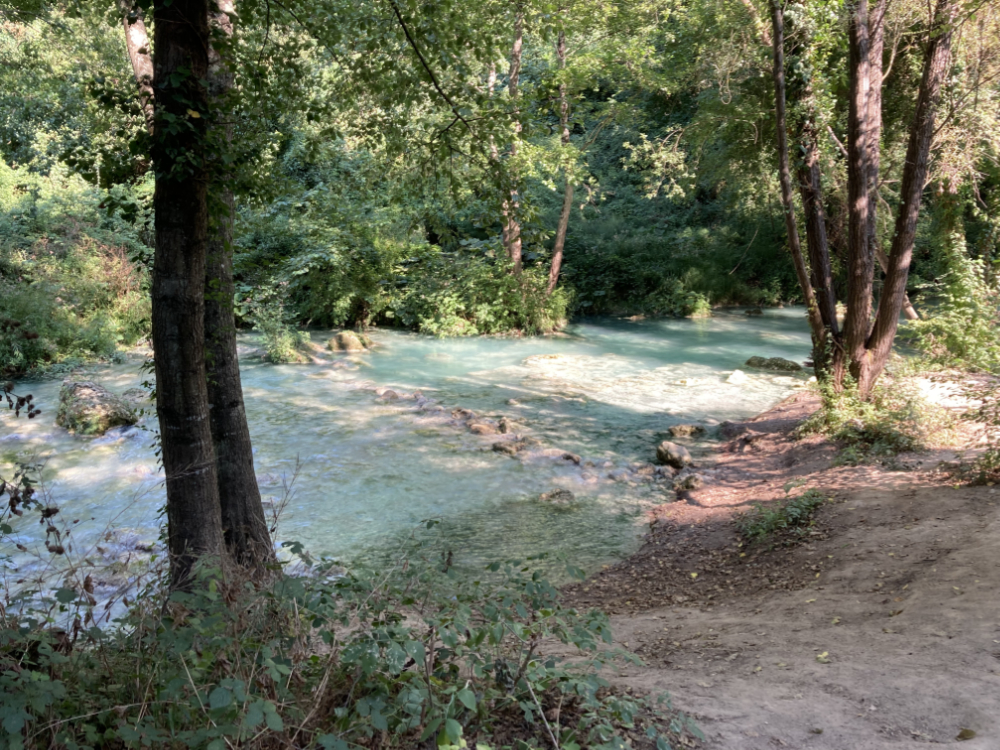
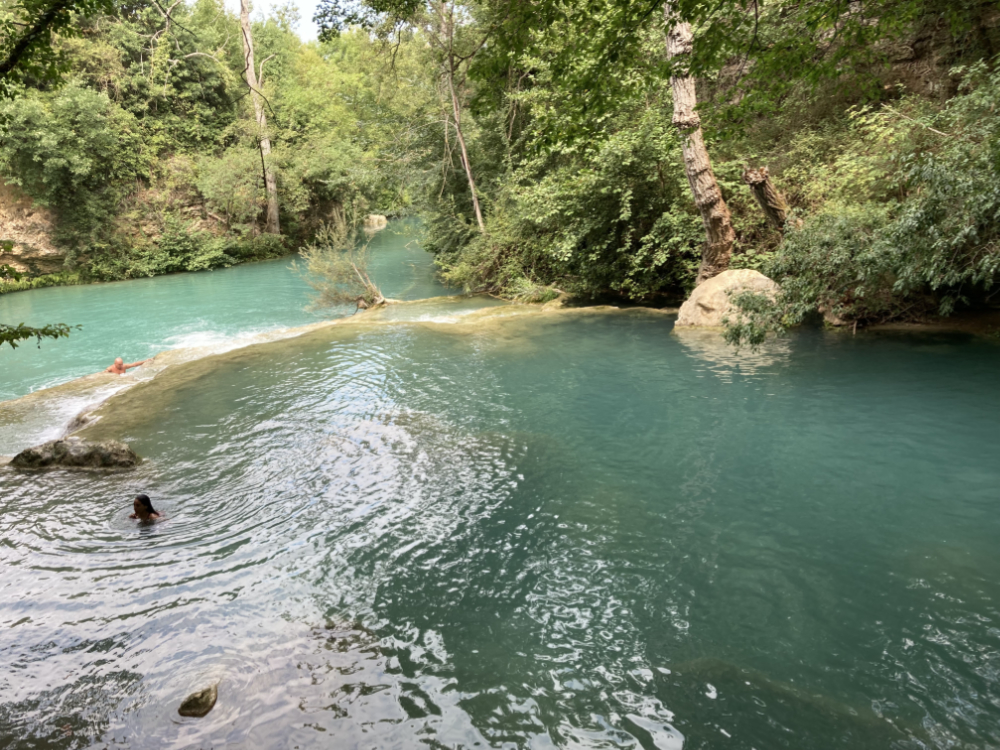
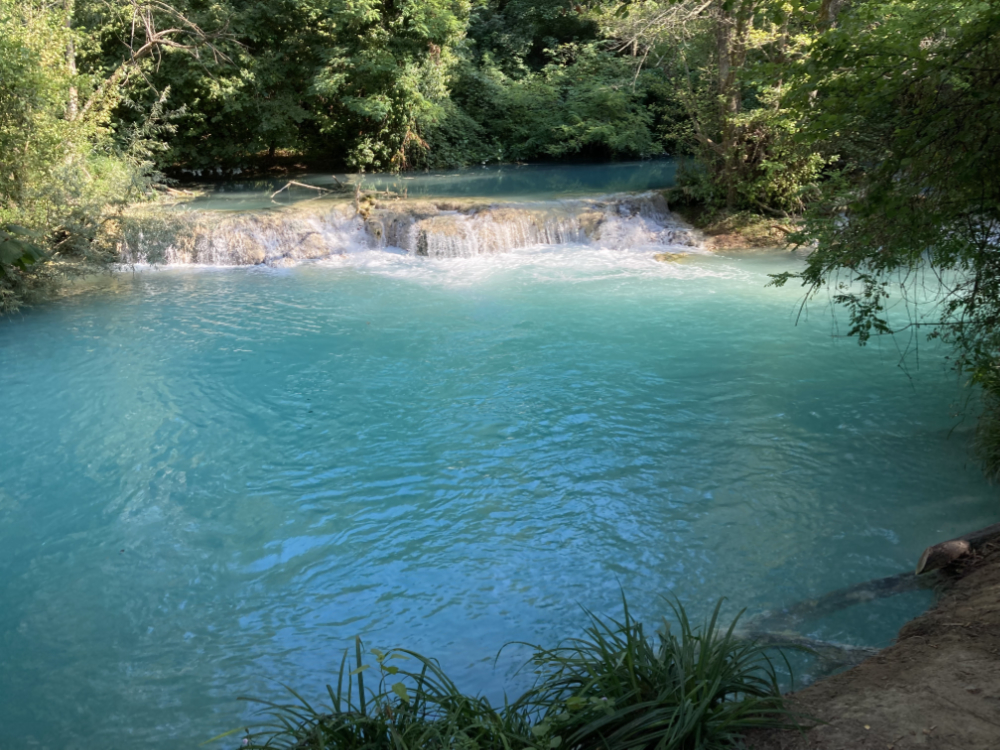
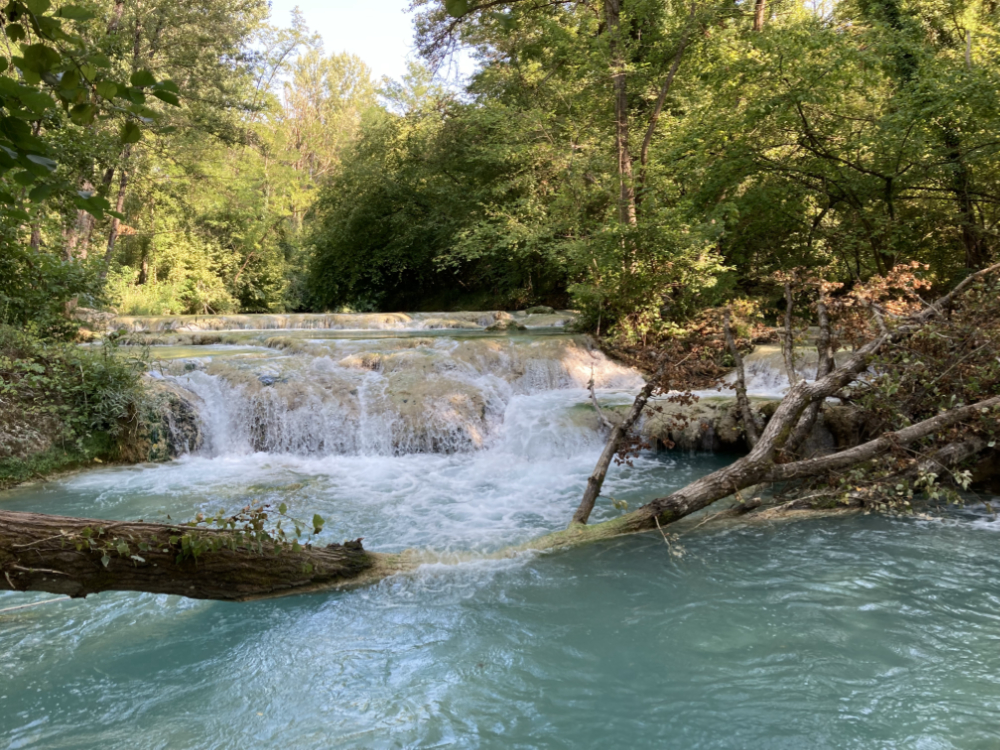
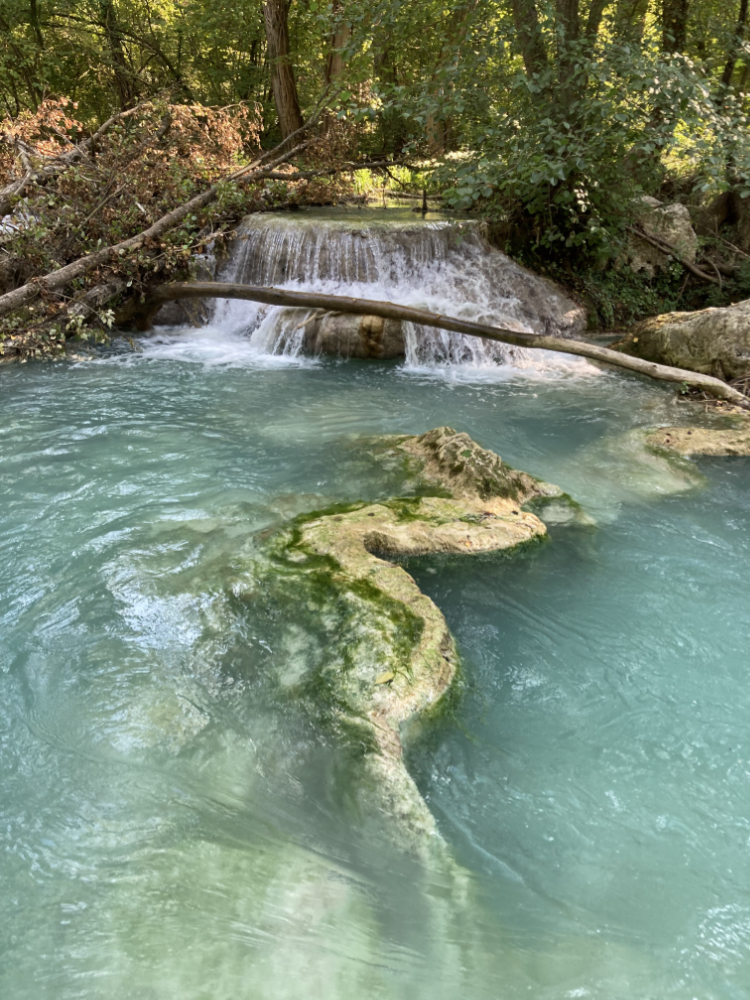
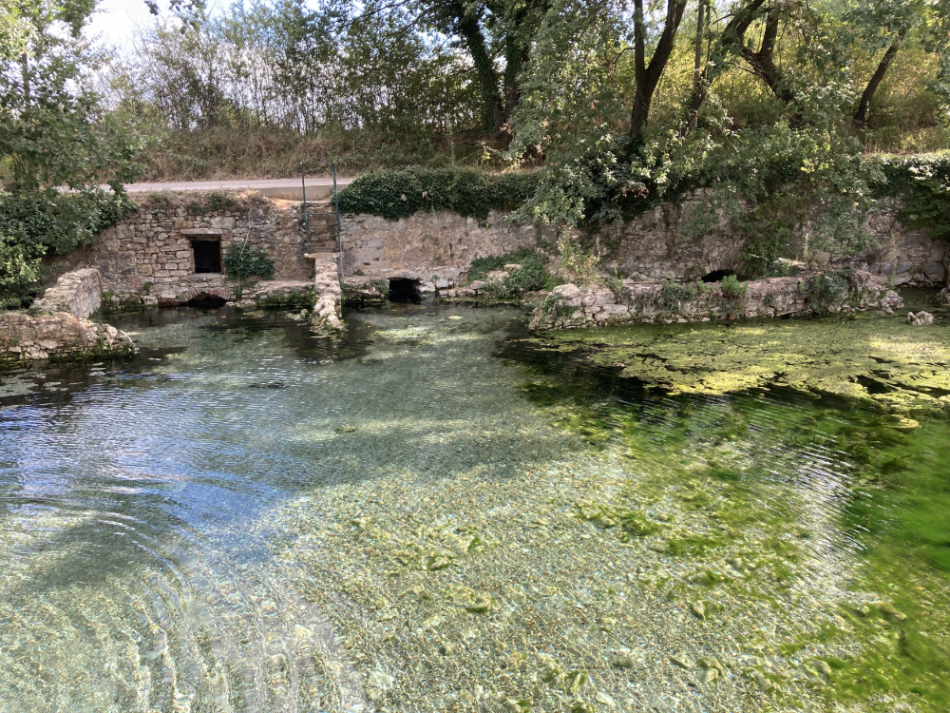
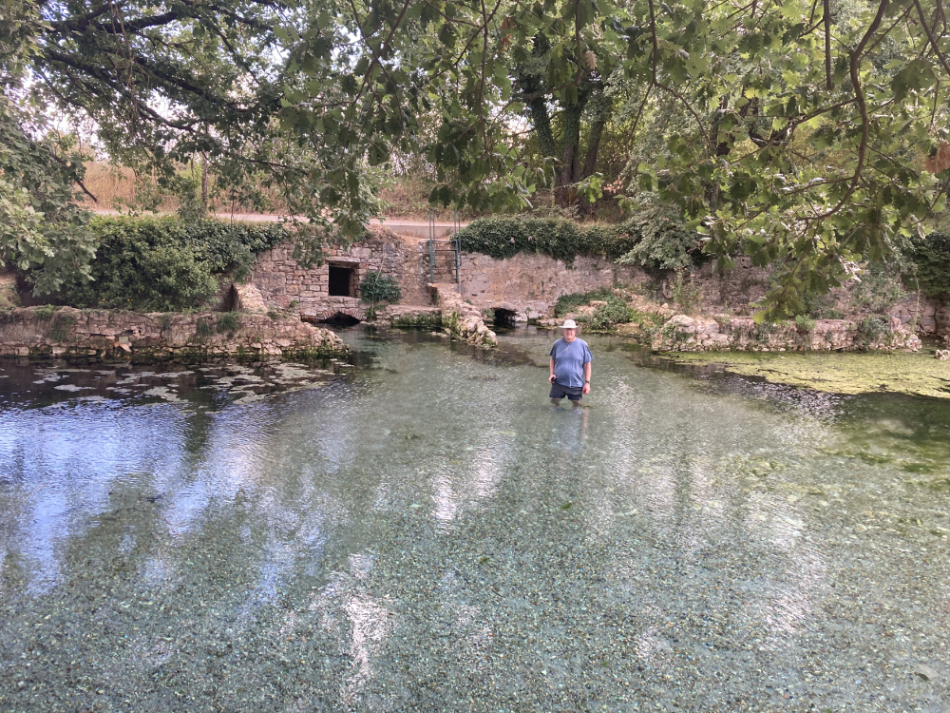
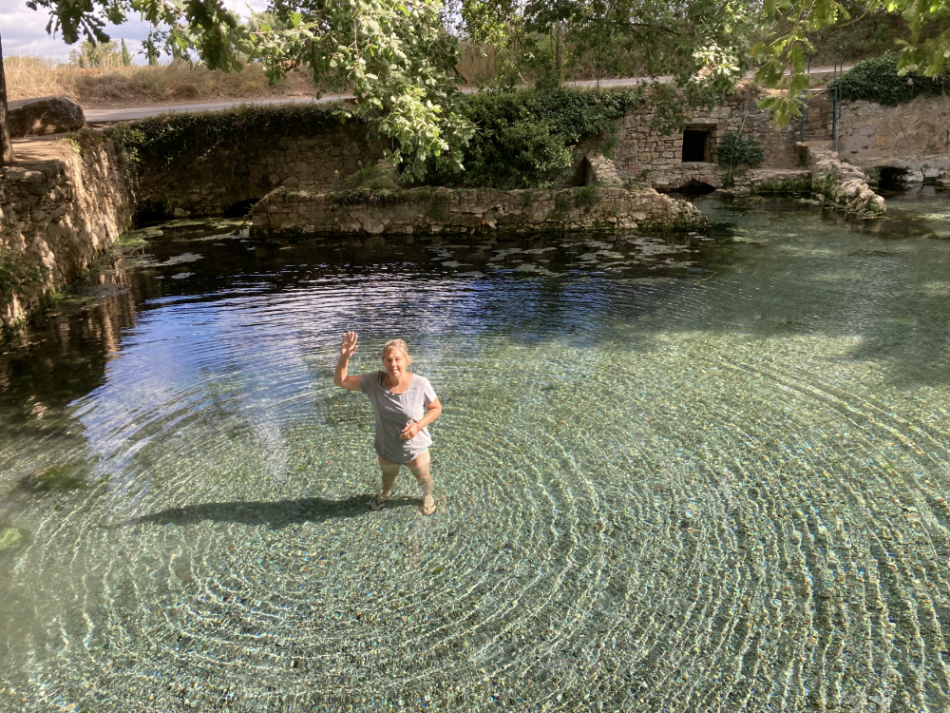
One of our favorite walks is along the Elsa River (about 4 miles round trip). The headwaters of the Elsa are near Siena. From there, it flows north through Colle di Val d’Elsa to the Arno (the river that runs east-west through Florence). The turquoise color of the river is due to the limestone river bed. The river erodes the limestone releasing microscopic crystals of calcium carbonate. These crystals reflect blue and green light creating the unusual color. Actually, satellite images of the ocean can have turquoise patches if there is a bloom of coccolithophorids, which have calcium carbonate in their cell walls…that’s probably enough of that.
The Elsa is the green strip running up through the middle of the image.
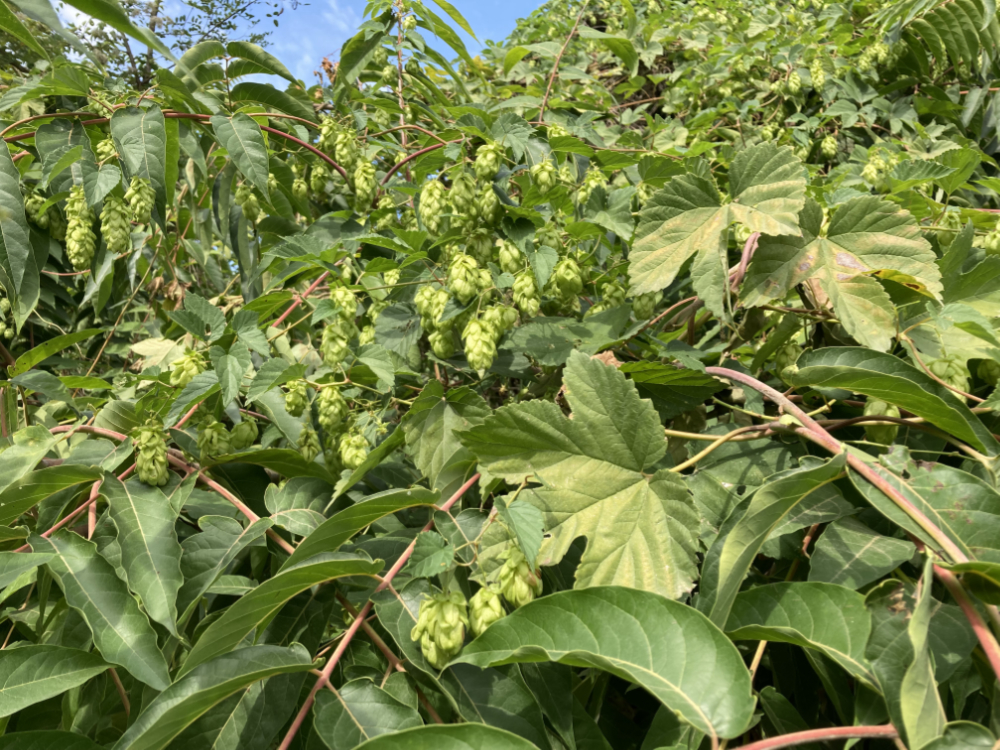
The light green “cones” are from a wild hops plant. It’s a vine growing through something else. The three-lobbed leaves on the left are the hops leaves.
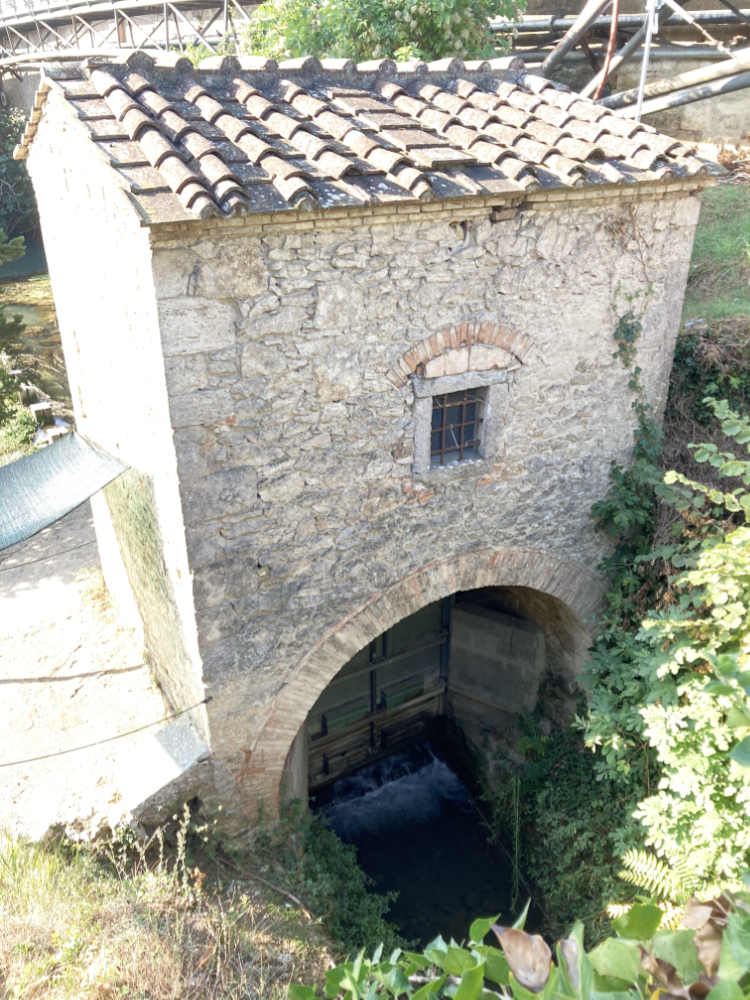
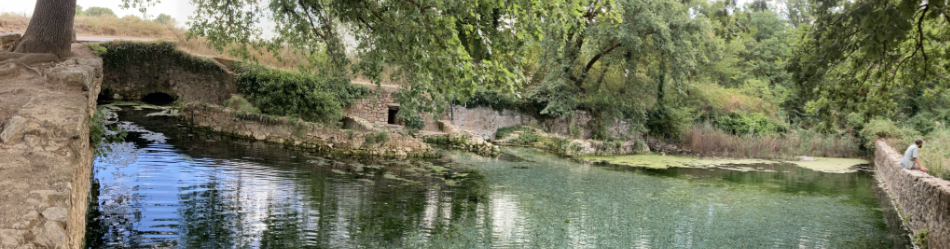
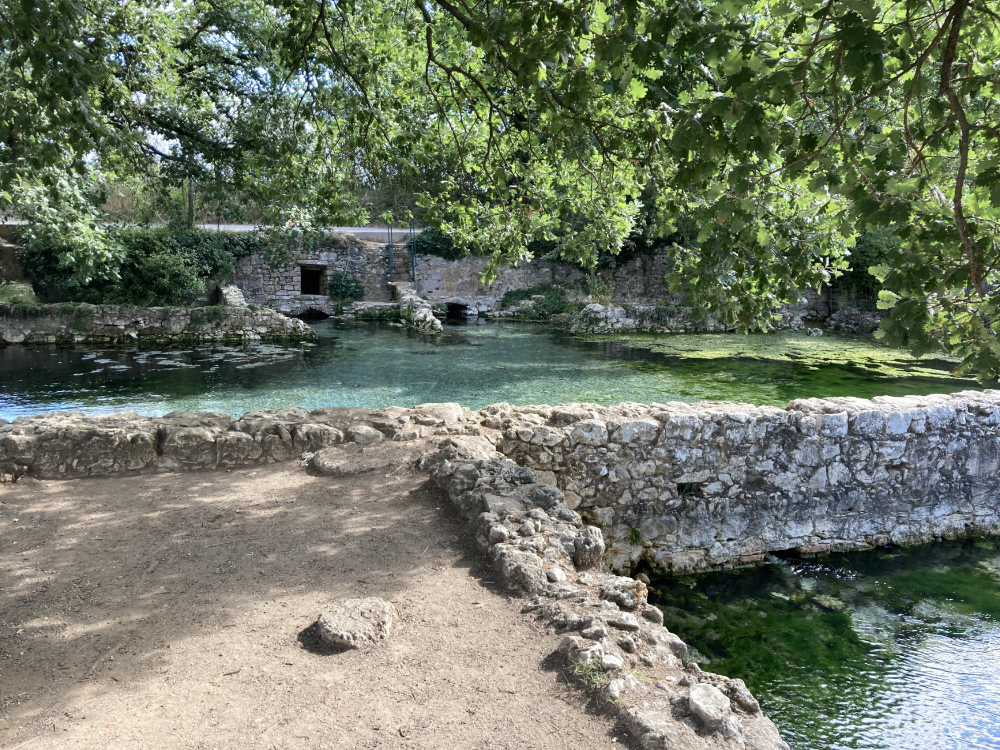
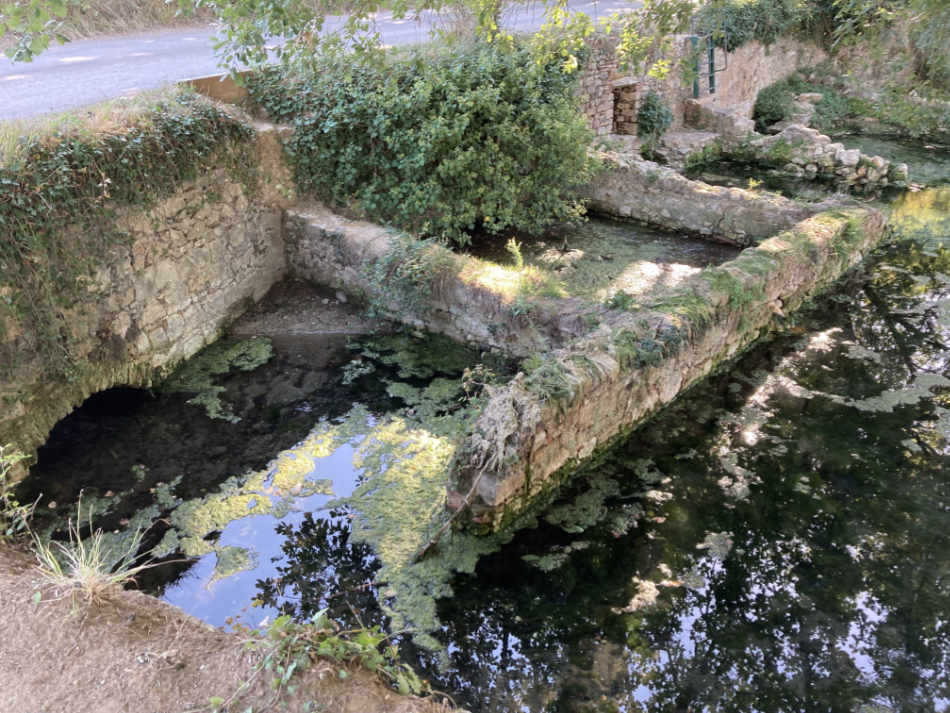
The Elsa has cut a bit of a canyon so the river is well below the level of the town. In the Middle Ages, they went upstream and dug a canal to bring water in at the level of the city. This is the gatehouse to regulate flow into the canal.
A brief history of Siena. As with many Tuscan towns and cities, Siena began as an Etruscan city (8th Century B.C.) and then became a Roman city. It’s primarily know today, however, for it’s “golden age” during the end of the Middle Ages into the Renaissance. It was a center for banking and had it’s own distinctive Sienese school of painting. During this time, it was in competition with Florence which often manifested in warfare. Eventually, Florence came out on top. The arrival of the Black Death (bubonic plague) in 1348 was the beginning of the end of Siena’s prominence in Italian affairs.
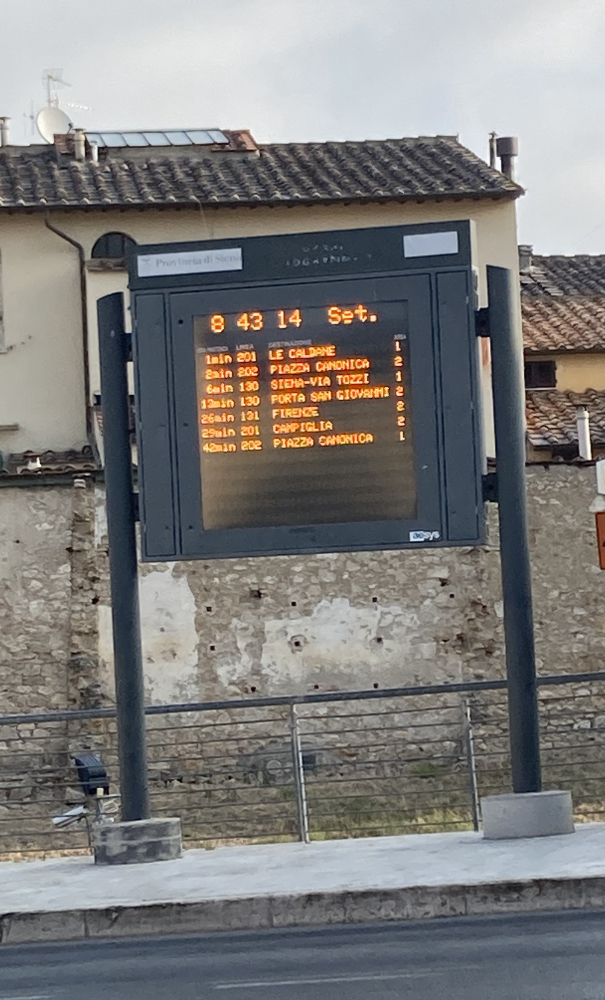
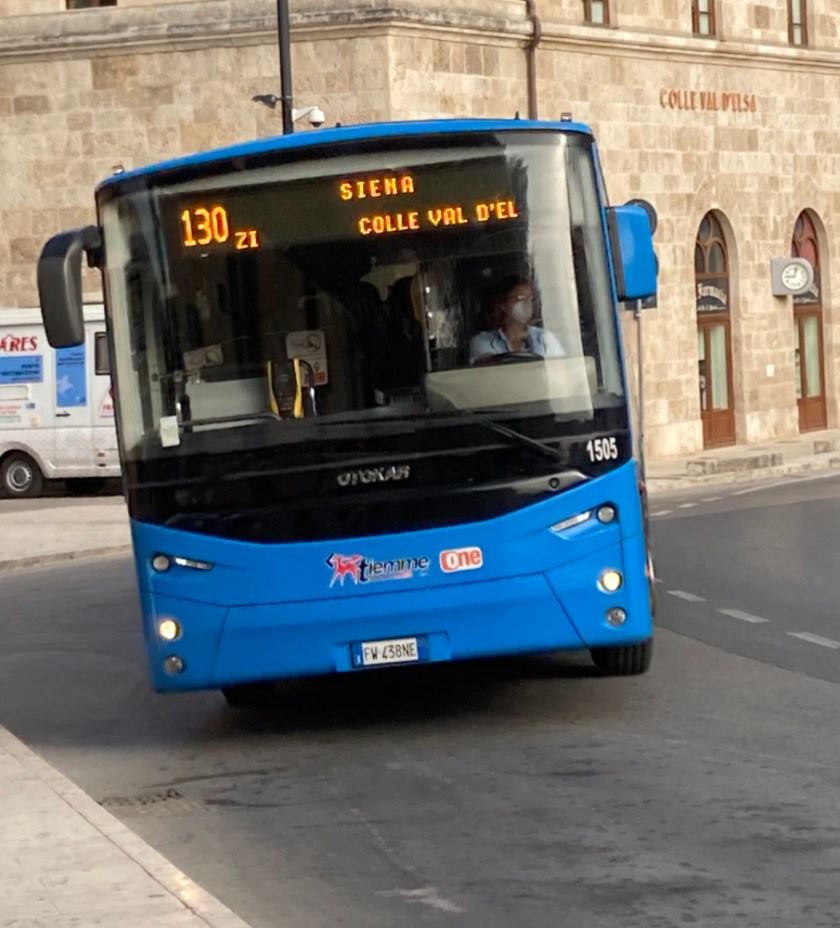
We’re learning the bus system. Looks like the 130 is on time.
Let’s go to Siena.
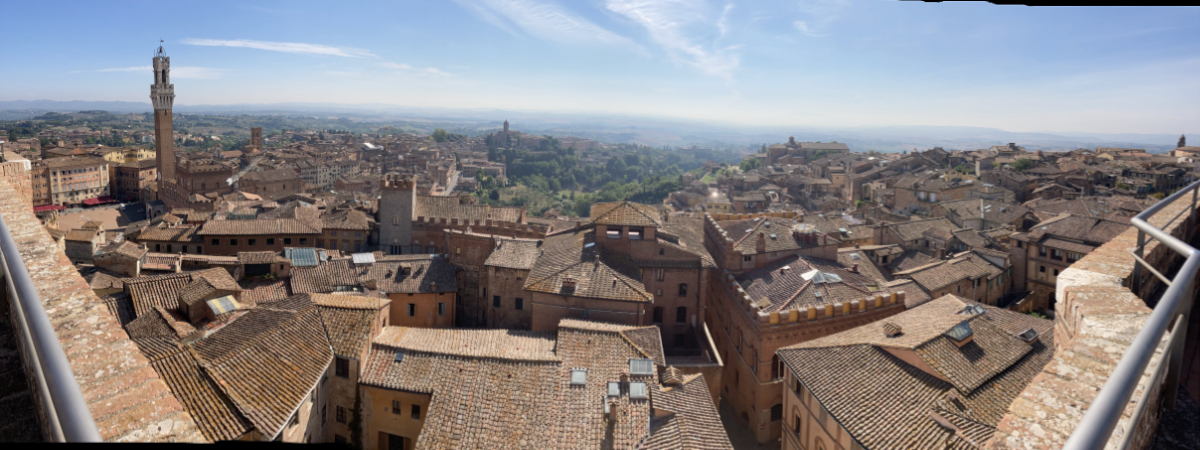
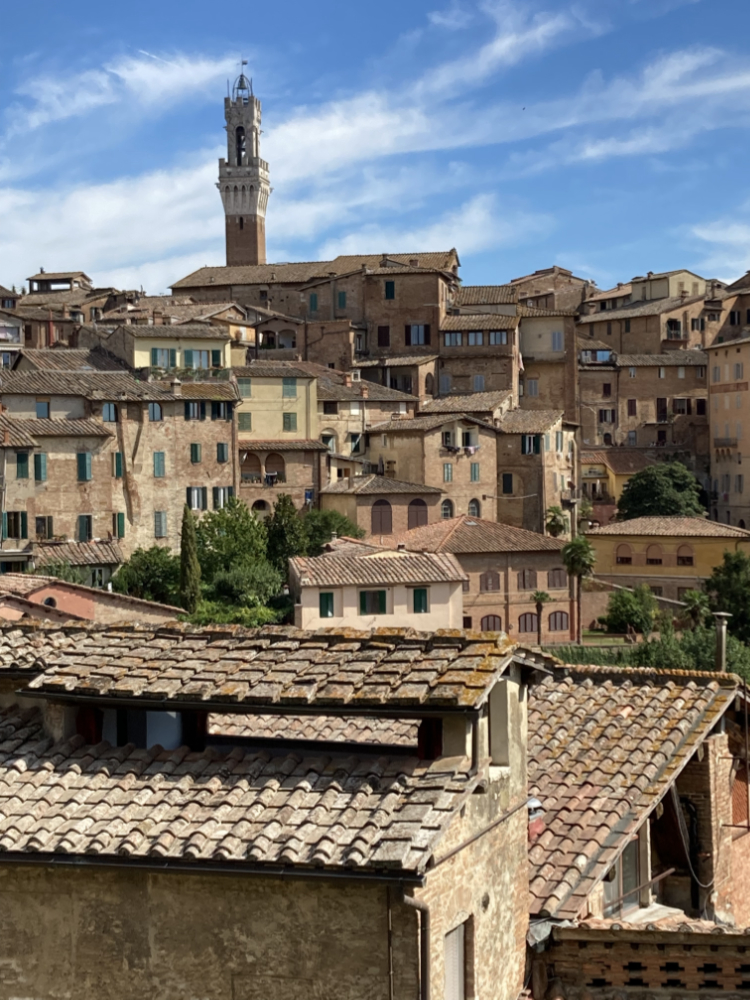
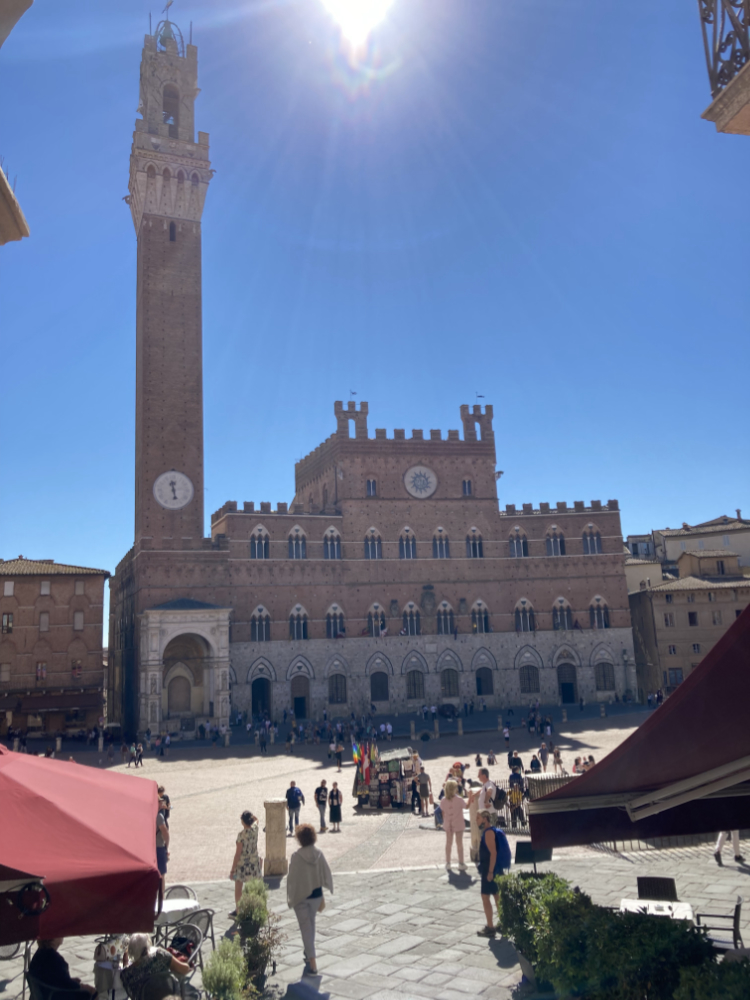
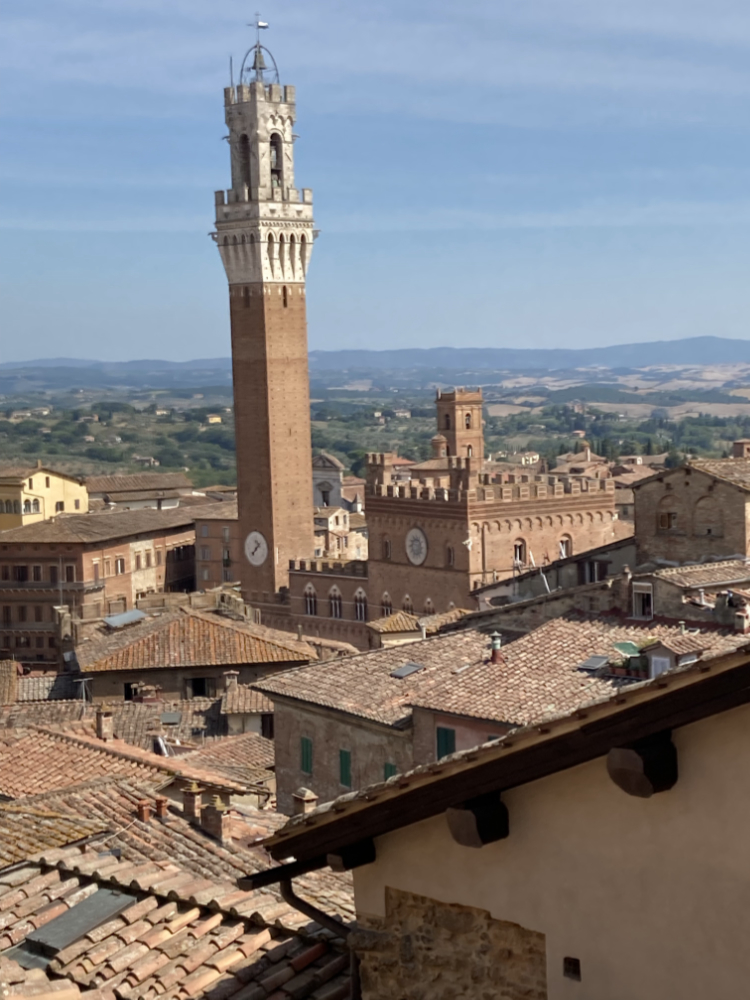
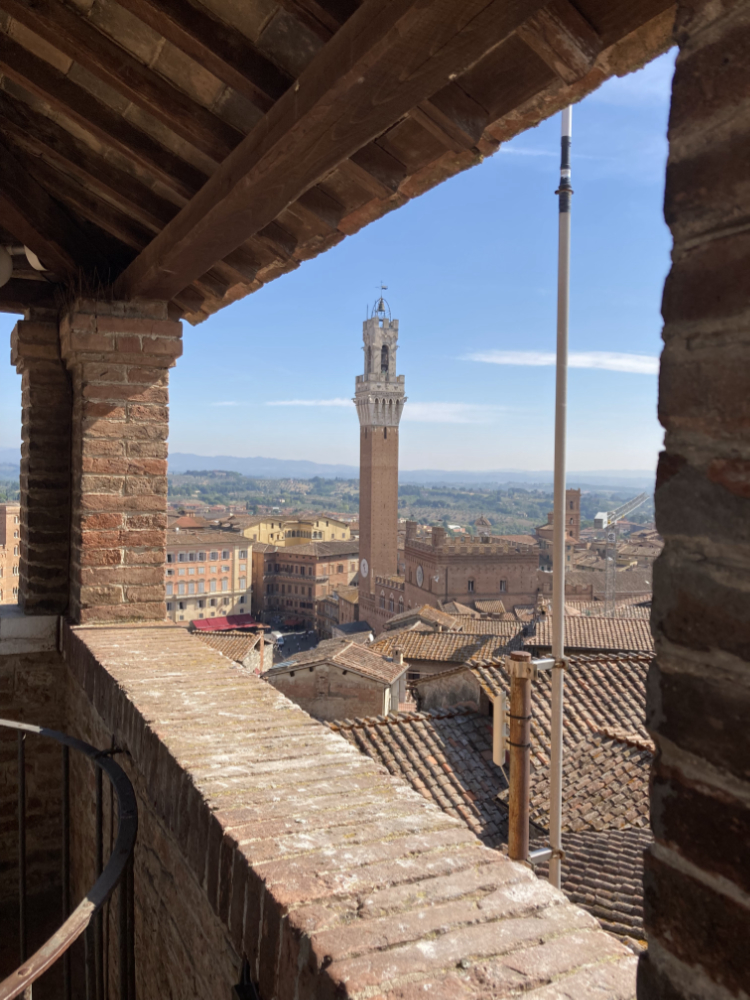
Palazzo Pubblico Tower.
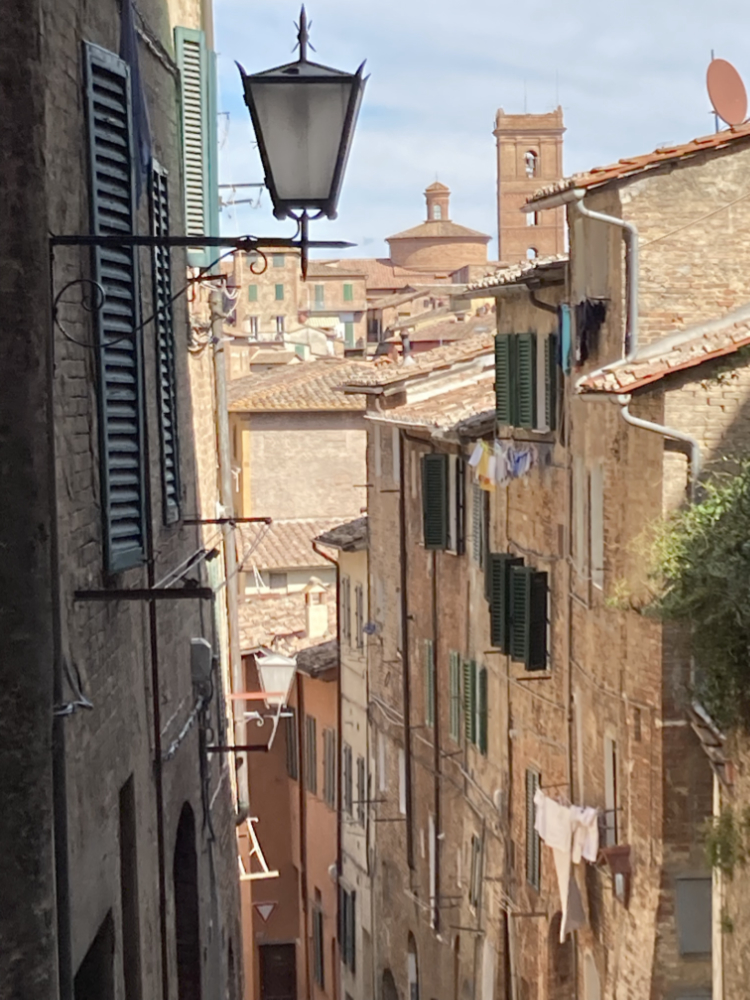
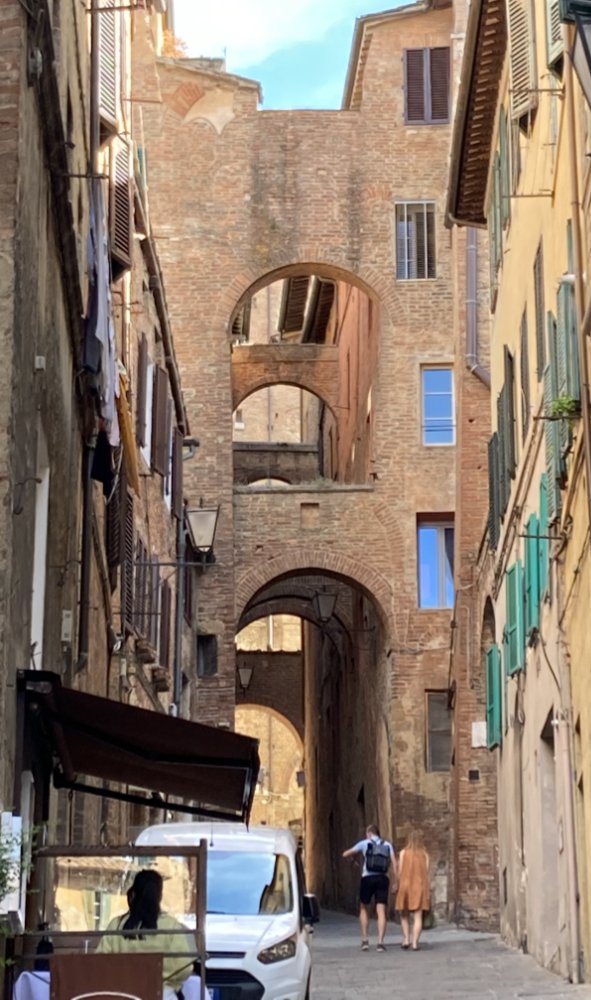
Street scene.
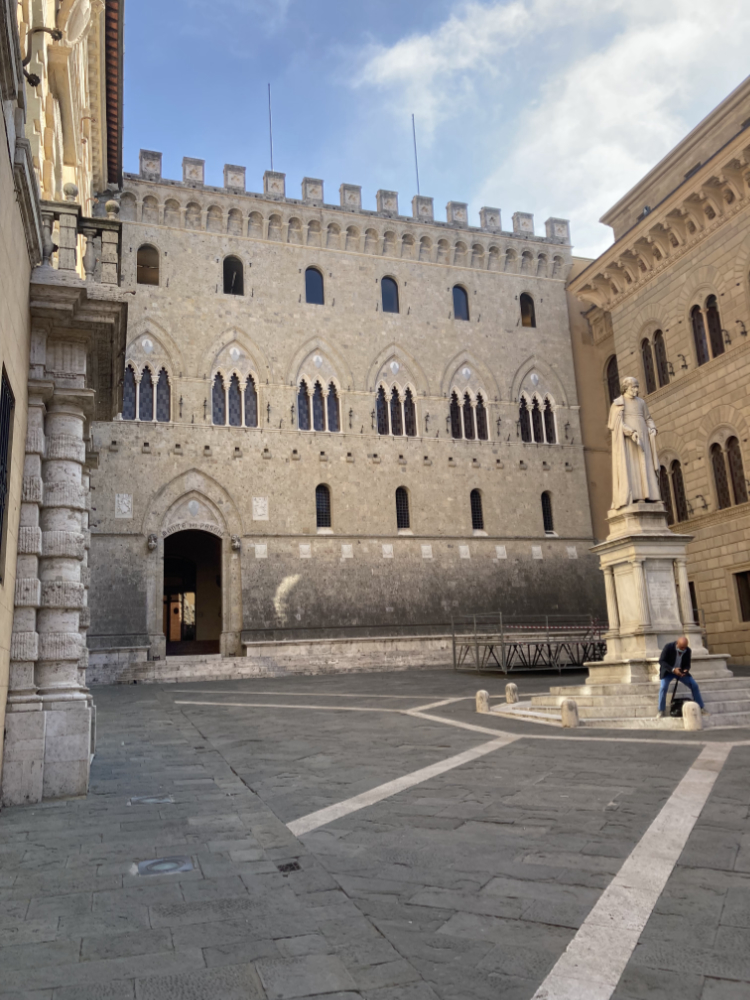
Banca Monte dei Paschi di Siena. Founded in 1472, it’s the oldest bank in the world; NYT says it may not be around too much longer- too many bad loans.
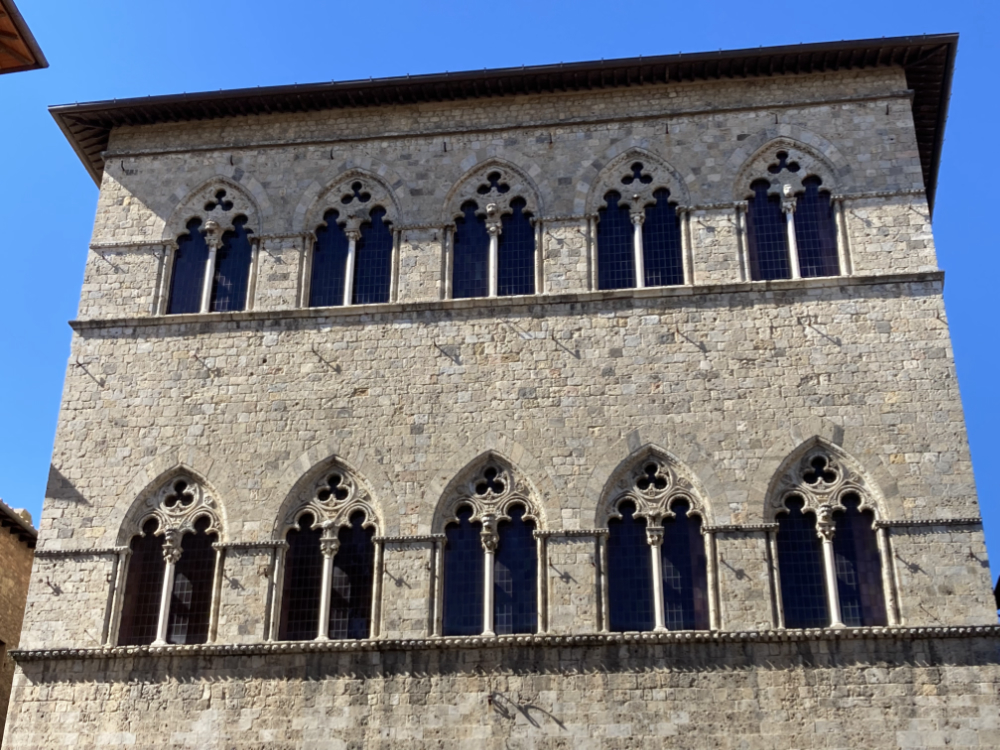
We were told these are classic Sienese renaissance windows- one arch over two windows.
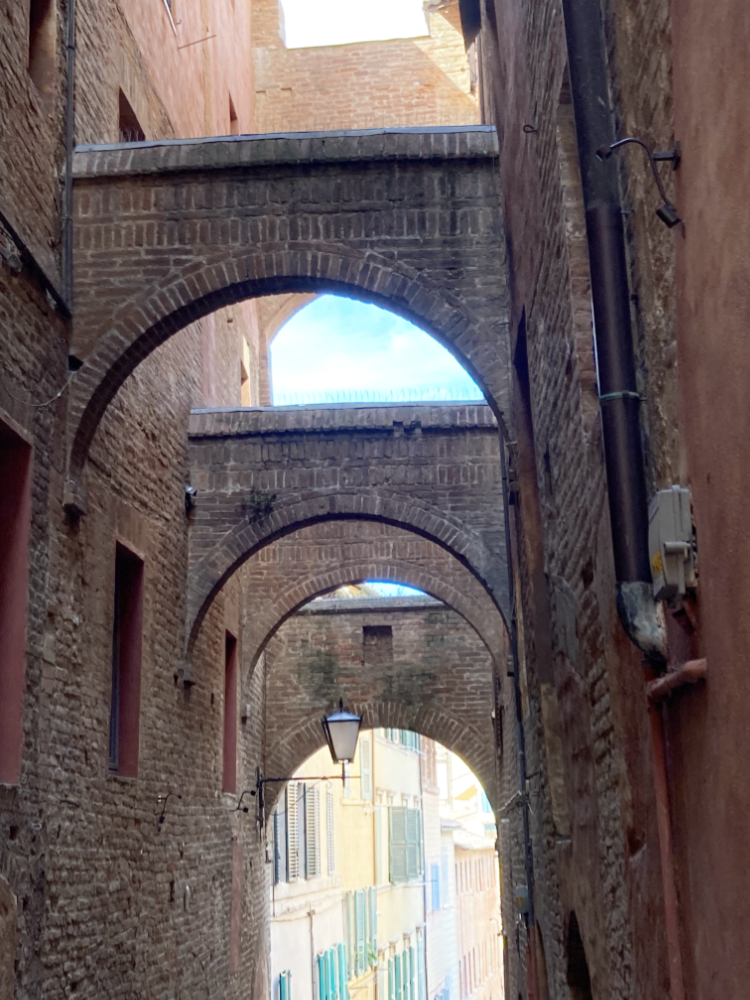
As the buildings got taller, they needed these arches to keep the buildings’ upper floors from leaning into each other.
One of the great things about Italy are the public fountains. That little boy and his turtle are saving lives dispensing potable water when the temperature is in the 90’s.
Palazzo Pubblico and Piazza del Campo.
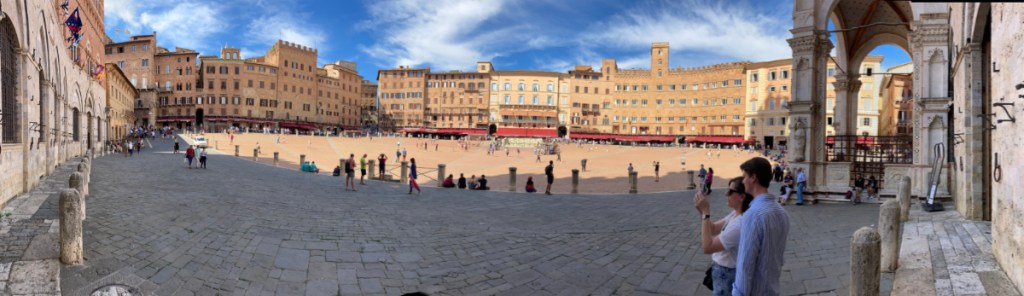
Piazza del Campo- Site of Roman forum. This is where they hold the Palio, a horserace with each horse sponsored by a Siena neighborhood (https://en.wikipedia.org/wiki/Palio_di_Siena)
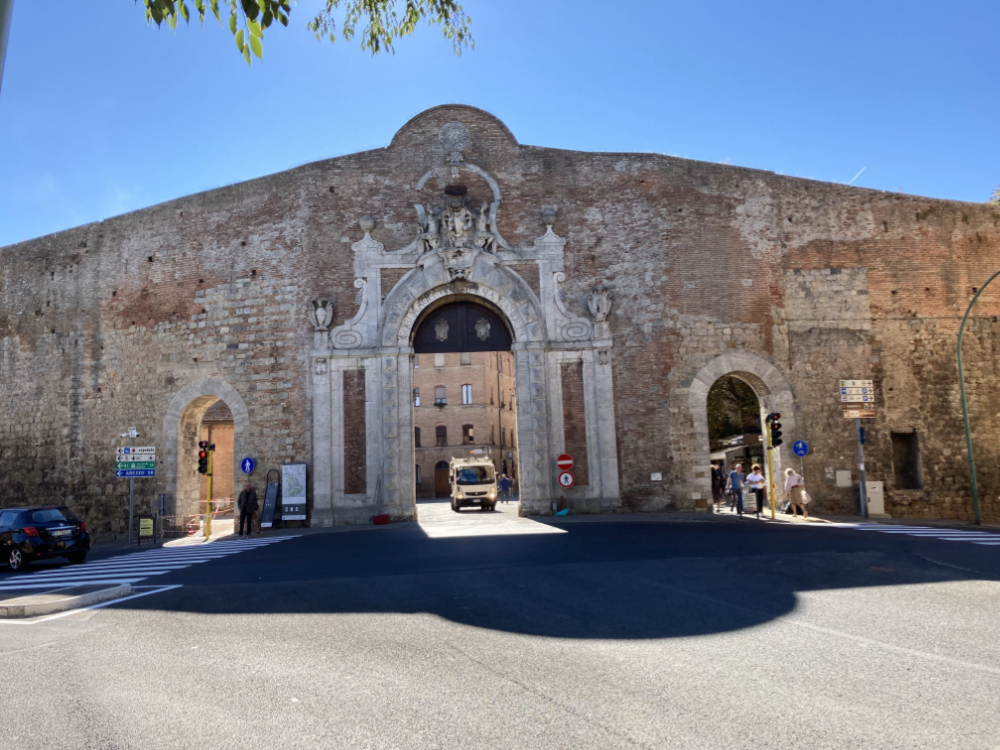
Porta Camollia- one of the gates in the wall around Midieval Siena
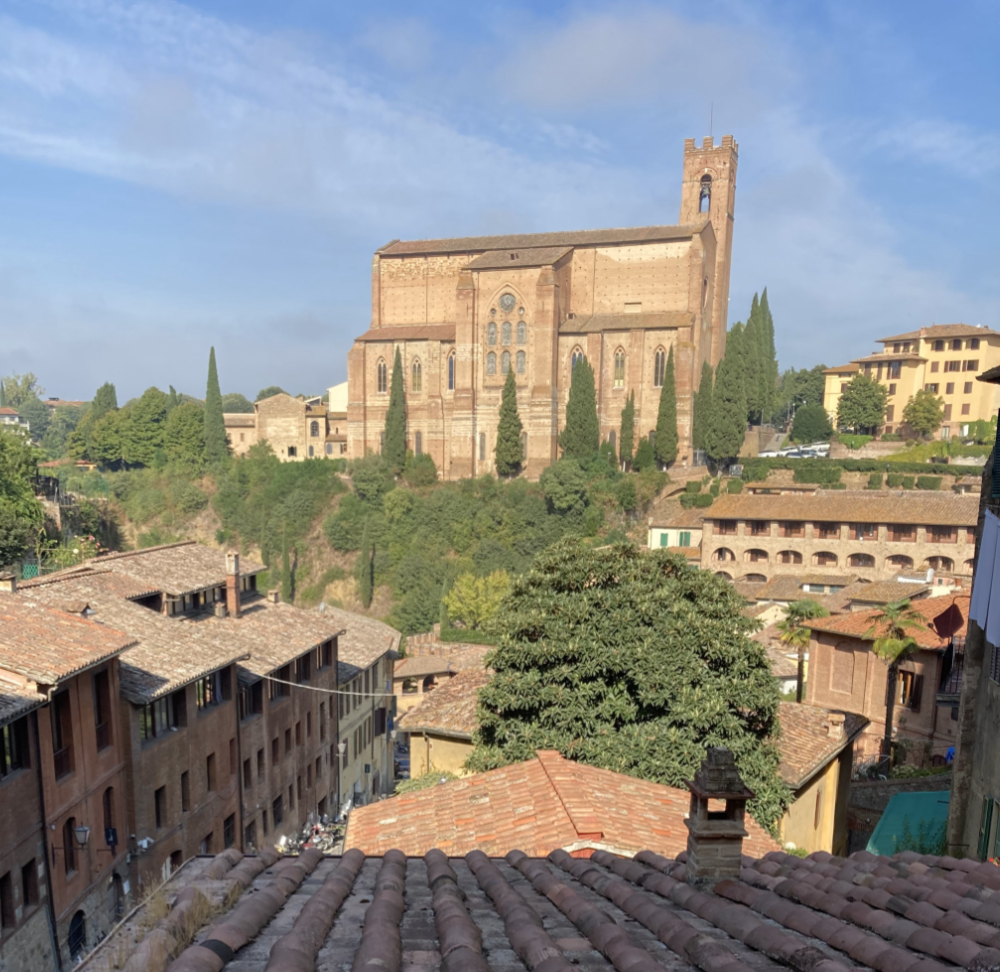
Basilica Dominca (also known as Basilica Cateriniana- a chapel inside contains the head and finger of St. Catherine (a little more on this in the next post).
Palazzo Pubblico (public palace or city hall).
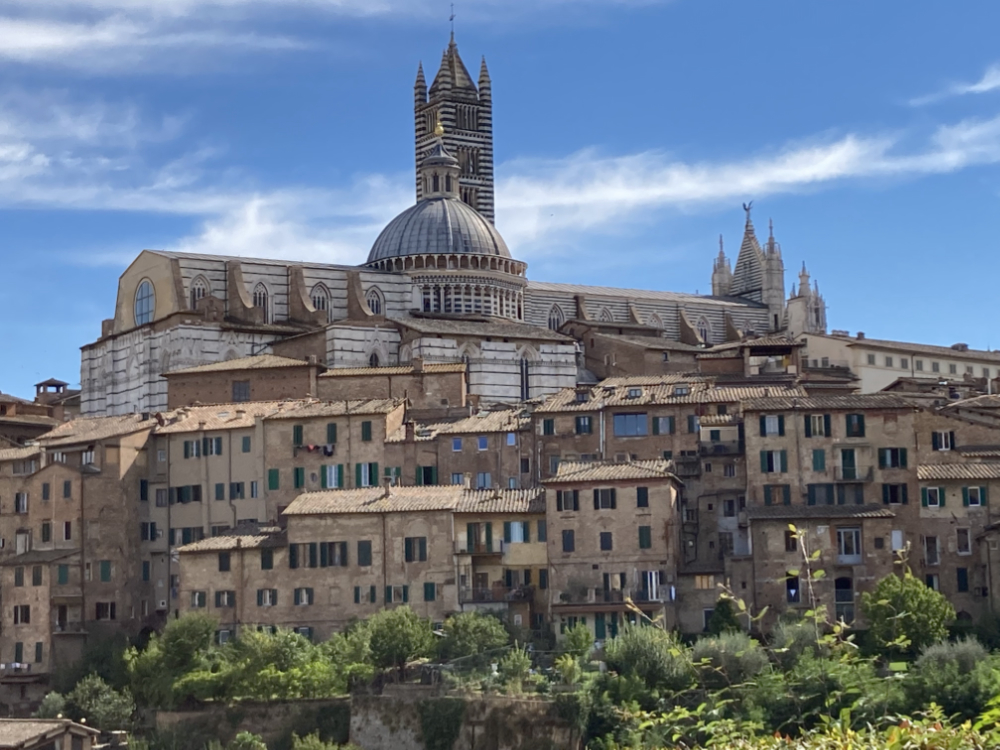
The Duomodi Siena (cathedral).
The Duomo di Siena is huge. It was built between the mid 1200’s and early 1300’s.
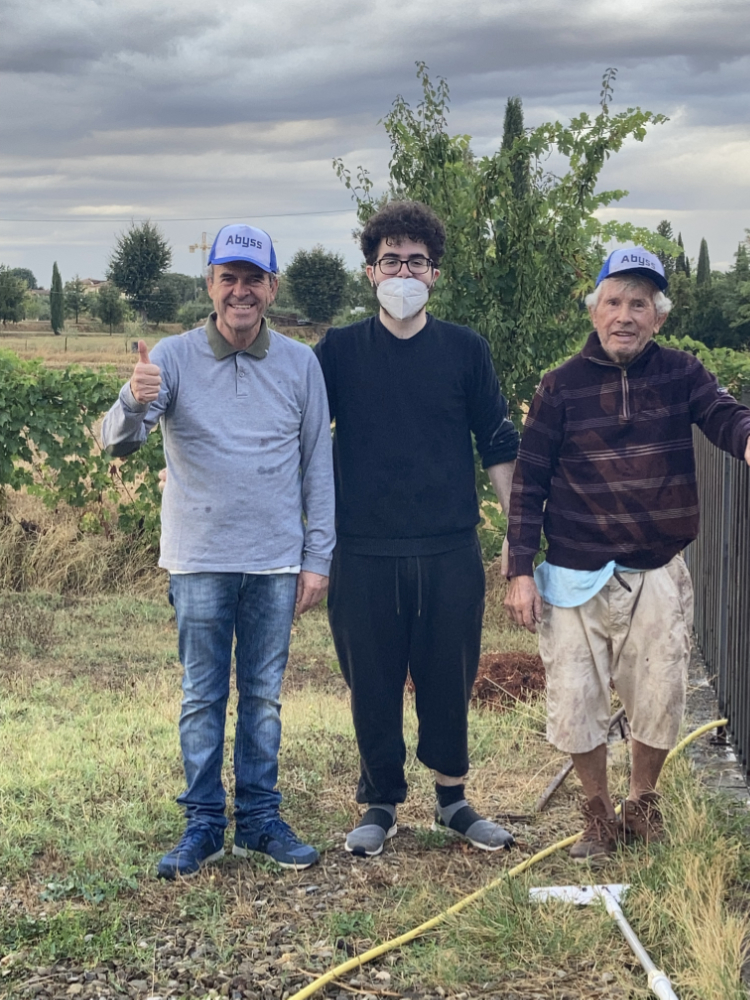
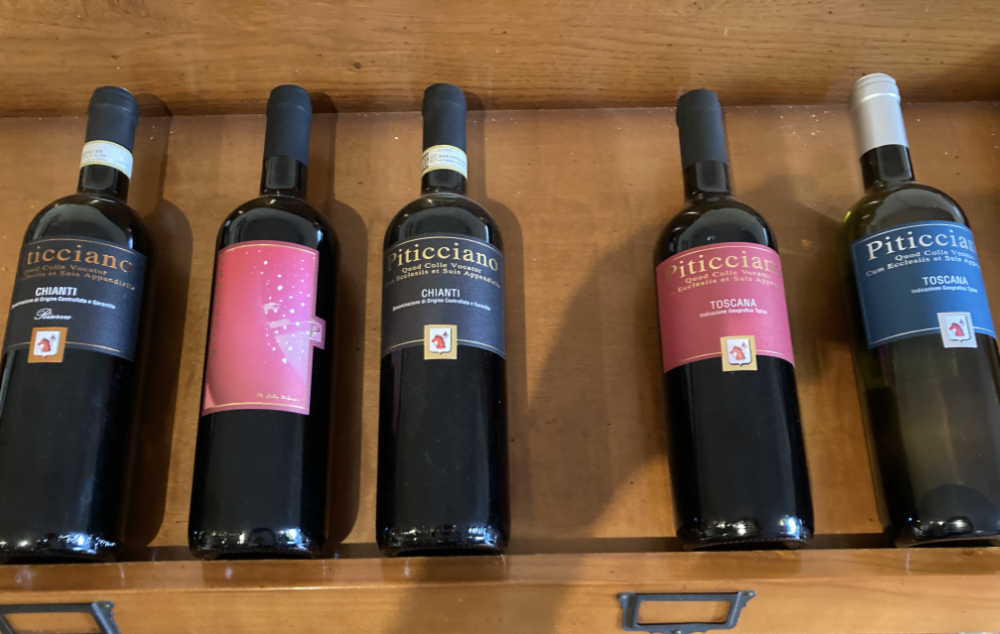
Wineries in Italy do not necessarily have showcase facilities with fancy tasting rooms. In fact, judging by Google Maps, they can be kind pretty far off the beaten track and hard to find. I guess this is because, in the USA, wineries are a relatively new thing and they had to recruit to create a market for wine. Italians, on the other hand have been drinking wine for over 4,000 years. So, a market for wine is already baked into the culture. After lots of Google searching, we found there is a winery about 2 miles from our apartment. It’s called Piticciano (pronounced petey-chi-ano). We walk out there, find a young man (old boy?) working and ask him if there’s tasting. He says sure, what do you want to taste. We say chianti. He says ok, pulls a bottle off the rack, opens it, and pours a couple of glasses. We taste it; it’s pretty good. Then we just look at each other for a few seconds. Susan and I begin to realize that he’s not going grab another bottle and give us his spiel on Piticciano wines. We then ask a bunch of questions and, fortunately, his English is good enough for us to get the gist of the Piticciano story. His name is Nico. His dad is Fabio. The property is Nico’s grandfather’s. 20 years ago, Fabio built some houses on the property, sold them, and used the proceeds to start Piticciano. The vineyards are certified organic and dry farmed. His flagship wine is a classic chianti which means the primary grape variety is Sangiovese. He blends in a small percentage of Colorino and Canaialo grapes. He also makes a white (Toscano Bianco) from a mix of Trebbiano and Malvasia grapes. The chianti sells for about 10 euro (~$12) and the white for 8 euro. We bought a 2015 Chianti and a 2019 Bianco. In our opinion, these were very much bargains.
Fabio, Nico, Grandpa
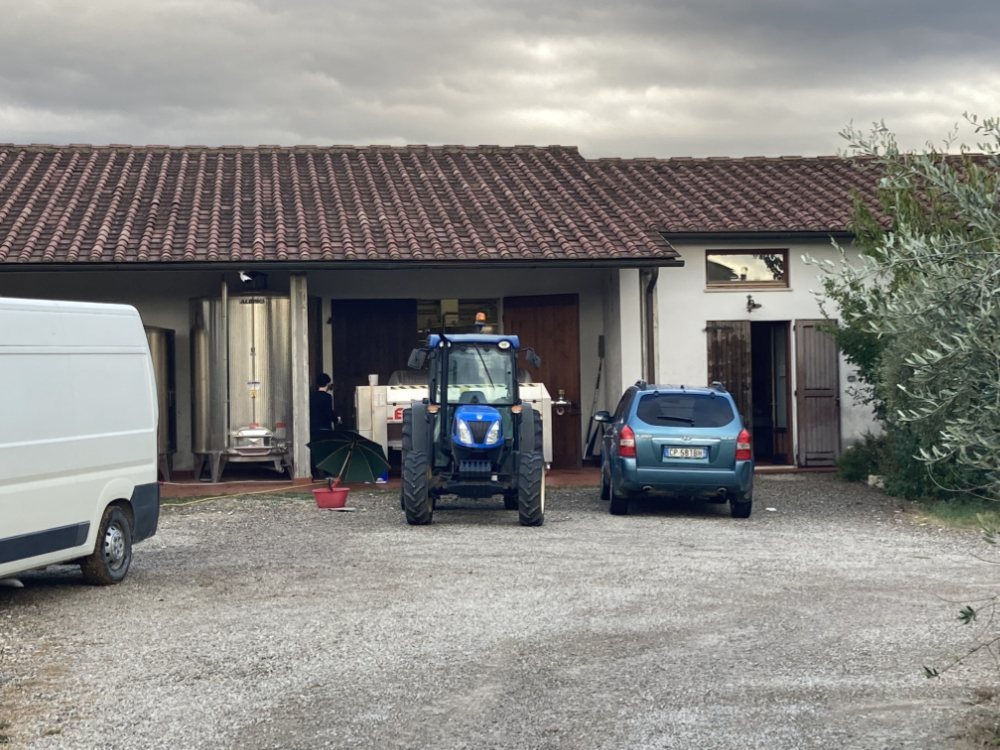
The winery, “tasting room” through the door behind the blue car.
Piticciano wines.
We walk out there again about a week later to procure more wine. Nico comes into the tasting room and says, “Oh, you guys. I saw a couple of people walking up, didn’t recognize you, and thought that’s unusual. Visited by hikers twice in one week.”
The Etruscan Civilization arose in the area we now call Tuscany a few hundred years before the Roman Empire (https://www.worldhistory.org/Etruscan_Civilization/). About 3 miles from our apartment, there’s an old thermal bath built by the Etruscans. It’s called Le Caldane (pronounced la cal-donnie). The bath is no longer “thermal,” although you do see a few streams of bubbles emerging from the bottom. I guess it’s not a big enough site to warrant protection and preservation. At least one website reports that the baths were destroyed by Sienese troops in 1260 and rebuilt in 1400. I am going with the story that we were in a bath built at least 2,500 years ago- no wonder the hot water is no longer running.
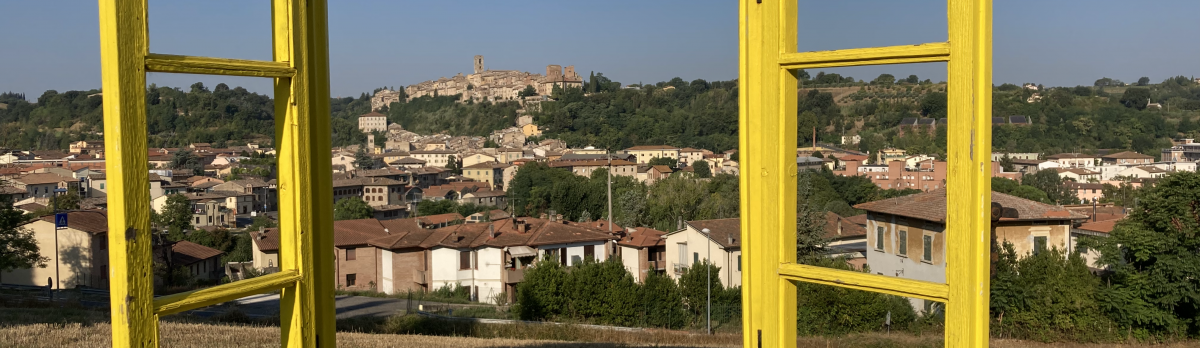
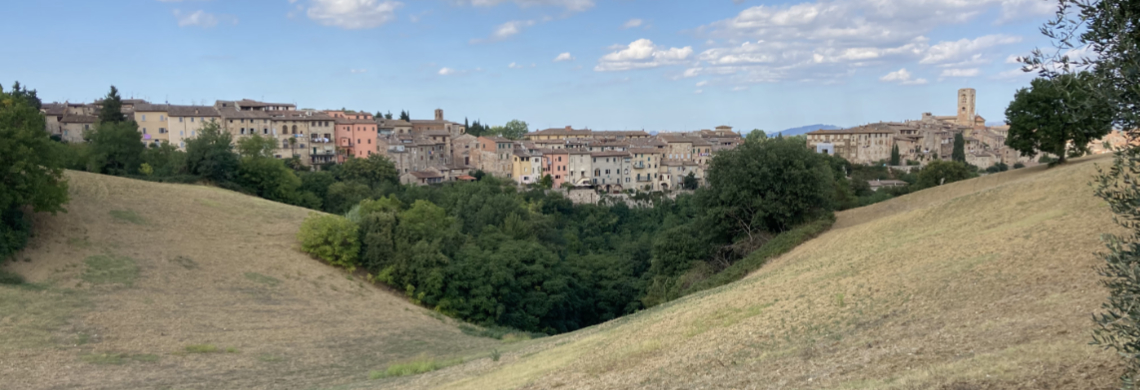
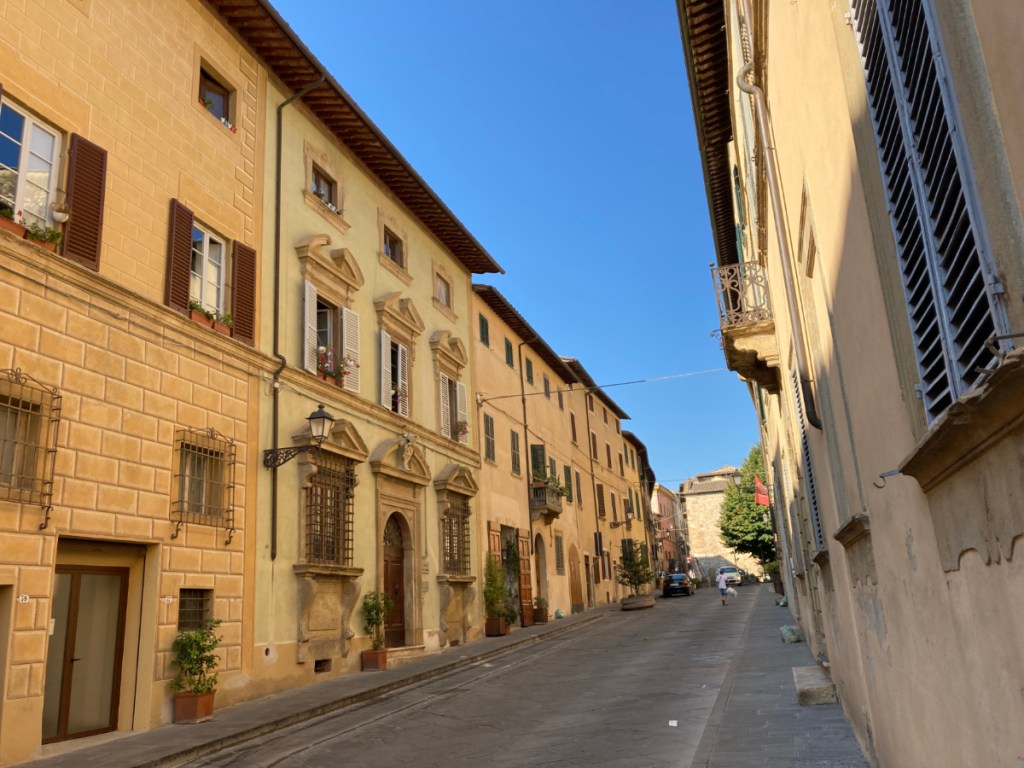
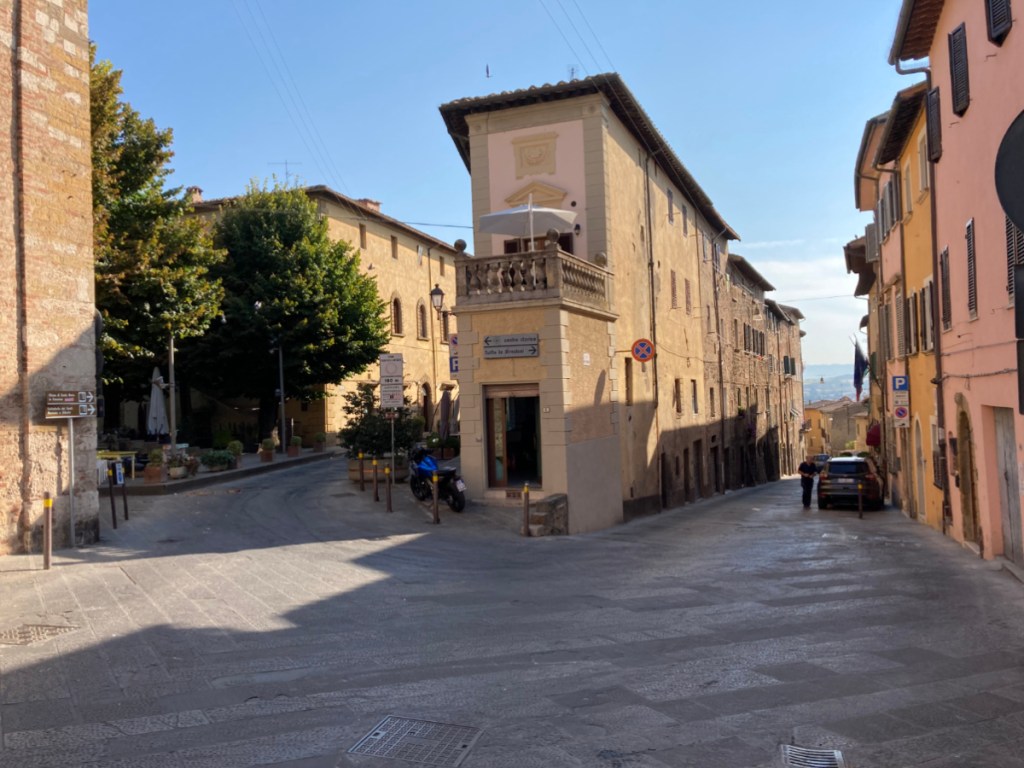
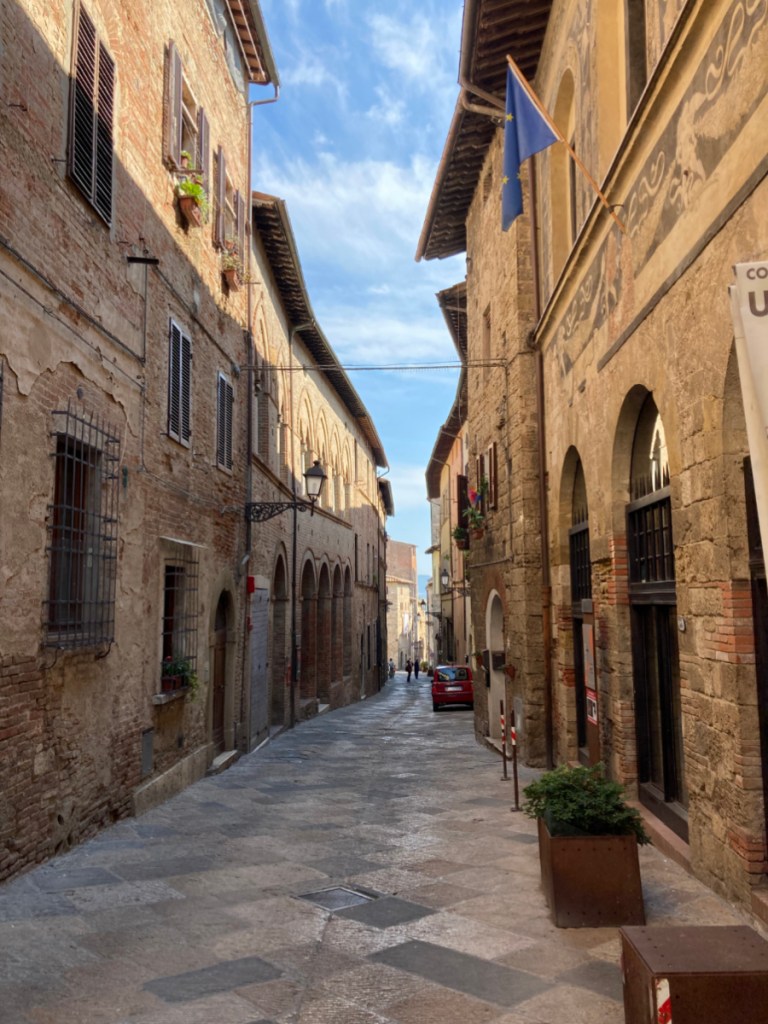
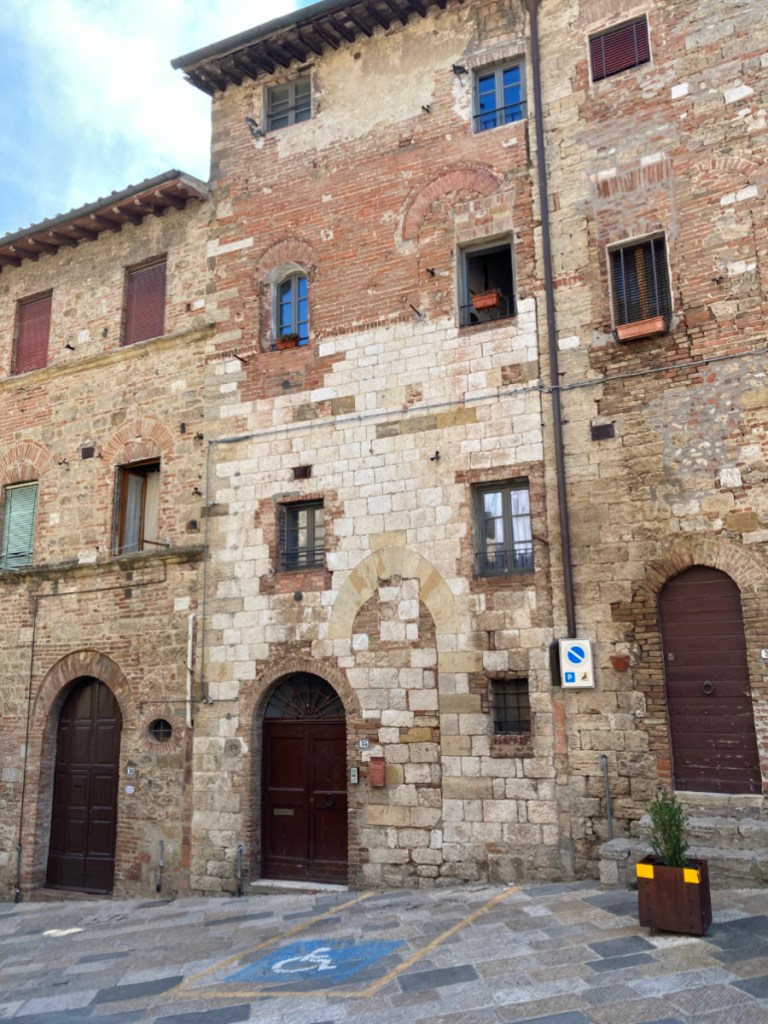
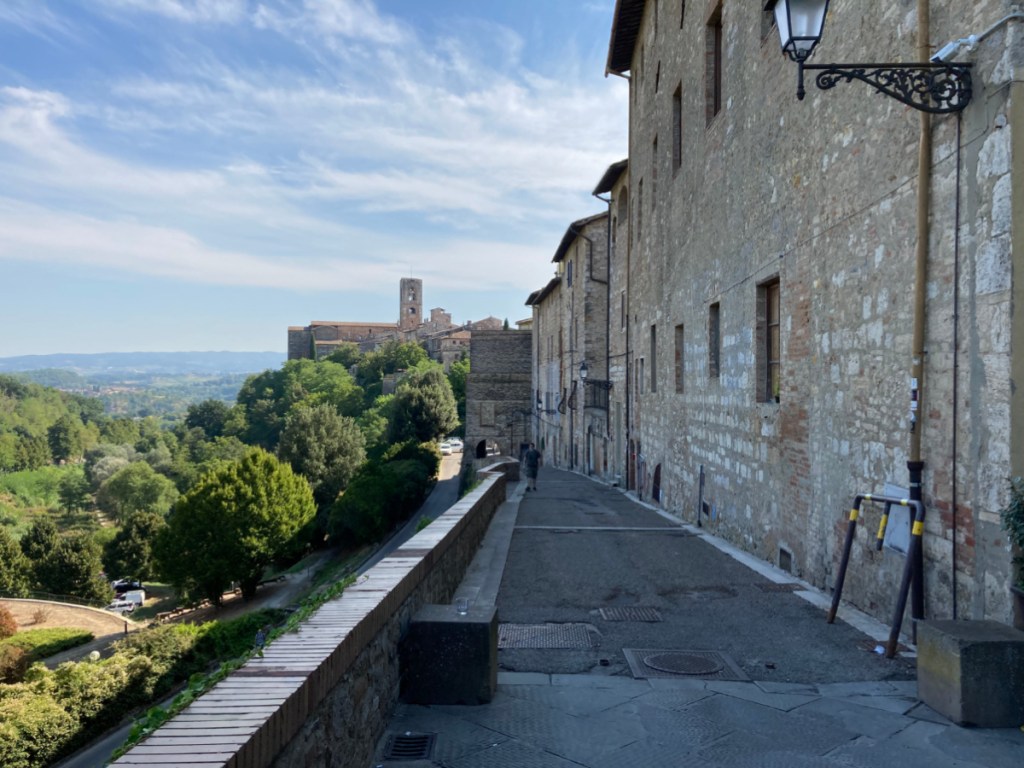
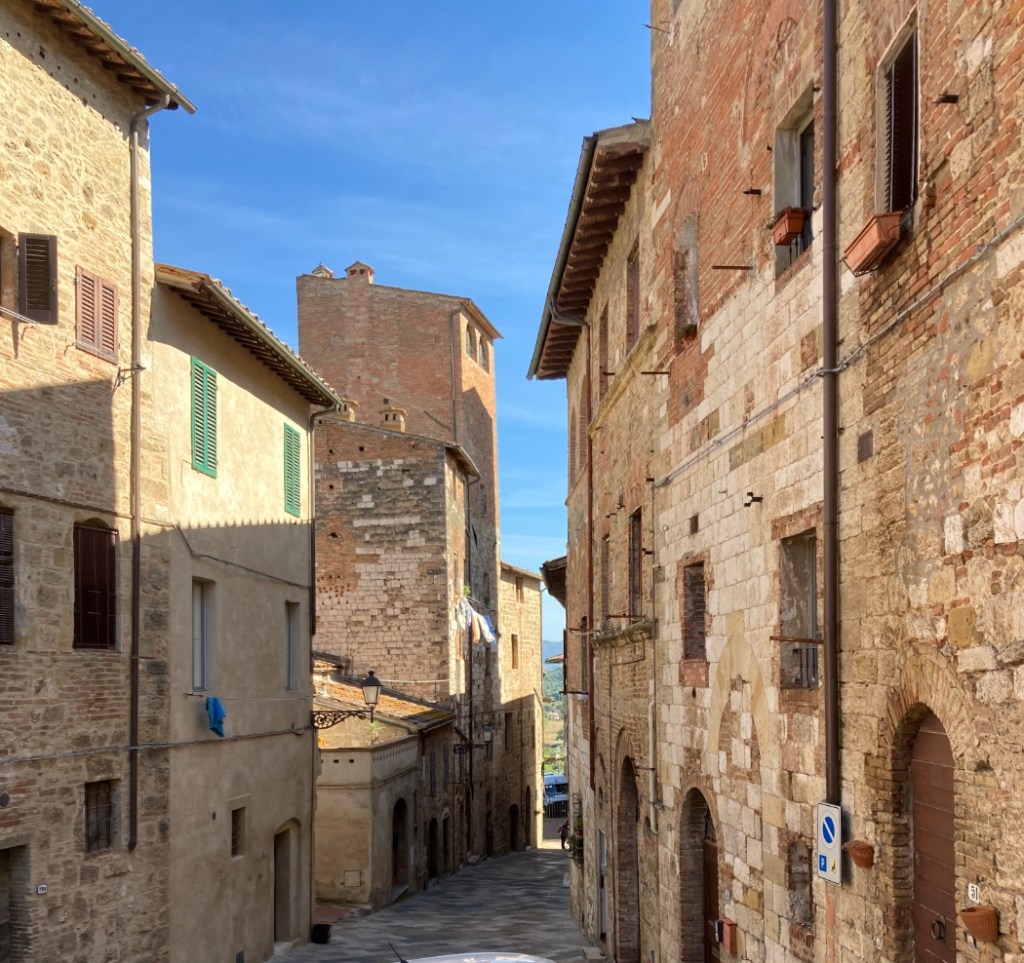
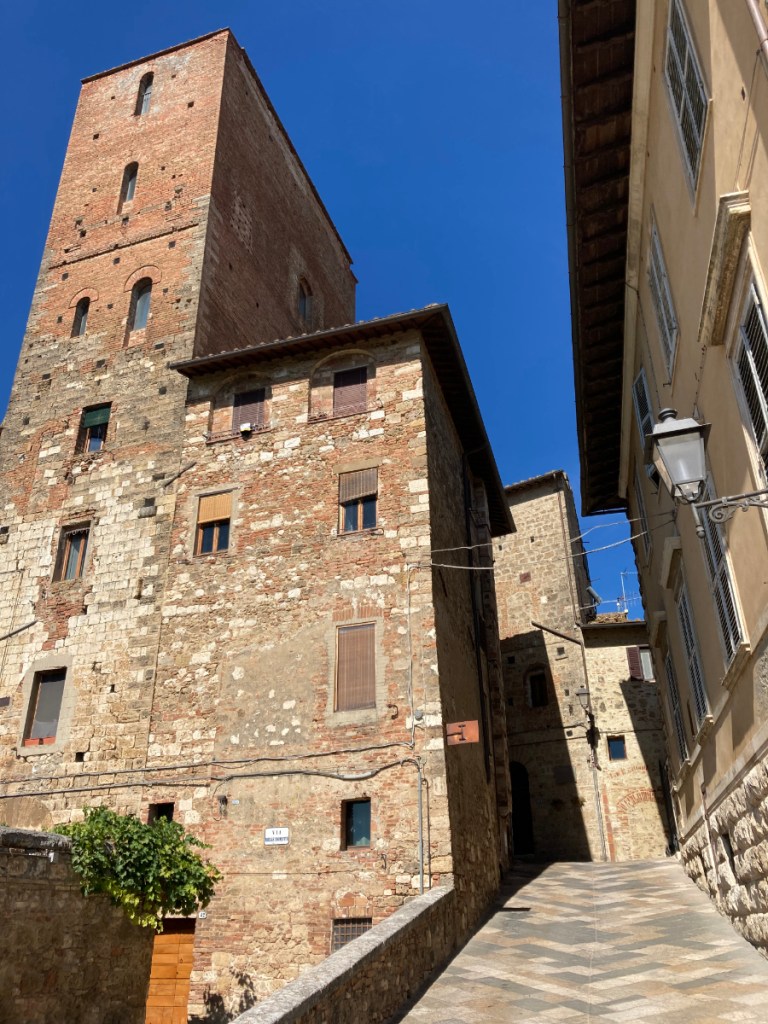
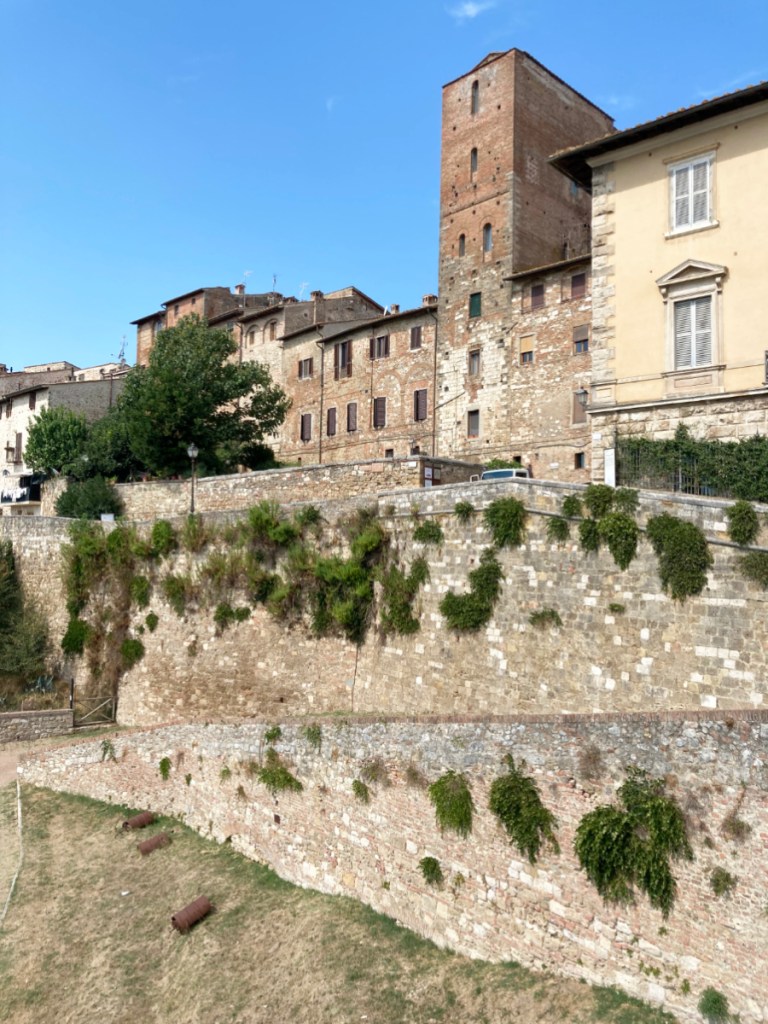
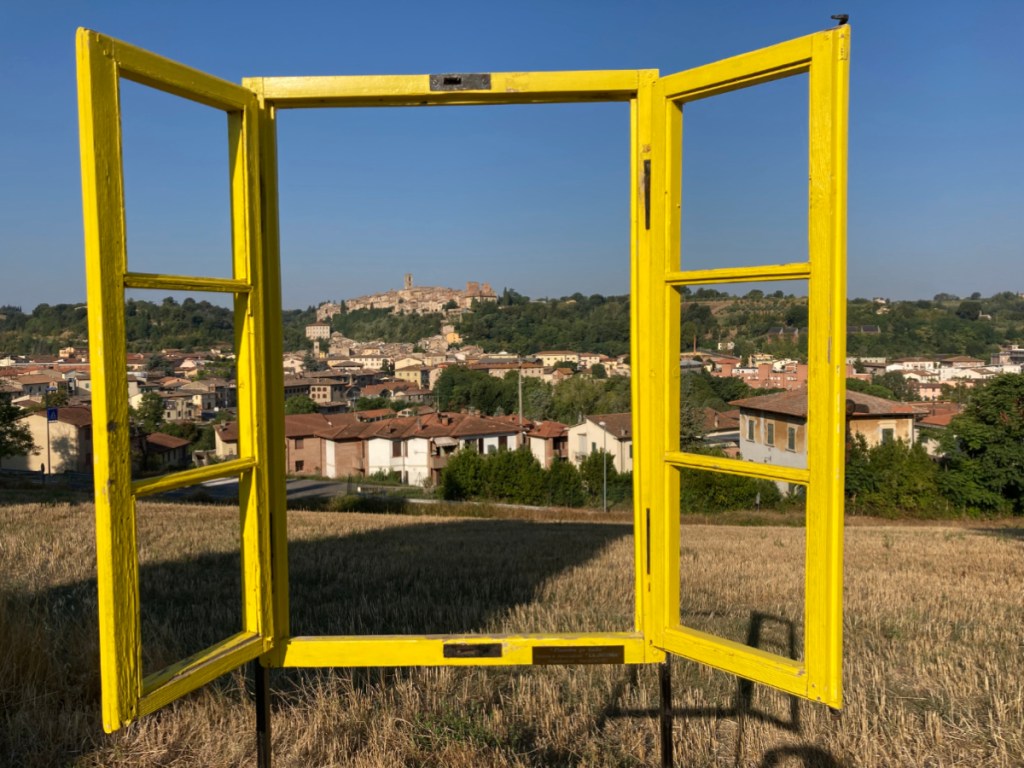
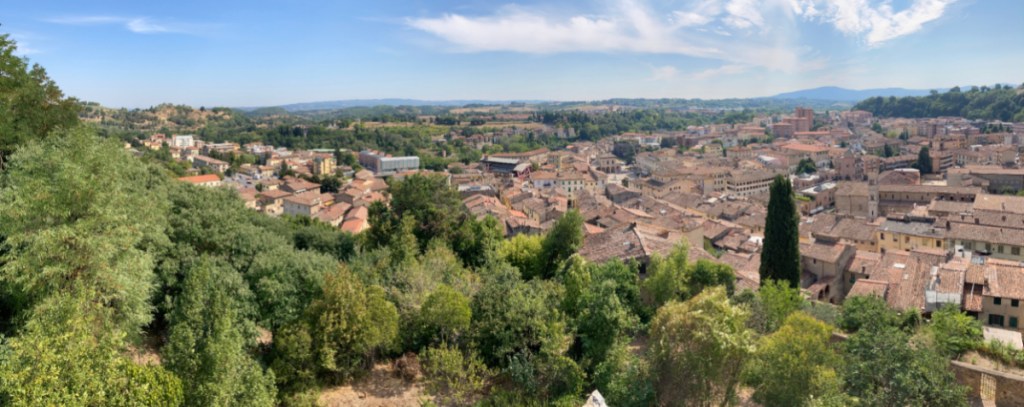
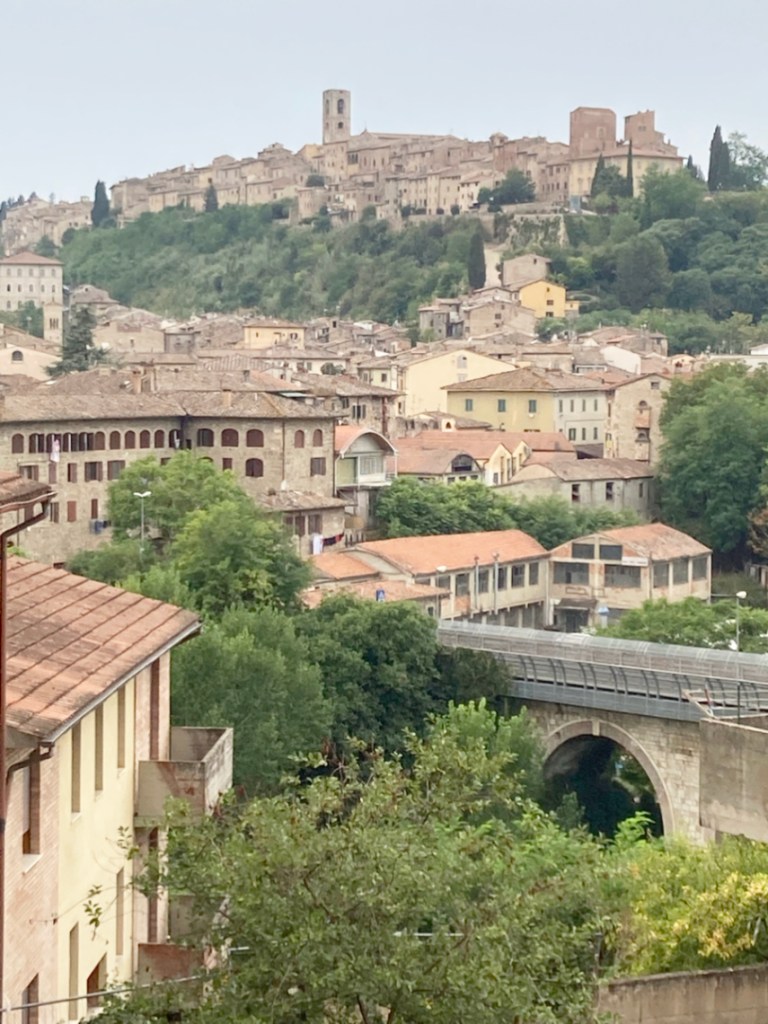
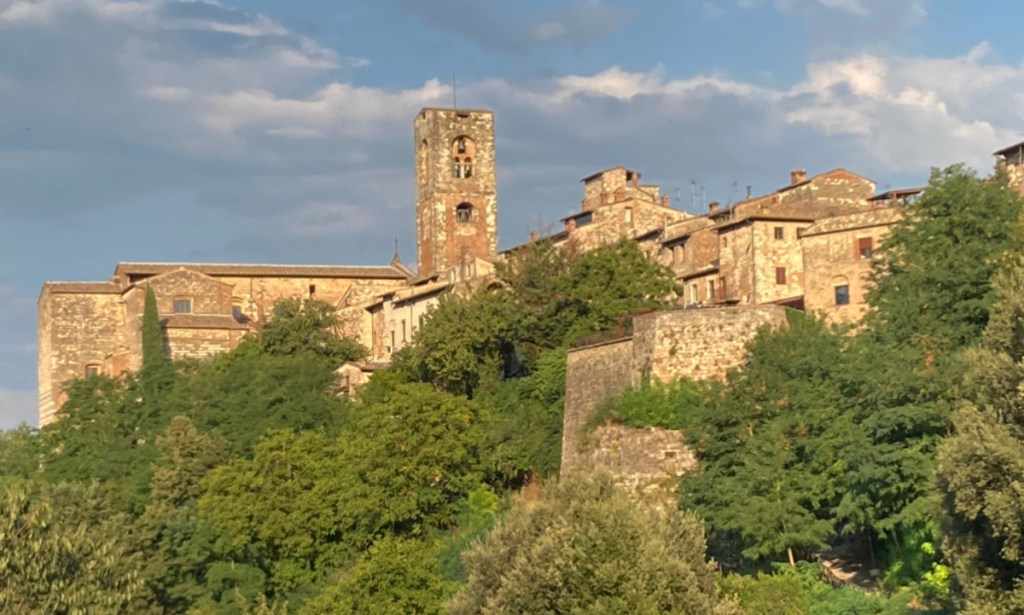
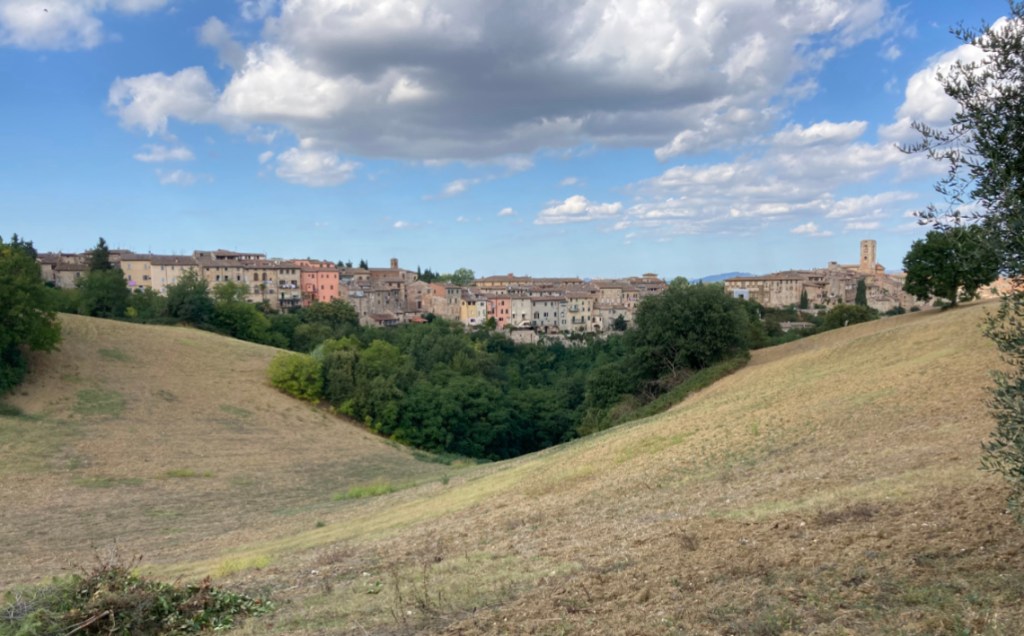
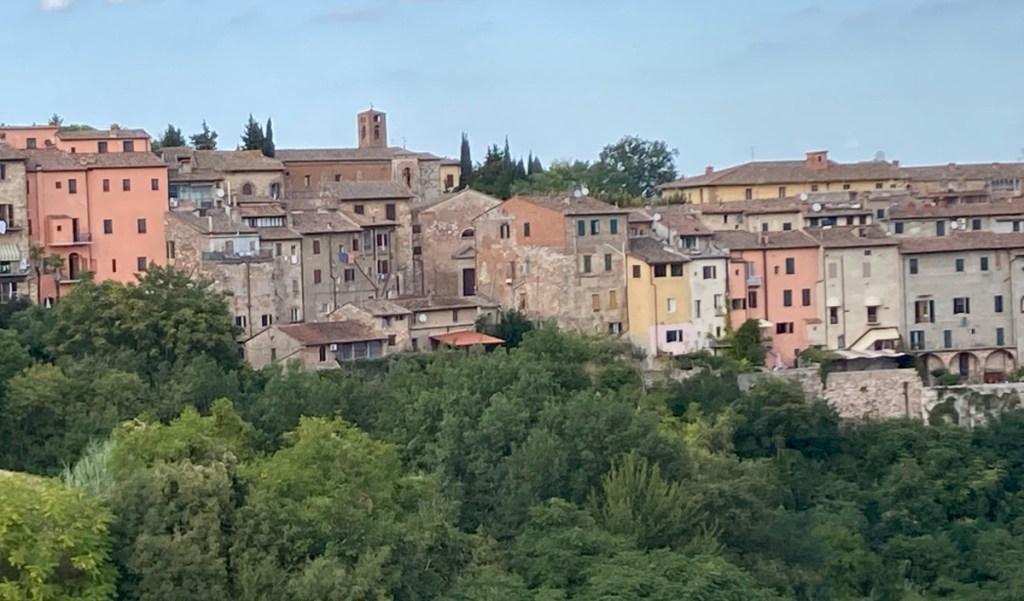
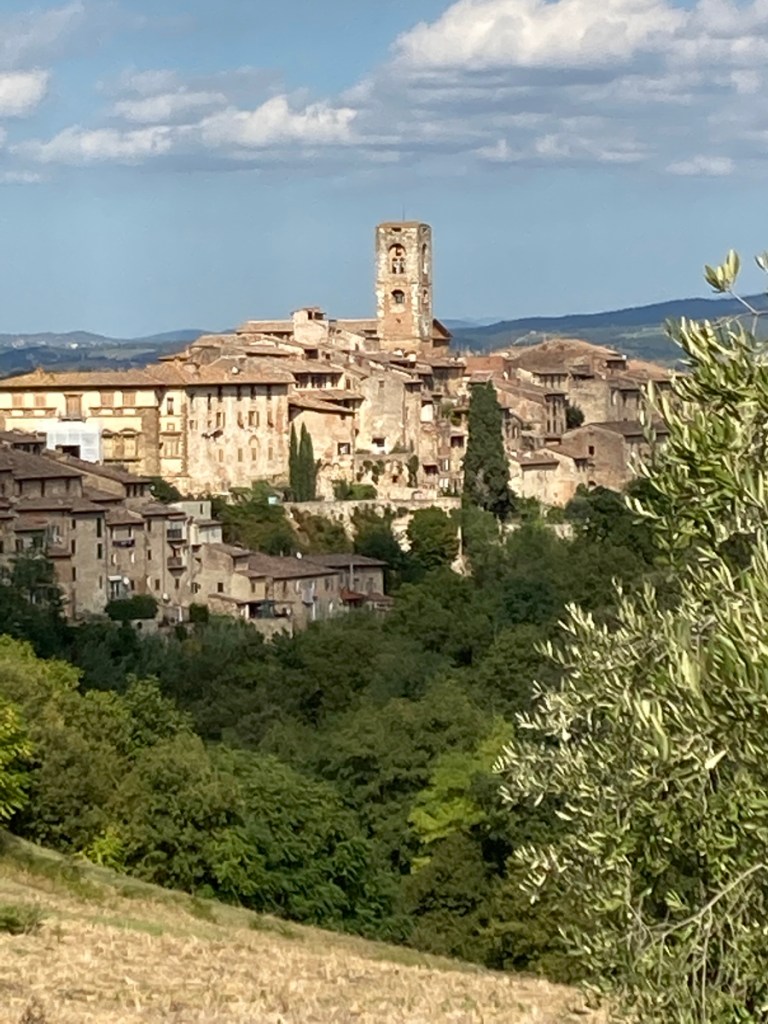
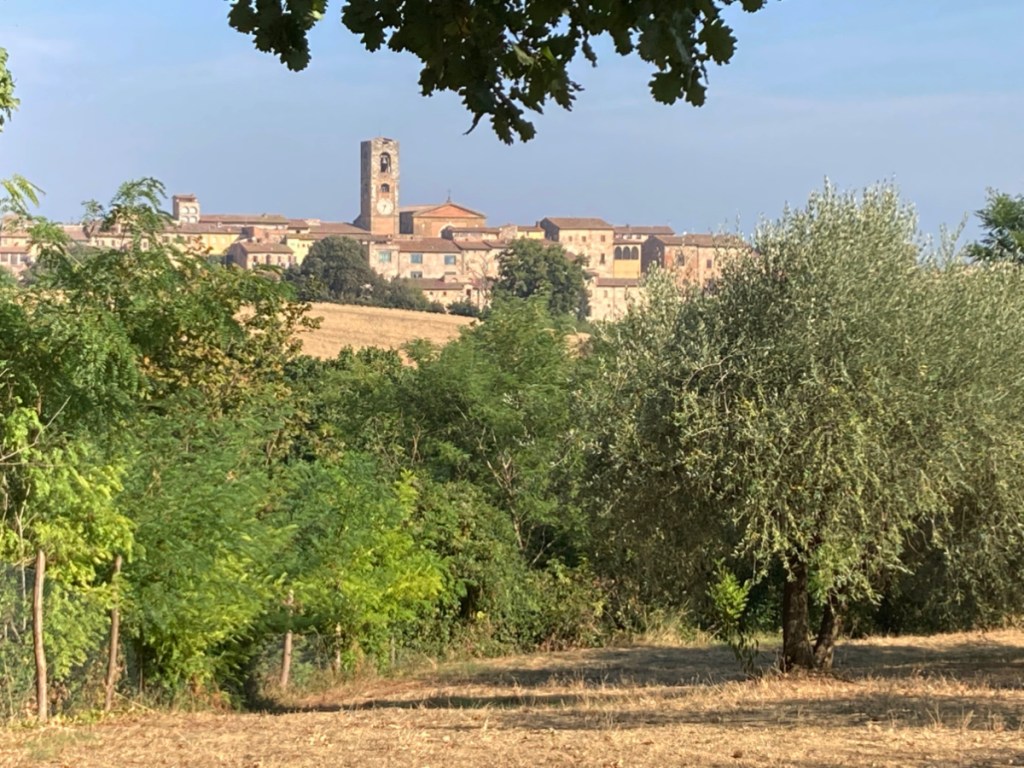
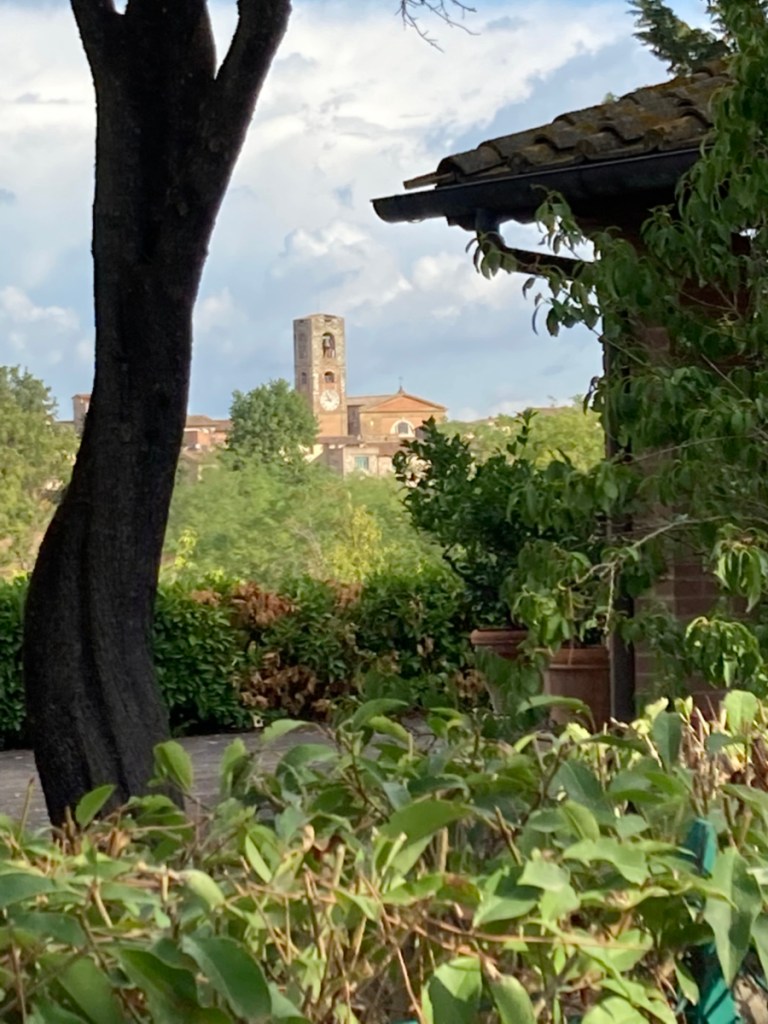
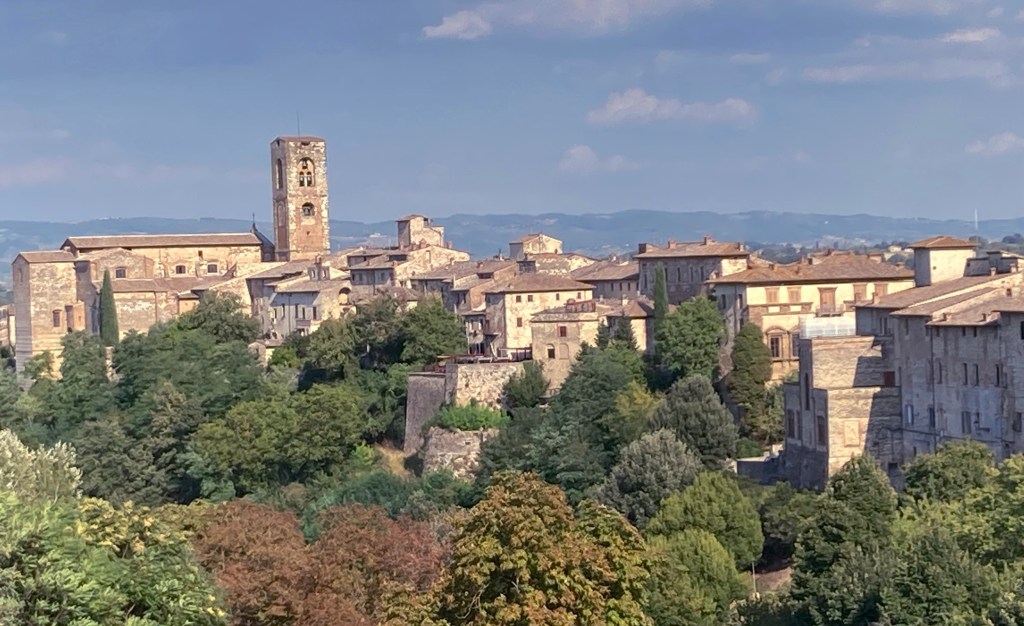
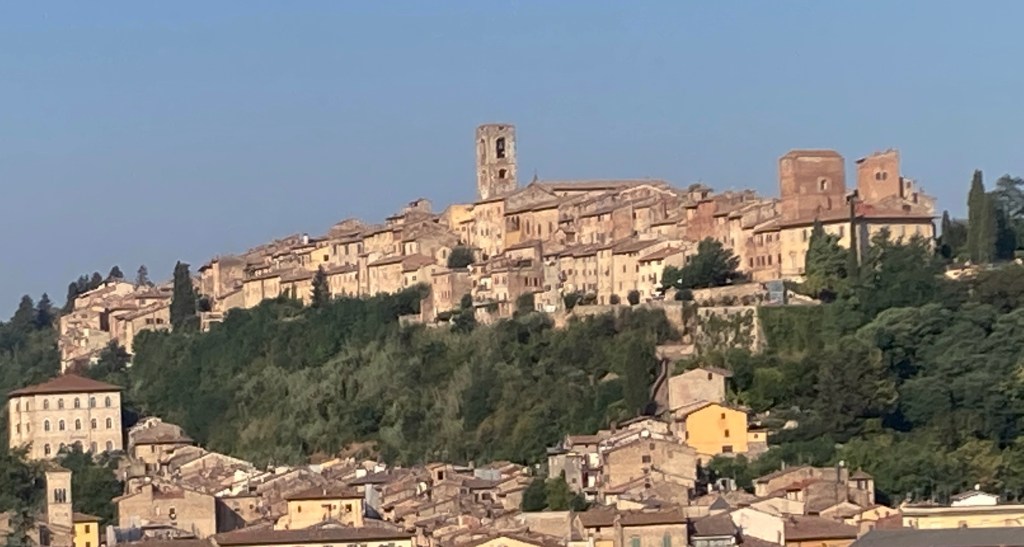
Colle Alta is the well-preserved medieval section of Colle di Val d’Elsa and sits on a ridge. I say “medieval” (500-1400A.D.); I guess, technically, it began in the medieval but didn’t really take off until late-Medieval/early Renaissance. You can see in the map (in the “Apt.” post) that the old part of town is long and narrow. You can also see in the “Apt.” post that Colle Alta hovers above our apartment. Although it’s not Florence or Siena, Susan and I think Colle is beautiful and has its own charm. And waking up every morning and looking up at a place like Colle Alta is one of the main reasons we are here. The following is a collection of street scenes and perspectives of Colle Alta from our daily walks. A note on photography- I don’t expect much argument when I say that I’m not a photographer. So, to compensate for the lack of quality, I have adopted the quantity strategy. I figure that this is a blog so the images are not taking forever to download and taking up space on your hard drive.
We finish our morning cappuccino at Caffe Garibaldi and head up to Colle Alta.
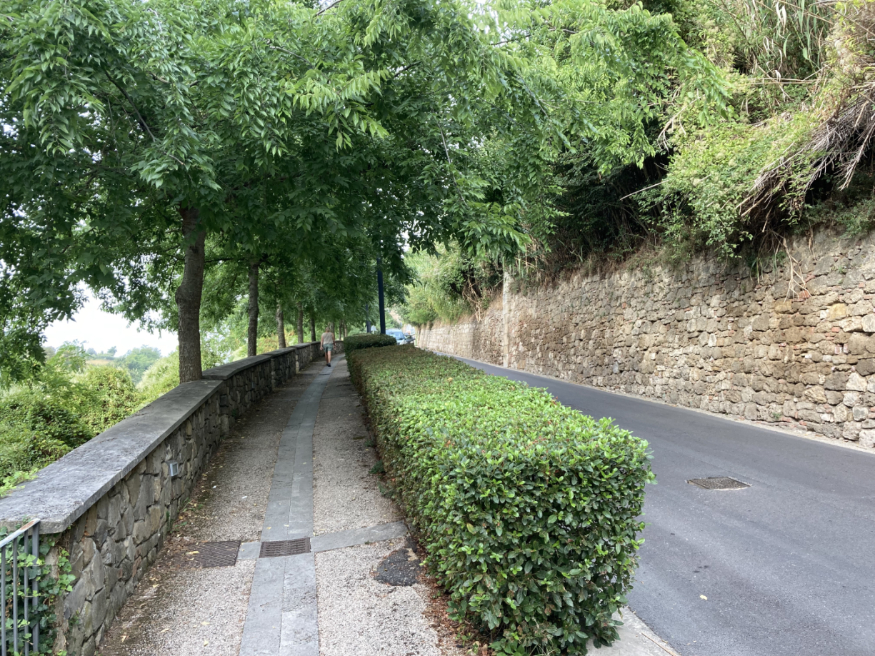
The walk up to Colle Alta.
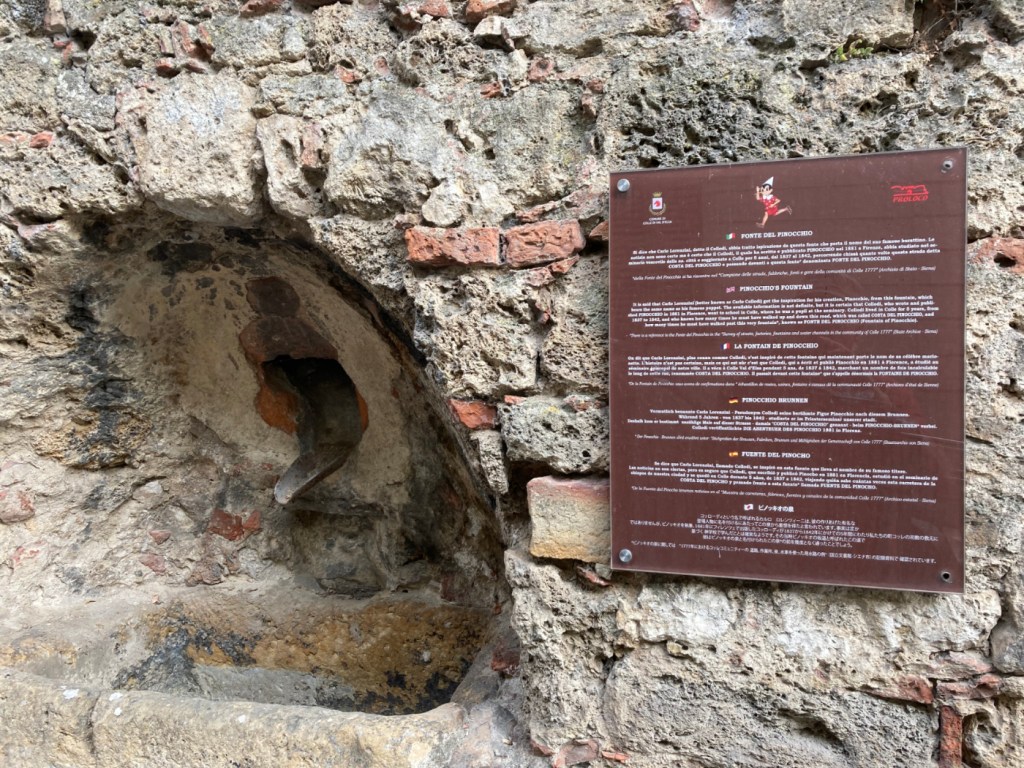
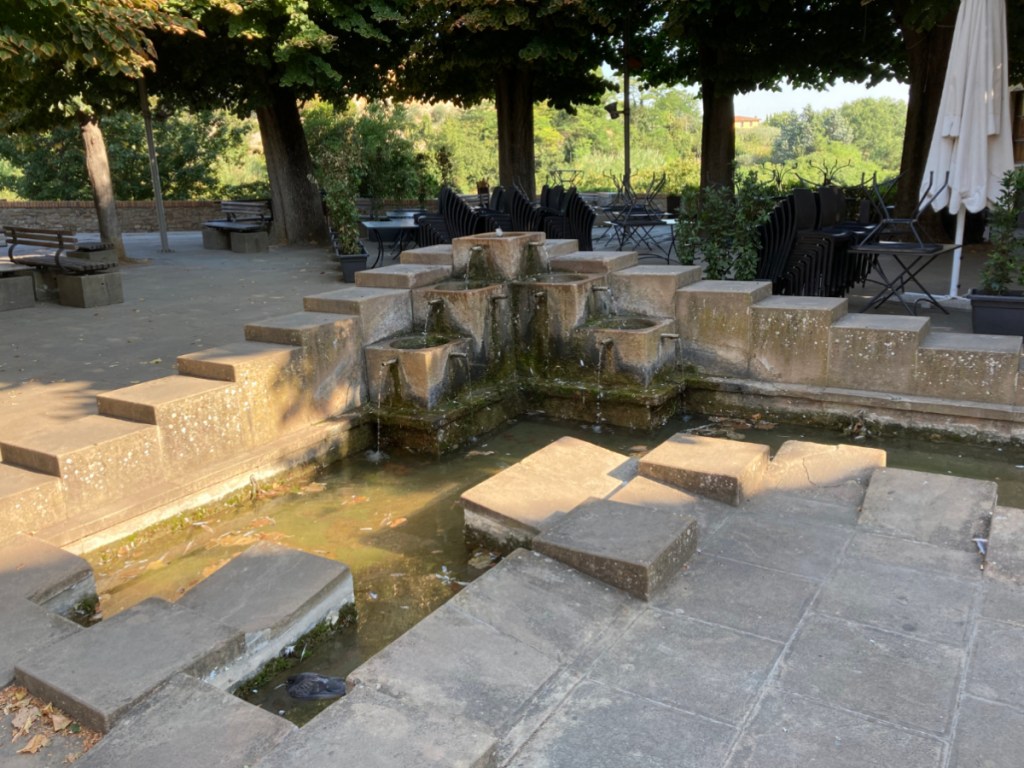
We pass the Pinocchio Fountain (now dry). Carlo Collodi was a seminary student in Colle prior to writing The Adventures of Pinocchio. Supposedly, this is where he got the puppet’s name.
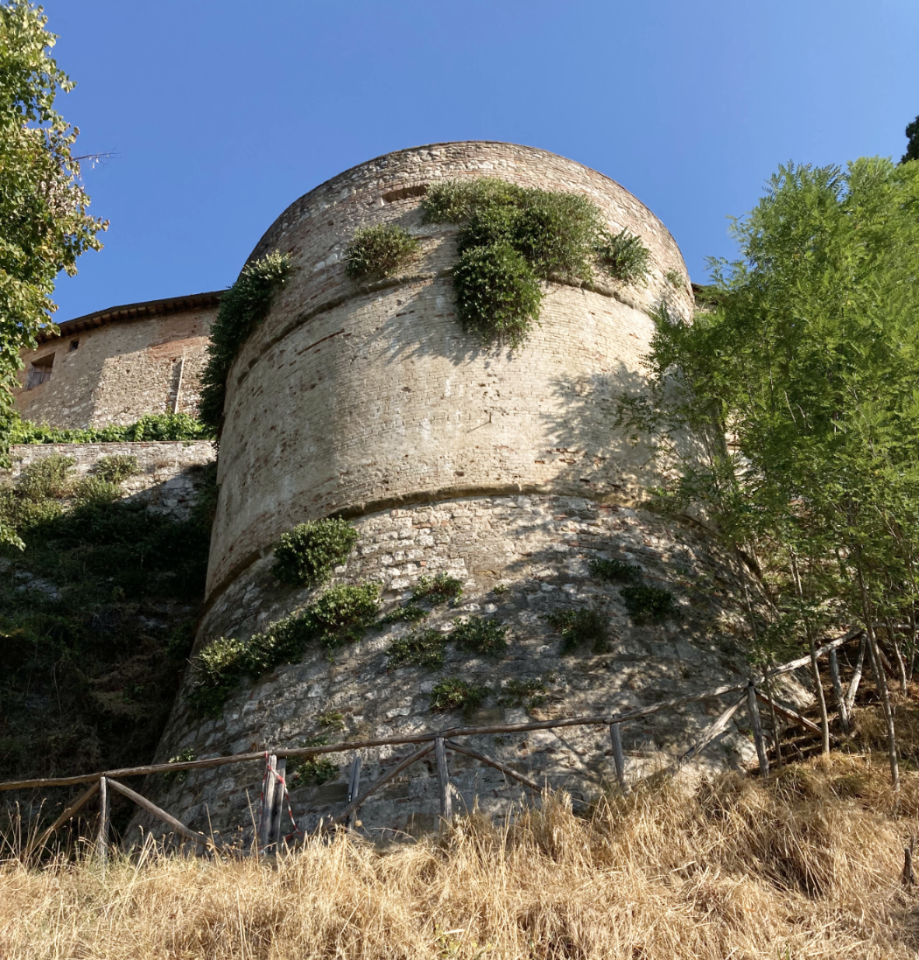
They sure knew how to build a “wall” in the Middle Ages.
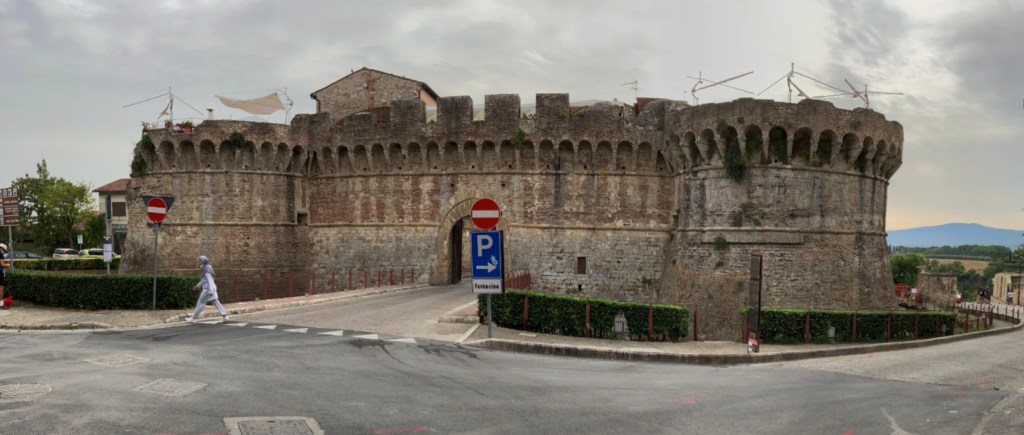
Main gate at west end of Colle Alta- suitably Medieval.During our 2010 trip, a group of us ate pizza in this park while we watched a World Cup match on a TV strapped to one of these trees.That’s the park shown above tucked in on the left.
I like this because you can see the location of a previous door- no attempt to hide it.Edge of Colle Alta.
Medieval towns could have many of these towers. Their height was correlated with the owners’ wealth. Mostly, they didn’t last. But wait till we get to San Gimignano.
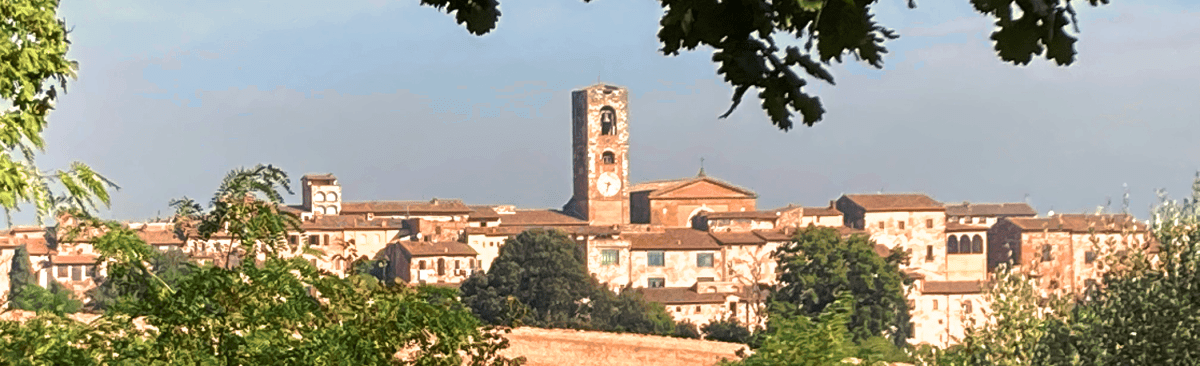
Susan & John’s Excellent Adventure began in 2010 on our first trip to Italy. Over about 3 weeks, we went from Rome to Tuscany to Cinque Terre. As we sat in the jet that would take us back to the States, we both commented that this was the first vacation where neither of us wanted to return. From that day, we’ve been waiting for retirement to remove the constraints on our time that would allow us come back for as long as European Union immigration policies would allow. Turns out, in our case, that’s 3 months. So, we’re in the Tuscan town of Colle Di Val d’Elsa (hill in the valley of the Elsa river) for the next 90 days.






 John and Susan's Excellent Adventure